
How to get the most out of this book
- Read the lessons in order (or use the table of contents to jump around).
- If anything feels confusing, take a note of it! We love suggestions.
- Share your thoughts in 💬 the live chat.
About this edition
First Steps in Lojban (affectionately nicknamed Hajiloji) has been in the works since September 2013. As of April 2015, we're moving sites and rolling out the Second Edition (Hajiloji 2). It's still a work in progress, but we’re publishing chapters as soon as they're ready.
In the first edition, the text was written by cogas (“Ginger”), with the adorable illustrations provided by Vae. I am deeply grateful to guskant for his ongoing guidance, to youxkei for improving the site's code for this migration, and to PJCG (the Young Lojbanists’ group) along with many others. Hajiloji only exists because of users like you and your generous support. ki'e sai — thank you all!
This English edition is an adaptation of はじめてのロジバン 第2版 (Hajiloji 2) — a Japanese introductory Lojban course by cogas (with illustrations by Vae). The adaptation to English, with expanded content and interactive quizzes, was done by la gleki.
The "Big Picture" Approach
While writing Hajiloji 2, my main focus was on maintaining a "big picture" perspective.
The original goal of Hajiloji was:
To make an introduction where you think, “Oh, Lojban isn’t such a big deal — it might even be easy!”
But due to some oversight on my part, the first edition ended up packing in so much detail that calling it an "introduction" was a bit of a stretch. Compared to older guides like First Steps in Arca or First Steps in Esperanto, complex topics started creeping in way too early.
So for Hajiloji 2, I returned to those inspirations, aiming for a broad grasp of Lojban. If you just want to start speaking and writing without drowning in deep theory first, this is the course for you.
Of course, if you’re looking to savor every nuance of the language, this might feel a bit brief. And if you’re the type who fusses over every technicality, you might find this course doesn't "scratch every itch" just yet.
To address that, Hajiloji 2 includes more supplementary material and FAQ notes for those finer details that often come up but might clutter the main lessons.
Another focus is the de facto standard usage. Lojban’s specifications allow for immense freedom, but explaining every possible permutation at once can quickly become overwhelming.
In this course, I want to use “how most people actually speak Lojban” as our model. Most speakers stick to ASCII and naturally favor something like SVO (Subject-Verb-Object) order. While exploring the full flexibility of Lojban is great, mastering a solid default first is even better.
Reference and BPFK
Even in the Hajiloji 2 era, grammar and semantics keep evolving.
Hajiloji 2 uses CLL 1.0 as a reference, but for semantics it mostly follows current BPFK material. Articles (le, lo, etc.) in particular may differ from CLL — please keep that in mind.
So: pick up the telescope called Lojban and see what the world looks like through a new lens!
Lesson 1. Greetings
Characters
Koshon

- Koshon, or in Lojban, .kocon (pronounced as KO-shon).
- Sora’s childhood friend.
- Speaks Lojban quite well.
- He'll be serving as Sora’s teacher throughout this course.
Sora

- Sora, or in Lojban, .soran. (pronounced as SOH-rahn).
- A total beginner at Lojban.
- Learning the ropes from Koshon.
Sevan

- Sevan, or Sevan (pronounced as SEH-vahn).
- Sora’s younger sister.
- Surprisingly has the most Lojban experience in the family.
- A fountain of random Lojban trivia.
Let’s get started!

Hi everyone, coi rodo! I’m Koshon. Great to meet you all.

Yahoo! I’m Sora! …Wait, Koshon, did you say “shoi rodo”?

That’s a greeting in Lojban, the constructed language. It means “hello, everyone.”
Cool! When I hear “Lojban” I think of logic.
Sharp eye! Lojban belongs to the loglang (logical language) family. Thanks to clever design, the grammar is remarkably simple and it's quite easy to pick up. Want to give it a try, Sora?

If you say it’s easy… okay, I’ll give it a shot!

Something like that, I guess.
And we’ll keep going from there.
Lesson 2. Pronunciation and the alphabet
First things first: if you can’t read it, you can’t use it! So let’s start with pronunciation and the alphabet.
Lojban is typically written in ASCII, which fits the internet age perfectly. While other scripts exist, ASCII is what most people use. Below are the letters we'll be using (H, Q, and W are not used). Here are approximate English hints — use the play buttons to hear each letter.
|
Letter |
Approximate sound | |
|---|---|---|
|
a |
a |
“ah” (spa) |
|
b |
b |
b |
|
c |
c |
sh |
|
d |
d |
d |
|
e |
e |
eh |
|
f |
f |
f |
|
g |
g |
g as in go |
|
i |
i |
ee |
|
j |
j |
zh as in measure |
|
k |
k |
k |
|
l |
l |
l |
|
m |
m |
m |
|
n |
n |
n |
|
o |
o |
oh |
|
p |
p |
p |
|
r |
r |
rolled or tapped r |
|
s |
s |
s |
|
t |
t |
t |
|
u |
u |
oo |
|
v |
v |
v |
|
x |
x |
voiceless velar fricative (between k and h) |
|
y |
y |
schwa (neutral vowel) |
|
z |
z |
z |
|
' |
' |
h-like glide only between vowels |
The period . and comma , are punctuation (pause / syllable break), not letters in the same sense as the row above.
Got it. So it's basically the standard Roman-letter values, but without H, Q, or W.
The tricky ones seem to be c (sh), x (that rasping sound), and y (the 'uh' sound), right? What exactly is “x”?
x is a voiceless velar fricative — between “k” and “h”. It’s like ch in Scottish loch, or ch in German Bach, or J in Spanish Jose, or Kh in Modern Arabic Khaled. Try pronouncing ksss while keeping your tongue down and you get this sound. Compare c, k, and x:
- c
- k
- x
(Uhh, velar-what now…?) I’ll replay those a few times before bed. And y is…?
That’s the neutral vowel — English schwa: like the vowel in comma, not the y in misty or cycle.
- y
Relax your mouth and voice; you’ll get something like it.
Got it. How do you name the letters? Ay, bee, cee?
Consonants: [consonant] + y + . · Vowels: . + [vowel] + bu
|
Letter |
Lojban name |
|---|---|
|
a |
.abu |
|
o |
.obu |
|
b |
by. |
|
s |
sy. |
|
n |
ny. |
The . represents silence—a brief pause or a glottal stop. Keep in mind it is not a sentence-ending period like in English (we’ll cover those later). Dots are used in letter names to ensure words don’t accidentally blend together.
Also, a crucial rule: the apostrophe only ever appears between two vowels. You'll never see sequences like k'a or d'e. While the apostrophe sounds like a soft h, Lojban treats it as a special glide, not as a standard consonant like b or m.
Makes sense. ts and tc are like 'tz' and 'ch', and dz and dj are just their voiced counterparts. Simple enough!
Semivowels and diphthongs
The chart covers most of it, but you should also know how vowel clusters work. The lerfu audio pack has no separate ia or ua files — only the trigraphs aia and aua, which are exactly i and u as semivowels between vowels:
|
aia |
i + vowel → like a 'y' sound + vowel (e.g. ia sounds like "ya"). In aia, the middle i is that semivowel between two a's. |
|
aua |
u + vowel → like a 'w' sound + vowel (e.g. ua sounds like "wa"). In aua, the middle u is that semivowel between two a's. |
In these clusters, i and u act as semivowels.
So ies is like English “yes”.
Exactly. Then we have diphthongs:
|
au |
— sounds like "ow" in "cow" |
|
ai |
— like in "high" |
|
ei |
— like in "hey" |
|
oi |
— like in "boy" |
These are always treated as a single syllable.
What about ao or ea?
Lojban only recognizes those four as diphthongs. If you want to connect a, e, or o directly, you have to separate them with i, u, or an ' (apostrophe).
Fair enough.
Quiz time! Try reading these sentences aloud.
Exercise
- Read the following Lojban aloud.
- coi ro do mi'e .soran. co'o .kocon.
— Hello everyone; I’m Sora; goodbye, Koshon. - mi prami do .i semu'ibo dunda lo melbi xrula
— I love you, so I give a beautiful flower. - .o'i mu xagji sofybakni cu zvati le purdi
— (Watch out) five hungry Soviet cows are in that garden.
- coi ro do mi'e .soran. co'o .kocon.
Okay, let's give it a go...
- shoy... ro... do... mi-heh... so-rahn... sho-ho... ko-shon (something like that?)
- mi pra-mi do... ee-seh-moo-hee-bo... doon-dah lo mel-bi khru-lah
- oh-hee... moo... khahg-zhee... so-fuh-bahk-nee... shoo zvah-tee leh poor-dee
How was my accent?
“Soviet cows” — what even is that?
The third one is a famous pangram: it uses every Lojban letter.
Whoa, you’re right!
It's a fun challenge! I even made my own—it includes diphthongs, semivowels, and those tricky affricates (ts, tc, dz, dj). Check this out:
.ua ja'o le mu tsali dzena cu djicai lo nu re xagji sofybakni cu zvati tu noi tcadu vau .iepei “Ah — so those five strong seniors really want two hungry Soviet cows to be over there in that town, huh?”
That’s long.
Here is a rough English-style pronunciation sketch of Koshon’s pangram above:
.ua ja'o le mu tsali dzena cu djicai lo nu re xagji sofybakni cu zvati tu noi tcadu vau .iepei
UH-wah ZHAH-hoh leh moo TSAH-lee DZE-nah shoo jee-SHY loh noo reh KHAG-zhee SOF-ee-bak-nee shoo zVAH-tee too noy CHAH-doo vow yeh-PEH-ee
And here is an IPA sketch of Koshon’s pangram above:
.ua ja'o le mu tsali dzena cu djicai lo nu re xagji sofybakni cu zvati tu noi tcadu vaw .iepei
ʔwa ʒaho lɛ mu t͡sali d͡zɛna ʃu d͡ʒiʃaj lo nu ɹɛ xagʒi sofəbakni ʃu zvati tu noj t͡ʃadu vaw ʔjɛpɛj
Lesson 3. Parts of speech and stress
Wait, we never actually talked about stress. I was just guessing that it falls on the second-to-last syllable.
Oh? And what led you to that conclusion?
I told you, it was a guess!

Sure it wasn't a "cheat sheet" guess?

I swear, no cheat sheets! Forgive me! 🙏🥺
Anyway, Sora is right. In Lojban, you generally stress the second-to-last syllable of every word.
(Wow, just ignored me...) See? A woman's intuition is never wrong.
In practice stress rules differ a bit by part of speech — so let’s cover parts of speech while we’re at it.
In Lojban, "part of speech" is tied directly to morphology (the shape of the word). You can usually tell what kind of word it is just by looking at the spelling:
- brivla ("content word" or predicate): Ignoring ' and y, these have a consonant cluster in the first five letters and always end in a vowel.
- cmavo ("structure word" or particle): These have no consonant clusters and no internal consonants (unless it's at the very beginning), and always end in a vowel.
- cmevla (name word): The name-shaped tokens that follow la—they always end in a consonant, and in modern Lojban we usually wrap them in dots (e.g., .soran.). This is a word shape, not the same thing as the predicate cmene (“x1 is the name of x2”), which is a separate content word you’ll see in phrases like zo .soran. cmene mi (Lesson 7).
Just remember that the apostrophe (the h sound) doesn't count as a "consonant" for these rules.
|
Gloss |
ends in |
cluster in first 5 letters |
consonants outside initial? | |
|---|---|---|---|---|
|
brivla |
predicate |
vowel |
yes |
yes |
|
cmavo |
particle |
vowel |
no |
no |
|
cmevla |
name word |
consonant |
free |
yes |

Here’s a quick decision tree to keep it straight:
- Does the word end in a consonant? → treat it as cmevla (a name word; in modern usage usually wrapped in dots).
- Else (it ends in a vowel): ignoring
'andy, is there a consonant cluster in the first five letters? → brivla (predicate word). - Else → cmavo (structure word): no internal consonants, so cmavo can be run together without spaces.
Exactly. The big questions are: “Does it end in a consonant?” and “Is there a cluster in the first five letters?”
One cool thing: because cmavo never have internal clusters, you can actually run them together without spaces. For example, pu zi ze'u ri'a vi ve'a can be written simply as puzize'uri'avive'a.
That saves some space—though you have to be careful not to mistake a long chain of cmavo for a single long word!
Let's revisit stress for a moment. It works like this:
- brivla and cmevla: Stress the second-to-last syllable (y is ignored and does not count as a syllable here).
- cmavo: Stress is free. However, if a cmavo comes right before a brivla, it's usually not stressed.
Stress freedom! Cmavo rules sound a bit fiddly, but "don't stress right before the predicate" seems like a solid default.
True. For cmevla, there's also an exception: you can manually mark stress using CAPITAL LETTERS if you want it somewhere other than the second-to-last syllable. But for now, just sticking to the “second-to-last” rule is plenty.
Let's keep it simple for now! We can worry about the exceptions later.
Lesson 4. Basic sentence structure
First the sounds, then the word types... Alright, Koshon, lay that Lojban grammar on me! I'm ready for the "Super Grammar"!
Let's start with basic statements. Think of a sentence as saying:
Who or what / does what / is like what / to whom / where...
Basically, you have "the thing we're talking about" and "what we're saying about it."
Makes sense. Like "I eat this"—I and this are the "things," and eat is the "doing."
Exactly. Borrowing terms from logic, we call the "doing/being" part the predicate (selbri), and the terms that fill its roles arguments. In Lojban those argument terms are sumti; the numbered roles x1, x2, … are terbricmi, and their ordered sequence is the terbri (place structure). A full claim is a bridi.
Exercise
- In each English sentence, pick out the predicate and its arguments (in Lojban terms: the selbri and the sumti):
- That bird is blue.
- The man is drinking at the bar.
- This person is a woman.
Let me see... A bridi is built from a selbri and the list of terbricmi (slots) that are fulled with sumti. The selbri is the is/does part, and the sumti are the who/what terms going into those slots. Right?
Spot on.
Okay, next.
Every Lojban predicate has a terbri—an ordered list of terbricmi (place slots) labeled x1, x2, x3, ...:
- x1 is / does ...
- x1 does x2 ...
- x1 is x2-ish to x3 ...
- and so on.
Think of x1, x2, etc. as numbered "holes" (terbricmi) that you plug sumti into.
To make a sentence, just put the sumti in their numbered order and tuck the selbri in the middle. Simple, right?
Like:
(sumti for x1) [selbri] (sumti for x2) (sumti for x3) …
Wait, where exactly does the selbri go?
Strictly speaking, the selbri can go almost anywhere—but most people put it between the sumti for x1 and the sumti for x2, much like English SVO (Subject-Verb-Object).
That feels pretty natural.
Right — a familiar default. Here are some sumti you can use already:
- mi
- I / me
- do
- you
- zo'e
- something unspecified / “whatever”
- ti
- this
- ta
- that (near you)
- tu
- that (yonder)
- ra
- he / she / it / they (in context)
Some predicates:
- ninmu
- x1 is a woman
- citka
- x1 eats x2
- zunle
- x1 is to the left of x2 from viewpoint x3
- sanli
- x1 stands on x2 using legs/support x3
- nelci
- x1 likes x2
Exercise
- Translate into Lojban:
- I am a woman.
- You eat this.
- She is to the left of that (from my perspective).
- He stands there (with some legs/support).
- I like you.
So, line up the sumti, tuck in the selbri...
- mi ninmu
- do citka ti
- ra zunle tu mi
- ra sanli tu zo'e
- mi nelci do
Perfect! We're taking it slow with the vocabulary, but you've already mastered the basic sentence structure.
Honestly, this might even be simpler than English for things like "they're to my left of that."
Ready to put it into practice? Let's take a little field trip—there's a town I've been wanting to show you...
Ooh, an outing! Lead the way!
Lesson 5. Getting comfortable with predicates

la .lacmatcad.
Welcome to Latcmatcad—the "Cat Town"! In Lojban, we write it as la .latcmatcad. (where la marks it's a name, and the dots are there to separate it from surrounding words).
Ooh! Cats! ...Wait, I don't see any...

That's strange. Maybe they're in a meeting? While we wait for them to show up, let's talk about .i and zo'e.
- .i
- Sentence boundary / start marker
- zo'e
- Unspecified sumti — “something,” “someone,” “who cares for now”
When you're connecting multiple sentences, you use .i to mark the start of each new sentence. It's kind of like a reversed period (Lojban punctuation often feels a bit "backwards" to English speakers!).
.i ti blabi .i tu xekri This is white. That is black.
- blabi
- x1 is white
- xekri
- x1 is black
We didn't use .i much in the previous lessons, did we?
If you're only saying one sentence, you don't strictly need it. But when you're speaking in a flow, it's the standard way to separate your thoughts.
Got it: use .i between sentences. ...And we've seen zo'e before too, right?
Exactly. Here's a very handy rule for keeping things concise:
You can almost always drop zo'e if it's at the very end of a sentence, or if it's in the x1 slot (right before the selbri).
In other words: if a slot for "someone/something" is empty, Lojbanists assume you mean zo'e.
Oh — cats! Look!

Illustration for mlatu in context.
Whoa, you’re right — cats!
Say it in Lojban:
- mlatu
- x1 is a cat of species/breed x2
mlatu zo'e mlatu zo'e “It’s a cat.” / “There’s a cat.”
Basically, leading zo'e and any zo'e hanging off the end of a sentence are optional. So zo'e mlatu zo'e can be shortened to just mlatu.
Here's the pattern:
- zo'e [selbri] [sumti] … zo'e zo'e … = [selbri] [sumti] …
But be careful! Internal zo'e slots that aren't at the end cannot be dropped, or the other sumti will shift into the wrong places:
- [selbri] [sumti] zo'e [sumti] ≠ [selbri] [sumti] [sumti]

Illustration for so'i mlatu.
mlatu .i mlatu .i mlatu .i mlatu...
Quite the crowd! Let’s take a walk and practice putting sentences together. I’ll give you the words you need, and you just arrange them. Grab a pen and paper—if you're not sure which sumti to use for a given terbricmi, just use zo'e (and feel free to drop it if it's at the end!).
Composition practice
- I am in Latcmatcad.
- zvati
- x1 is at location x2
- mi = I
- la .latcmatcad. = Latcmatcad (the so-called place).
- Sora goes to Latcmatcad by this car.
- klama
- x1 goes to x2 from x3 via route x4 by means x5
- la .soran. = Sora
- lo vi karce ku = this car
- Koshon knows that Sora is in Latcmatcad.
- djuno
- x1 knows that proposition x2 is true, about topic x3, in epistemology x4
- la .kocon. = Koshon
- lo du'u la .soran. zvati la .latcmatcad. kei ku = the proposition that Sora is in Latcmatcad
- I like walking.
- nelci
- x1 likes x2
- cadzu
- x1 walks on surface x2 with limbs x3
- lo nu cadzu kei ku = the event of walking
- Many cats are sleeping.
- sipna
- x1 sleeps
- lo so'i mlatu ku = many cats
- I’m happy I met you in Latcmatcad.
- penmi
- x1 meets x2 at x3
- gleki
- x1 is happy about x2
- do = you
- lo nu [bridi] kei ku = the event that [bridi]
- We’re tired, so we drink coffee or tea.
- tatpi
- x1 is tired from x2
- pinxe
- x1 drinks x2 from vessel/source x3
- mi'o = we (you and I)
- .i se ki'u bo = therefore (replaces the .i boundary)
- lo ckafi ku .a lo tcati ku = coffee or tea

Phew, I'm beat... a hot Earl Grey is exactly what I need right now.
Nice work! You're really getting the hang of this. Check your answers below (remember, the bracketed parts are optional):
I am in Latcmatcad. [.i] mi zvati la .latcmatcad.
Sora goes to Latcmatcad by this car. [.i] la .soran. klama la .latcmatcad. zo'e zo'e lo vi karce ku
Koshon knows Sora is there. [.i] la .kocon. djuno lo du'u la .soran. zvati la .latcmatcad. kei ku [zo'e] [zo'e]
I like walking. [.i] mi nelci lo nu cadzu kei ku
Many cats are sleeping. [.i] lo so'i mlatu ku sipna
I'm happy to meet you in Latcmatcad. [.i] mi gleki lo nu mi (or [zo'e]) penmi do la .latcmatcad. kei ku
We’re tired, so we drink coffee or tea. [.i] mi'o tatpi .i se ki'u bo (mi'o) pinxe lo ckafi ku .a lo tcati ku
So: pick the selbri, look up its terbri, and put a sumti in each terbricmi. That "fill-in-the-blanks" template is what you called the Place Structure, right?
Exactly! Place Structure (PS) is the usual English name for a selbri's terbri—the ordered terbricmi that define the relationship.
PS—got it. ...All this talk about tea and coffee is making me crave a crêpe!

Mmm, PS and crêpes... a perfect combination!
Wait, how are those related...?
Lesson 6. Compounds (tanru)
Crêpes are amazing! And wow, I still can't believe how many cats there were!
Yeah... (There goes my diet...)
I'm all powered up now. Basic sentences are starting to feel like second nature!
Great. Once you're comfortable with simple sentences (bridi), we can start fleshing out the words themselves for more detailed expression. First, let's look at how to expand our selbri.
Chaining brivla builds tanru
In Lojban, you can chain multiple brivla (predicate words) together. This kind of chain is called a tanru.
blanu kanla mlatu blue-eyed cat
- blanu
- x1 is blue
- kanla
- x1 is an eye of x2
- mlatu
- x1 is a cat …
So the words on the left modify the ones on the right?
Precisely. And here's the cool part: tanru grouping is always unambiguous. Lojban has strict rules for how these chains are interpreted.
So there's no "attachment ambiguity"?
Exactly. The rules are very logical. Of course, the downside is that sometimes the grammar might force a grouping you didn't intend—so you have to pay attention.
The basic rule is simple: each word (or group of words) on the left modifies the immediate word to its right.
((blanu kanla) mlatu) ((blue eye) cat) — a "blue-eye" type of cat
((((stedu xunre) finpe) citka) mlatu) ((((red-head) fish) eating) cat) — a cat that eats red-headed fish
- stedu
- x1 is a head of x2
- xunre
- x1 is red
- finpe
- x1 is a fish …
- citka
- x1 eats x2
In natural languages, a phrase like "red-headed fish-eating cat" can be interpreted in several ways. But Lojban forces a single, specific structure.
That's what we mean by Lojban's syntactic precision. Tanru are a perfect example of that.
Lojban doesn't mess around, does it?
Tanru meanings are flexible
While the structure is precise, the meaning of a tanru is actually quite flexible. It usually just means "a Y that has something to do with X" or "an X-ish Y."
blanu mlatu blue cat — this could mean blue fur, blue eyes, or even a cat wearing a blue collar. Context decides the specifics.
Humans fill in the usual reading.
In ordinary situations, trust your intuition.
A tanru is still a selbri
A tanru functions as a single selbri. Its place structure is determined by the rightmost word (the "anchor" or "head" of the chain).
So, both blanu mlatu and stedu xunre finpe citka mlatu share the same place structure as the basic word mlatu.
ti blanu mlatu this is some kind of blue cat.
tu stedu xunre finpe citka mlatu that is a red-headed fish-eating cat (species unspecified).
Lesson 7. Articles
Hrrrgh...
Good morning! Why the long face?
I was just going over my notes, and I realized I only know a handful of sumti—and most of them are just pronouns like "me" or "you."
That's a fair point. Today, let’s learn how to turn any word into a sumti.
lo turns a selbri into a sumti
Exactly. How do I talk about a "woman" or a "cat" as a thing? Is there a word for "the" or "a"?
Remember our predicates ninmu and mlatu?
"Woman" and "cat". Yep, got it.
- ninmu
- x1 is a woman
- mlatu
- x1 is a cat …
Those are brivla. If you wrap a brivla (or even a tanru) in lo ... ku, it turns into a sumti meaning "the thing(s) that fit the x1 slot of that predicate."
So lo is like an article? And what's ku for?
ku is a terminator—it tells the listener exactly where the description ends. Lojban is very explicit about its structure.
- lo
- Generic article: “some thing(s) fitting x1 of the following selbri”
- ku
- Terminator closing lo/le phrases
So lo ... ku acts like brackets around a description.
lo ninmu ku nelci lo mlatu ku The woman likes the cat. / Some woman likes some cat.
Precisely. lo [selbri] ku basically means "some thing that is (or does) [selbri]."
So with words we know:
- lo blabi ku — something white
- lo citka ku — an eater
- lo sanli ku — someone standing
- lo cadzu ku — someone walking
- lo klama ku — someone going
- lo sipna ku — a sleeper
- lo gleki ku — someone happy
- lo tatpi ku — someone tired
Just think of lo as "pulling out" that first place slot (x1). And this works for tanru too:
lo sipna ninmu ku sleeping woman
lo stedu xunre finpe citka mlatu ku red-headed fish-eating cat
la turns cmevla into sumti
la .soran., la .latcmatcad. — is la also an article?
Yes. la before cmevla (name words—the dotted, consonant-final pieces like .soran.) means “the thing called …”
- la
- Name article: “the one(s) called [by the following cmevla / name word(s)]”
la .soran. Sora (so-called)
la .kocon. Koshon
la .latcmatcad. Latcmatcad
No ku after la?
There are complications…

Never mind then!
Each cmevla (name word) must end in a consonant. If your name ends in a vowel, you just add one—usually s or n.
So my name becomes .soran. Self-intro… la .soran. cmene mi?
- cmene
- Predicate “…is the name of…” (a brivla, not a cmevla name token): x1 (text) is the name of x2 to namer x3

Not quite! cmene here is the predicate “x1 is the name of x2”—not the same idea as a cmevla (the name-shaped word .soran.). The x1 of cmene has to be the name text (often marked with zo), not “whoever la points at.” la .soran. picks out the person; saying what you’re called uses patterns like zo .soran. cmene mi.
So how should I introduce myself?
To say "My name is Sora", you can use zo (which we'll cover later) or me (which we'll see in Lesson 15):
zo .soran. cmene mi “soran” is my name (string).
mi me la .soran. I am (one of) Sora / I am Sora-ish (we’ll refine me).
Or attitudinal intro in Lesson 25:
mi'e .soran. I’m Sora.
Simplest is probably mi'e.
le picks out something specific
Wait, doesn't Lojban distinguish between "the cat" and "a cat"?
Not in the way English does. lo is our workhorse—it's very general and covers both cases.
"When in doubt, use lo." Got it.
There's also le, which we use for "the specific one(s) I'm thinking of." It's still referring to the x1 slot, but the speaker is singling it out.
- le
- Specific article: x1 of selbri, as singled out by the speaker
Like saying "that one thing I was talking about..."
Roughly. Practically speaking, if you can use le, you can almost always use lo instead. le is just a more specific tool in your kit.
When in doubt, lo—I think I can remember that!
Lesson 8. Conversion (SE)
Next, let's look at how we can manipulate our selbri—which, in practice, opens up a whole new set of tricks for our sumti.
Manipulation, huh? Sounds like we're getting into the advanced stuff!
It’s actually very intuitive. The SE series of words can be attached to a selbri to swap its x1 slot with one of the others (x2, x3, x4, or x5).
- se
- swap x1 and x2
- te
- swap x1 and x3
- ve
- swap x1 and x4
- xe
- swap x1 and x5
"Swap"? How does that work in practice?
Example with klama:
- klama
- x1 goes to x2 from x3 via x4 by means x5
mi klama ta ta se klama mi I go there.
mi klama zo'e ti ti te klama zo'e mi I go from here.
mi klama zo'e zo'e tu tu ve klama zo'e zo'e mi I go via there.
mi klama zo'e zo'e zo'e ti ti xe klama zo'e zo'e zo'e mi I go using this.
I see! So se swaps places 1 and 2, te swaps 1 and 3, and so on.
Exactly. These conversion words don't change the underlying meaning—they just change the perspective of the sentence.
Is it really worth the extra words?
Definitely! For one thing, if you only care about a recipient or a tool and don't care about the giver or the user, it saves you from having to use a bunch of zo'e:
[zo'e] klama zo'e zo'e zo'e ti ti xe klama [zo'e] (Someone) goes using this.
Hmm, I guess that is cleaner.
But the real magic happens when you combine it with lo! This lets you turn any place slot into a description or title:
lo klama ku goer (x1 of klama)
lo se klama ku destination (x1 of se klama = x2 of klama)
lo te klama ku origin
lo ve klama ku route
lo xe klama ku vehicle / means
Whoa, that's a huge power-up for our descriptions!
Oh, I get it now! That's what you meant by "widening sumti tricks."
Bingo. Whenever you're stuck, just remember: with se/te/ve/xe, you can use lo to extract any slot from x2 to x5.
Lesson 9. Tagging places (FA)
We've covered a lot of ground—simple sentences, tanru, articles, conversion words... I think I'm starting to get the hang of this!
Good! Today we're looking at the FA series. This is mostly a trick for readability and making sentences more compact.
The "FA series"? What's that about?
Example:
mi klama zo'e zo'e zo'e ti I go, using this (x5).
Right, we saw that in the previous lesson.
It feels a bit clunky with all those zo'e's, doesn't it?
I guess. But without them, mi klama ti would just mean "I go to this place" (x2), rather than "using this tool" (x5).
Exactly! FA words let you assign a following sumti to a specific terbricmi (x1, x2, …), no matter where it appears in the sentence:
mi klama fu ti I go... using this (x5).
Oh, so we can just skip all the middle "zo'e" slots by tagging the one we actually want!
- fa
- the following sumti fills x1
- fe
- the following sumti fills x2
- fi
- the following sumti fills x3
- fo
- the following sumti fills x4
- fu
- the following sumti fills x5
Just one thing to keep in mind: Conversion (SE) is always applied before the FA tags. So if you use both, the FA tags count according to the new converted terbri.
Exercise
- Translate to English:
- mi dunda fi do
- lo nanmu ku tavla fo la .lojban.
- lo verba ku ciska fi lo pelxu pelji ku lo pinsi ku
- dunda
- x1 gives x2 to x3
- nanmu
- x1 is a man
- tavla
- x1 talks to x2 about x3 in language x4
- verba
- x1 is a child …
- ciska
- x1 writes text x2 on medium x3 with tool x4
- pelxu
- x1 is yellow
- pelji
- x1 is paper …
- pinsi
- x1 is a pencil/crayon
(1) I give (something) to you. (2) The man speaks in Lojban. fo puts la .lojban. into the x4 slot!
Right! And (3) is the real test. Here's the key rule: after you tag a sumti with a FA word, any following untagged sumti just follow in order from that point. They "fall in line."
Okay, let's see. The selbri is ciska (writes). The first sumti is "the child" (x1). Then we see fi, which puts the yellow paper in x3. So the next word, pinsi (pencil), must fill x4!
So: The child writes on yellow paper with a pencil.
Spot on! You just combined articles, tanru, and FA tags all in one go.
I'm on fire!
Naturally!
Lesson 10. Abstractions (noun clauses)
We're almost halfway through! This is a great time to learn about abstractions—what we call "noun clauses" or "that…" clauses in English.
From Lesson 5, recall:
la .kocon. djuno lo du'u la .soran. zvati la .latcmatcad. kei ku Koshon knows that Sora is in Latcmatcad.
- djuno
- x1 knows proposition x2 …
mi nelci lo nu cadzu kei ku I like walking.
mi gleki lo nu mi penmi do la .latcmatcad. kei ku I'm happy that I met you in Latcmatcad.
I see the pattern:
- lo nu [sentence] kei ku — the event where [sentence] happens.
- lo du'u [sentence] kei ku — the proposition that [sentence] is true.
Exactly. While English often just uses "that" for both, Lojban distinguishes between an event and a proposition (along with several others).
Wait, what exactly is a "proposition"?
Think of it as the "content" of an idea—the kind of thing you believe, doubt, or claim as true.
A bit fuzzy, but I think I get the gist.
Lojban dictionaries will tell you whether a word normally takes nu or du'u in its slots. You'll develop a feel for it as we go.
The general pattern is: lo [Abstractor] [sentence] kei ku
The word in the middle is called an abstractor (or a NU-series cmavo). We'll start with just nu and du'u.
- lo nu
- article + abstractor: event of the following bridi
- lo du'u
- article + abstractor: proposition of the following bridi
- kei
- terminator closing the abstraction’s bridi
There are several others like ka, ni, si'o, and so on, but let's stick to these two for now.
It still feels a little... well, abstract.
Let's have some practice!
Exercise
- Translate to English:
- mi badri lo nu le ninmu ku morsi kei ku
- lo nu citka lo plise ku kei ku pluka le cipni ku
- le nanmu ku birti lo du'u le plise ku kukte kei ku
- lo nu tadni la .lojban. kei ku cinri mi
- mi jinvi lo du'u do melbi kei ku
- badri
- x1 is sad about x2
- morsi
- x1 is dead
- plise
- x1 is an apple …
- pluka
- x1 pleases x2 …
- cipni
- x1 is a bird …
- birti
- x1 is certain proposition x2 holds
- kukte
- x1 is tasty to x2
- tadni
- x1 studies x2
- cinri
- x1 interests x2
- jinvi
- x1 opines that x2 …
- melbi
- x1 is beautiful …
Roughly:
- I'm sad that the woman died.
- Eating that apple pleases the bird.
- The man is certain (of the proposition) that the apple is tasty.
- Studying Lojban is interesting to me.
- I think you are beautiful.
Excellent! You can think of them as building noun clauses with a clear closing tag (kei).
kei ku feels like a lot of typing... So nu [sentence] kei is basically a selbri by itself?
Technically, yes—abstractors take a full sentence and build a new predicate out of it. But in practice, you'll almost always see them wrapped in lo ... ku to turn them into arguments (sumti).
So nu means "...is an event" and du'u means "...is a proposition." If you say I don't need to overthink it, I won't!
Lesson 11. Dropping terminators; cu
I've been on a bit of a decluttering kick lately.
Oh? Do tell.
Tossing out old junk just feels so good!
It's a rare sight to see you being so tidy! Want to try some decluttering in Lojban while you're at it?
What do you mean? Is there junk in the language too?
The "junk" that most beginners (and even pros) want to get rid of are terminators—all those repetitive ku's:
lo ninmu ku klama lo tcadu ku lo zdani ku lo zarci ku lo karce ku The woman goes by car from home via the shop to the city.
- tcadu
- city …
- zdani
- nest/home …
- zarci
- shop …
- karce
- car …
Ugh, five ku tokens in a single sentence! That's a lot of work.
Well, Lojban actually lets you omit terminators whenever your intended meaning is clear to the listener. The golden rule is:
If dropping it doesn't change how the sentence is parsed, you can throw it away.
That sounds like a bit of a judgment call...
Here are the ABCs of Elision:
- End-of-sentence terminators: You can almost always drop these.
- ku: You can usually drop this, except when it's right before the selbri.
- kei: Be very careful with this one. Don't drop it unless it's at the end of the sentence.
The key is that your "brackets" must still be unambiguous to the listener.
So:
lo ninmu ku klama lo tcadu lo zdani lo zarci lo karce
Wait, why can't we drop ku right before the selbri?
Look at what happens if you do:
lo ninmu klama lo tcadu …
That turns it into a tanru ("woman-type goer")! The listener won't know where the description ends and the main verb begins.
Precisely.
So that one ku has to stay? That's kind of annoying.
There's a better way! You can use cu—the selbri marker. It tells the listener "the main verb starts here," and it effectively closes all open descriptions before it.
- cu
- Marks the start of the selbri; ends all open structure before it.
lo ninmu cu klama lo tcadu lo zdani lo zarci lo karce
Now that's much cleaner!
And what was the deal with not dropping kei in the middle of a sentence?
Words like nu and du'u are greedy—they will keep swallowing the following words into the sub-clause until they hit a kei. If you drop kei, they might swallow the rest of your sentence! cu can also act as a stop-gap, but it's safer to keep the kei visible unless it's at the very end.
Got it: lo/le descriptions are easy to close, so ku is often gone. But abstractions (NU) are greedy, so keep the kei around until the very end.
Lesson 12. Tense: time and space
Tense in Lojban is straightforward: just put a PU-series word immediately before the selbri.
- ca
- now
- pu
- before (past)
- ba
- after (future)
mi ca citka lo plise I am eating the apple now.
mi pu citka lo plise I ate an apple (in the past).
mi ba citka lo plise I will eat an apple (later).
- citka
- x1 eats x2
- plise
- x1 is an apple …
Simple enough. But what do you mean by "tag"?
ca, pu, and ba are what we call tags. They "stick" to the following word and give it a specific time or place context. For now, we'll just stick them onto the selbri.
Got it. They're like little context stickers!
Compound tags
You can get even more specific by adding distance words after your time direction: zi for "near" and zu for "far."
|
zi |
zu | |
|---|---|---|
|
pu |
a little before |
long ago |
|
ba |
soon |
far future |
- zi
- short distance in time (after PU)
- zu
- long distance in time (after PU)
mi pu zi citka lo plise I ate an apple a short while ago.
mi ba zu citka lo plise I’ll eat an apple in the distant future.
Direction plus distance—that's a neat little system.
That creates a compound tag. And we can take it even further by adding duration: ze'i for a short duration and ze'u for a long one.
- ze'i
- short extent of interval
- ze'u
- long extent of interval
mi pu ze'i bajra I ran for a short time in the past.
mi ba zi ze'u bajra I'll soon be running for a long time.
- bajra
- x1 runs on x2 …
So the order goes: Direction → Distance → Duration. I think I can remember that.
Space: FAhA, VA, VEhA
The exact same pattern works for space too! In Lojban, time and space use the same parallel structure (we call both "tense" in a broad sense).
The template is: Direction → Distance → Dimension (area/region).
FAhA (direction), VA (distance), VEhA (extent).
- ca'u
- in front of...
- ri'u
- to the right of...
- zu'a
- to the left of...
- vi
- near (the spatial version of zi)
- vu
- far (the spatial version of zu)
- ve'i
- small region (spatial duration)
- ve'u
- large region (spatial duration)
le nanmu ba zi ze'u ca'u vu ve'u bajra That man will, a bit later, for a long time, run far ahead in a wide area.
That's a lot of little words to stack up, but at least the template is consistent.
Wait, we didn't use any of these tags in the earlier lessons. What tense were those sentences in?
Tense is completely optional. If you don't use any tags, the time and place are just understood from context—much like how Japanese leave things like singular/plural or tense vague when it's already obvious.
But will people actually understand me?
Of course! Natural languages leave out massive amounts of detail all the time, and we still communicate just fine.
Alright, so the lesson is: omit the tags when it's clear, and add them when you need to be precise.
Lesson 13. Aspect (event contours)
Continuing our look at context tags, let's talk about aspect (or ZAhO cmavo). This tells you which phase of an event you're referring to.
Which phase? You mean like... stages?
Think about the act of running:
- The state before you start.
- The moment you begin.
- The act while it is ongoing.
- The moment you stop.
- The moment you finish.
- The state after you've finished.
Lojban has a specific tag for each of these "slices" of an event.
I see. So for something like "eating an apple," we could talk about being about to eat, starting to eat, being in the middle of eating, stopping, finishing, or having already eaten.
Exactly! And just like tense tags, these aspect tags go immediately before the selbri.
- pu'o
- prospective—about to happen
- co'a
- inceptive—the start of the act
- ca'o
- progressive—the act is ongoing
- co'u
- cessative—the act has stopped (perhaps prematurely)
- mo'u
- completive—the act is successfully finished
- ba'o
- perfective—the act is done / in the aftermath
Right — it really is the tense follow-up: tags go before the selbri. So my try at the pattern would be:
mi pu'o citka lo plise I’m about to eat the apple.
mi co'a citka lo plise I begin eating the apple.
mi ca'o citka lo plise I’m eating the apple.
mi co'u citka lo plise I finish eating the apple.
mi ba'o citka lo plise I’ve already eaten the apple.
You can also combine tense and aspect! The standard order is tense first, then aspect.
mi pu zi ba'o citka lo plise A little while ago, I had just finished eating the apple.
Exercise
- Lojban for:
- Sora is about to go to sleep now.
- Koshon is in the middle of drinking water from the river.
- That beautiful bird flew away long ago.
- That man just died. (Hint: treat "dying" as the "cessation of living".)
- sipna
- x1 sleeps
- pinxe
- x1 drinks x2 from x3
- rirxe
- x1 is a river …
- djacu
- x1 is water
- melbi
- x1 is beautiful …
- cipni
- x1 is a bird …
- cliva
- x1 leaves x2 …
- jmive
- x1 is alive …
Alright, let's try these! 1: la .soran. ca pu'o sipna 2: la .kocon. ca'o pinxe lo djacu ku lo rirxe ku 3: le melbi cipni pu zu ba'o cliva 4: Wait, "That man over there"... is that vu nanmu (far man)? So, lo vu nanmu ku?
Spot on. lo vu nanmu ku means "the distant man" or "that man over there."
Then 4 is: lo vu nanmu pu zi co'u jmive.
Exactly! Another nice side benefit: putting tense or aspect tags before a selbri also marks the start of the verb, acting much like the cu we learned earlier. It prevents "accidental tanru" from forming.
Oh, cool! So if a selbri is tagged, it can't be mistakenly swallowed as part of a compound word on its left.
Correct. And just like before, once you've built your tagged selbri, you can wrap the whole thing in lo … ku to turn it into a description.
So we can basically nominalize an entire phased event. That's powerful!
Lesson 14. Sumtcita (tagged sumti)
We've seen how tense and aspect tags work before the selbri. But these tags have another major job: they can be placed before a sumti, acting much like prepositions in English.
A sumti with a tag in front of it is called a sumtcita (tagged sumti). You can place them anywhere a normal sumti can go—most often at the beginning or end of a sentence.
So far tags sat on the selbri — e.g. le nanmu ba zi ze'u ca'u vu ve'u bajra.
Right. You can also say things like:
pu lo nu do klama ti kei ra cliva ti Before you came here, they left here.
mi ctuca do fo lo lojbo ca lo bavlamdei I teach you Lojban tomorrow.
lo nanla cu cmila ti'a do A boy laughs behind you.
mi tavla lo pendo lo lojbo ba lo nu penmi do kei bu'u la .latcmatcad. After meeting you, I talk to my friend in Lojban in Latcmatcad.
I see. So these tags are versatile—they act like adverbs when they're on the selbri, and like prepositions when they're on a sumti.
Exactly. And here's a shorthand: if you want to use a tag with an unspecified place (zo'e), you can just use tag + ku. It turns out ku is a very busy word!
pu ku mi penmi do I meet you (at some time) before (now).
Does the tagged sumti modify the whole sentence, then?
Generally, yes. You can think of the tagged sumti as providing the context for the entire bridi. For example: "I meet you; and this whole event took place before some reference time."
We have another family of tags called BAI—these are modal tags derived directly from brivla. The meaning of the tag corresponds to the x1 slot of its source word. (And just like before, you can use se/te/ve/xe to swap those slots!)
ti grusi jubme fi'e lo patfu This grey desk, father created (it).
Ah, so fi'e means "by the creator" because it's derived from the x1 of finti (to create).
Precisely! BAI tags pull out the x1 of their source brivla. And if you use those swapping words (se, te, etc.), you can access the other slots, too. It's exactly the same logic we used with lo se klama.
Here are some common ones: bau (in language...), gau (done by agent...), ka'a (going with...), ka'ai (together with...), ki'u (for the reason...), pi'o (using tool...).
mi ciska bau lo ponjo I write in Japanese.
tu cu blanu gau le nanmu That is blue by the man’s doing.
mi lacpu lo bloti se ka'a lo xamsi I pull the boat toward the sea.
la .kocon. cu citka lo grute ka'ai lo nixli Koshon eats fruit with the girl.
mi cortu lo jamfu ki'u lo nu ze'u bajra kei My feet hurt because I ran a long time.
ra ca'o zbasu lo stizu sepi'o lo xance They’re making a chair using their hands.
Whew, that's a lot of new vocabulary to digest.

Sorry about that! I might have gotten a little carried away. Since we're officially at the halfway point, now is probably a perfect time to take a breather, review your notes, and try to commit some of these to memory.
Lesson 15. Copulas: me and du
Let's take a break from tags for a bit and talk about copulas—the "be-verbs." Specifically, how to say things like “A is B” when B isn't just a simple predicate.
You mean like when we're setting two things equal to each other?
Something like that. Remember, we already have sentences like ti mlatu (this is a cat) or ti bloti (this is a boat), which don't need any extra words for "is."
True. But I still don't know how to say something like "This is Sora" or "That is the specific boat we were talking about."
Good point! Lojban handles this in a few ways. Let's start with me.
- me
- Before a sumti: selbri meaning “x1 is among / identical with [that sumti]” (see dictionary for full places).
When you say A me B, you're saying one of three things: that A is among the items in group B, that A is identical to B, or that A's group is a subset of B's group.
Basically, think about "the things A points at" and "the things B points at":
- If every thing A refers to is also something B refers to, you're using me (it's either a member of B or a sub-group of B).
- If A and B refer to exactly the same set of things, that's identity (co-reference).
In simple terms: everything that is A is also B.
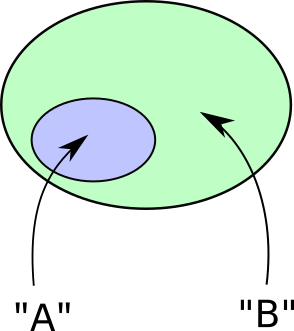
Rough picture: what A refers to is covered by what B refers to.
For example:
lo vi nanmu cu me lo dinju cikre This man is one of the building-repair crew.
Be careful! me is not used to talk about literal parts of a whole (like a wheel being part of a car). For that, we use the word pagbu.
lo vi klupe cu pagbu le minji This screw is a part of the machine.
Got it. pagbu for the "part-of" relationship, and me for "membership" or overlap.
If you want to express strict identity (A and B are exactly the same thing), we use the word du.
- du
- x1 is identical to x2
ti du la .mikan. This is Mika.
tu du le bloti That is the boat.
du, like me, is a cmavo that can act as selbri.
Lesson 16. Negation
You may notice more vocabulary per chapter from here on: the skeleton of Lojban is mostly set, so we widen expression and reading practice.
Up until now, we've mostly dealt with straightforward statements. But what if you want to say that something isn't the case? It's time to tackle negation.
The simplest way is to place the word na immediately before the selbri. This basically says, "It is not true that..."
- na
- negates the bridi; typically immediately before the selbri.
mi na catra le gerku I am not killing the dog.
la .miran. na dasni lo crino kosta Milan is not wearing a green coat.
mi na du la .kocon. I am not Koshon.
- catra
- x1 kills x2 by method x3
- gerku
- x1 is a dog of species/breed x2
- dasni
- x1 wears x2 as garment x3
- crino
- x1 is green
- kosta
- x1 is a coat of material x2
Just like the tense tags we saw earlier, placing na before the selbri also clearly marks where the verb begins. It can even take the place of cu.
That's remarkably simple! Is there an opposite word? Like a way to say, "Yes, it really is true!"
There certainly is! That would be ja'a. It works exactly like na, but it affirms the entire sentence instead of negating it.
- ja'a
- emphatic affirmation before selbri.
do ja'a ca jmive You are (really) alive right now.
ti ja'a prenu .i na minji This is a person; it's not a machine.
- prenu
- x1 is a person (psychological sense)
- minji
- x1 is a machine for purpose x2
Nice — paired particles that work the same way.
So, na and ja'a deal with the truth of the entire sentence. But we also have the NAhE-series of words, which allow you to tweak the meaning of the selbri itself (similar to how SE works).
These words let you build new shades of meaning: the opposite, a neutral midpoint, or just something "other than" the standard definition.
- to'e
- the logical opposite (polar meaning)
- no'e
- the neutral midpoint (not X, not its opposite)
- je'a
- the strong affirmation ("it really is [selbri]")
- na'e
- something else ("other than the usual sense of [selbri]")
mi prami do / mi to'e prami do I love you / I hate you (the opposite of love).
lo vi tanxe cu barda / lo vi tanxe cu no'e barda The box is big / The box is medium-sized (not big, not small).
lo nu cilre fi lo lojbo gerna cu je'a zdile mi Learning Lojban grammar really is fun for me.
- prami
- x1 loves x2
- tanxe
- x1 is a box for contents x2, material x3
- barda
- x1 is big in property x2 compared to x3
- cilre
- x1 learns fact x2 about subject x3 from source x4 by method x5
- gerna
- x1 is the grammar of language x2 regarding property x3
- zdile
- x1 is fun for x2 in aspect x3
Keep in mind that NAhE words don't act as sentence markers like na or cu do. The [NAhE] + selbri combination is still treated as a single unit and can still form part of a tanru.
lo crino to'e barda green small-ish thing
lo na'e crino kosta a non-green coat (a coat of some other color)
From the definitions alone, na and na'e don’t look that different…
na negates the entire claim (it says the whole sentence is false). na'e simply points to a different predicate ("not green" still implies we're talking about a color—it's what we call "suggestive negation").
la .miran. na dasni lo crino kosta It’s false that Milan wears a green coat (maybe naked, maybe other coat).
la .miran. cu dasni lo na'e crino kosta Milan is wearing a coat that is something other than green.
Oh, I see. So ti na nanmu means "This thing is not a man" (it could be a rock for all we know). But ti na'e nanmu suggests it's something like a man or has a gender, but specifically is not a man.
In general, na is your safe default for negation. Use the NAhE series when you want that specific "it's another kind of..." nuance.
Negate with na, refine with NAhE. Simple!
Lesson 17. Questions
Today's topic: questions! There are two main families: truth questions (yes/no) and fill-in-the-blank questions (for things or actions). First, a quick test, Sora—translate: "I am not a human."
Exercise
- Lojban?
- remna
- x1 is a human
mi na remna—but hey, I definitely am human!
Truth questions: xu
Good—glad to see you haven't forgotten na. To ask a yes/no question, just place the word xu at the beginning of the sentence (or right after the .i marker).
- xu
- An attitudinal word that asks whether the sentence is true.
[.i] xu lo vi prenu cu mamta mi Is this person my mother?
- mamta
- x1 is x2’s mother
What kind of example is that...? And what's an "attitudinal"?
Attitudinals express emotions or attitudes—we’ll cover them in detail in the finale. For now, the important question is: how do you answer? You can use go'i to mean "Yes, that's right" or na go'i for "No, that's not it."
.i xu lo vi prenu cu mamta mi Is this my mother?
― .i na go'i .i tu mamta do No, I'm not. That woman over there is your mother.
- go'i
- pro-bridi; repeats the previous bridi.
(Wait, so she wasn't your mother?) So go'i basically repeats the previous statement, right?
Exactly. Grammatically, go'i acts as a selbri that means "the same as the last sentence." So na go'i just means "that sentence isn't true." This is usually all you need for answering yes/no questions.
Got it. English yes/no flips on negative questions — how does Lojban handle that?
It's a common stumbling block! In Lojban, go'i echoes the exact previous statement. If you're asked a negative question like "Is it true you're NOT my mother?", a plain "yes" or "no" can be confusing. To be perfectly clear, you can use ja'a go'i to strongly affirm the positive version of the sentence.
.i xu lo vi prenu na mamta mi Is this person not my mother?
ja'a go'i (affirms the positive inner bridi — roughly “yes, they are your mother.”)
Wh- questions: ma
For "fill-in-the-blank" questions, use ma. You just place ma exactly where the thing you're asking about would go. You can even use several in one sentence! The listener answers by giving the missing information in the same order.
- ma
- Asks a question that needs a thing (sumti) as an answer.
.i mi ca catlu ma What am I looking at?
― .i lo patfu Father.
- catlu
- x1 looks at / watches x2
To ask when, where, why, or how, just combine a tag with ma. For example: ca ma (when), bu'u ma (where), ki'u ma (why), or ta'i ma (how—from tadji, meaning method).
- ca ma
- when
- bu'u ma
- where (at …)
- ki'u ma
- why (with what reason)
- ta'i ma
- how (by what method)
mo — selbri question
mo replaces the selbri: “What is x1 / what is going on?” Answer with a selbri — same idea as ma, different slot.
- mo
- Asks a question that needs an action or attribute (selbri) as an answer.
.i lo vi prenu cu mo Who or what is this person? (What's their relationship to the topic?)
― .i ja'a patfu They are (truly) my father.
Exactly. mo can even be used inside tanru—for instance, mo nanmu means "What kind of man?"
Exercise
- Lojban / English drill (see Japanese edition for full table): book location; restaurant location; “what sees what”; finished eating; ma jalge … riddle.
Watch zvati vs stuzi place structure when asking “where is the restaurant?” — ma stuzi le gusta vs le cukta pu zvati ma.
Lesson 18. Commands and requests
Now let's look at how to urge someone to do something: commands.
To make an imperative sentence, you just replace "do" with the word ko.
- ko
- The imperative "you"; it covers a wide range from strict commands to polite requests.
ko stali ta Stay there.
ko na kusru mi Don’t be mean to me.
lo prenu cu prami ko Be someone that people love.
So putting na before the selbri with ko means "don't..." That last example is interesting—it takes a moment to wrap my head around it.
ko can fill any terbricmi — the command is “make this bridi true.”
So instead of ordering someone to love you, lo prenu cu prami ko is more like "Behave in a way that results in people loving you."
ko alone already spans “do it” through “please do”; that covers most imperative needs.
If you want to add more nuance—like making a polite request, a suggestion, or granting permission—you can use attitudinals at the start of your sentence:
- .e'o
- request
- .e'u
- suggestion
- .e'unai
- warning against
- .e'a
- permission
- .e'anai
- forbiddance
- .e'i
- constraint / obligation
- .e'inai
- release / “up to you”
(Plus pei for “may I?” patterns — see below.)
Some sentences keep do instead of ko — proposals and permissions aren’t always straight imperatives.
We’ll go deeper into the nai suffix in the finale. But generally, if it's a suggestion or a request rather than a direct order, it's very common to use do instead of ko.
You can also use the word pei to turn an attitudinal into a question:
- pei
- Turns the preceding attitudinal word into a question.
.e'a pei mi lasna do lo bitmu lo dunja badna May I stick you to the wall with a frozen banana?
― nai No.
I see. So nai flips the attitude, similar to how to'e flips a brivla. This is getting deep!
Lesson 19. Relative clauses and phrases
This chapter includes some pedagogical choices that may differ from other references; for ordinary communication it should be fine.
Relative clauses allow you to attach extra information to a sumti. You can use a full sentence with poi or noi, or a simple link to another thing with pe or ne.
poi / noi + ku'o
- poi
- restrictive relative — narrows which referents
- noi
- non-restrictive — adds side comment
- ku'o
- closes NOI-clause
- ke'a
- resumptive pronoun inside the clause (defaults to x1-ish if omitted)
mi citka ti poi ke'a lenku I eat those of these that are cold (only the cold ones).
mi citka ti noi ke'a lenku I eat this, which, by the way, is cold (adding a detail).
The key difference is that poi restricts the group you're talking about, while noi just adds an incidental description.
ku-internal relatives
Whether you place the relative clause inside the description (lo [selbri] poi … ku) or after it (lo [selbri] ku poi …) can slightly change the meaning. For most everyday talk, either works, but check the refrence grammar if you need to be extremely precise.
pe / ne — sumti–sumti links
- pe
- restrictive "related to..."
- ne
- non-restrictive "incidentally related to..." (like an appositive)
pe sumti ≈ poi ke'a srana sumti (and ne ≈ noi version).
lo nicte pe lo cabdei The night of this day (tonight).
.e'o ko jgari lo kabri ku pe do Please pick up the cup that belongs to you.
po'u / no'u — identity appositives
po'u ≈ poi ke'a du; no'u ≈ noi ke'a du.
mi no'u la .kocon. cu ctuca do I, Koshon, teach you.
le mikce po'u le misno cu zvati lo vi spita The doctor—specifically the famous one—is at this hospital.
Exercise
- Parse: .i lo bruna poi vu xabju cu benji lo dakli ku po'u lo narju mi ne lo nurma (see answer key in Japanese PDF or unpack with textbook).
Lesson 20. be, bei, be'o (sumti links into selbri)
We widen selbri → practically sumti again (like Lesson 8).
Déjà vu!
It's a similar pattern: be and bei allow you to fill the slots of a brivla while it's still being used as part of a description.
mi citka lo plise I eat an apple.
The predicate citka has x1 eater, x2 food.
If you want to turn "eating an apple" into a single property, you'd say: citka be lo plise. This creates a new concept: "eats-apples."
So lo citka be lo plise would be "an apple-eater"!
- be
- Links the following sumti into the x2 terbricmi of the preceding word.
- bei
- Links further sumti into the next available terbricmi (x3, x4, etc.).
- be'o
- A terminator that ends the chain of links when needed.
mi klama lo klaji be la .latcmatcad. I go to the street(s) of Latcmatcad.
lo ckule be fi lo lojbo bei fu la .mikan. cu se stuzi ma Where is the Lojban school run by Mikan located?
ko na pencu lo nenri be lo tanxe be fi lo pelji Don’t touch what’s inside the paper box.
Why bei after the first sumti?
If we used be for every link, complex nested structures would become impossible for the parser to untangle. bei ensures that the groupings stay perfectly clear.
These be-phrases can even be used inside tanru, and you can use be'o to stop the chain before it accidentally swallows the next word in your description.
Explore the toolkit: Notice the subtle differences between:
- ti lumci be lo dinju be'o minji
- ti dinju lumci minji
- ti me lo minji poi ke'a lumci lo dinju
- ti minji lo nu lumci lo dinju
Lesson 21. Numbers
Time for numbers! The digits are pa, re, ci, vo, mu, xa, ze, bi, so, no (1–9, 0). Notice that most of the vowels follow the a, e, i, o, u pattern (though mu breaks it slightly by using u).
To make larger numbers, you just string the digits together: pano (10), recivo (234), or renopamu (2015).
li — the number as sumti
- li
- The number article; it turns a number into a sumti (an argument).
- lo'o
- The terminator for li; you can almost always leave this out.
li xa pilji li re li ci 6 is the product of (multiplies) 2 and 3.
lo nu le nixli cu limna cu mentu li reno The girl swam for 20 minutes.
lo vi nanba cu grake li sovo This loaf of bread weighs 94 grams.
li so pi'e cimu tcika lo nu mi co'a cikna 9:35 is the time that I woke up.
- pi'e
- A sub-number separator, used for things like clock times and dates.
Counting lo / le sumti
You can specify a quantity by putting the number right after the article: [lo / le] + [number] + [selbri].
lo mu verba cu kelci lo re bolci Five children are playing with two balls.
mei
[number] mei → selbri “x1 is a set/cardinality N …” — combine with noi for “these N things.”
pi (decimal point), ki'o (thousands separator), and xo (the question word for "how many?"). We also have general quantifiers like ro (all), so'i (many), and so'u (few).
lo xo prenu cu klama ti How many people are coming here? ― mu ― Five.
There's a lot to memorize here, but for now, focus on the digits, the article li, and how to use them with lo. You can pick up the more advanced quantifiers as you need them!
Lesson 22. Quotation
Next up: quotation! We'll look at how to quote Lojban directly and indirectly, plus some handy tricks for referring back to things you've already said.
Grammatical Lojban — lu … li'u
- lu
- The opening quote for grammatically correct Lojban text.
- li'u
- The closing quote (make sure not to confuse it with lu'u!).
do cusku lu mi prami do li'u mi You said to me, “mi prami do.”
If you need to quote Lojban that isn't grammatically correct (like a list of random words or an unfinished sentence), you can use the more flexible lo'u ... le'u brackets.
Quote just one word: zo
mi se cmene zo .soran. My name is the word “soran.”
zo pu cu cmavo The word "pu" is a cmavo.
zo quotes exactly one single word following it. (Even if that word is one of those compound words like "puzi", it only grabs the "pu" part!)
Non-Lojban — zoi X … X
When you need to quote anything that isn't Lojban at all, you use zoi. You pick any word as a "delimiter" to mark the beginning and end of your quote. (People often just repeat the word "zoi" as the delimiter.)
Indirect speech — du'u / se du'u
do cusku lo se du'u mi prami do kei mi You said that I love you (expressing that particular idea).
Discourse sumti — di'u, di'e, …
These are like pronouns for entire sentences. di'u refers to "that thing I just said," and di'e refers to "the thing I'm about to say."
la'e — “the referent of”
.e'o mi'o zgana la'e zoi py. My Neighbor Totoro py.
le ninmu cu cisma .i mi gleki la'e di'u She smiled; I'm happy about that (specifically, her smiling).
la'o — non-Lojban names with delimiters
.e'o mi'o zgana la'o py. My Neighbor Totoro py.
Exercise
- Use the word fanva to say: "Translating 'dog' from Japanese to Lojban yields gerku."
- How would you ask "What is 'dog' in Lojban?" using ma?
- fanva
- x1 translates text x2 to language x3 from language x4 yielding x5
Lesson 23. Logical connectives
Before we dive into the deep end, here's a non-logical connective: jo'u. This is what you use when you just want to group two things together like a bundle, meaning "X and Y together."
mi jo'u la .soran. cu klama lo briju be la .xekir. Sora and I (together as a group) go to Xekir’s workplace.
Logical connectives — shape families
|
sumti |
sentence |
tail |
forethought | |
|---|---|---|---|---|
|
A (OR) |
.a |
.ija |
gi'a |
ga … gi … |
|
E (AND) |
.e |
.ije |
gi'e |
ge … gi … |
|
O (IFF) |
.o |
.ijo |
gi'o |
go … gi … |
|
U (whether) |
.u |
.iju |
gi'u |
gu … gi … |
|
question |
ji |
.ije'i |
gi'i |
ge'i … gi … |
The rule of thumb is: use the vowel to pick the logic (AND, OR, etc.), and the consonant/shape to pick what you're connecting.
You can also add na or nai to these connectives to get negative variations like "neither X nor Y" or "X but not Y." You can find full tables for these in the CLL or in most Lojban cheat-sheets.
Sentence connectives .i jV
ti glare .ije ta lenku This is hot and that is cold.
mi citka .ija mi sipna I eat or I sleep.
do citka .ije'i do sipna ― .ijenai Are you eating or sleeping? ― I'm (truly) eating, not sleeping.
Sumti connectives .V
mi cortu lo cutne .e lo stedu My chest and head hurt.
gi'V — bridi-tail connectives (shared front)
mi klama lo zarci gi'e te vecnu lo tsasmani I go to the shop and I buy a gorilla.
Forethought gV … gi …
Exercise
- Rewrite: mi citka .ija mi sipna → ga citka gi sipna, etc. (see full drill in source lesson).
Order note: na placement differs between afterthought and forethought forms — check examples.
Lesson 24. Pronouns and pro-bridi
Personal and demonstratives
- mi, mi'o, mi'a, ma'a, do, do'o
- The personal pronouns (me, us, you-all). Lojban is very specific about whether "we" includes the listener!
- ti, ta, tu
- Demonstratives: this (near me), that (near you), and that yonder (far from both). These are used for pointing to things that are physically present.
ri is one of the most common words in Lojban—it repeats the very last complete sumti mentioned. It's normally used for third-person "it" or "him/her."
mi cirko lo mapku .i ri crino I lost a hat; it is green.
If ra or ru feel too vague, you can always narrow them down with a relative clause: ra noi ...
These refer to the slots of the current sentence: vo'a refers to the x1 slot, vo'e to x2, and so on.
mi cusku lo se du'u vo'a prami vo'i kei do I say to you that I love you.
go'i is used to repeat an entire previous statement. You can even place new sumti after it to override specific slots in the original sentence.
.i ti pixra .i lo se go'i cu tcati .i lo te go'e cu me la .xekir. This is a picture; its subject (x2) is tea; and the person who made it (x3) is Xekir.
You can use goi ko'a to assign a short name like ko'a to something you've just mentioned, or cei broda to assign a temporary action word. These are mostly used in legal or technical documents.
Letter variables
Initial-letter sumti for nearby la / le / lo phrases are a common shorthand; letters can act as sumti.
This is the "whatchamacallit" word—you use it when you can't think of the right verb but the meaning is clear from context.
lo moklu be do cu co'e Your mouth is... well, busy (or whatever is obvious from context).
.i mi klama lo gusta .i .e'u co'e I'm going to the restaurant. Care to join? (Or any other suggestive action).
Lesson 25. Attitudinals (UI)
Finally, we have attitudinals. These are "contextual stickers" that attach to a word to express how the speaker feels about it, but they don't change the underlying grammar of the sentence. They're what make Lojban feel "alive."
Examples:
- .a'o, .au, .ie, .iu, .ua, .ue, .ui, .u'i
- hope, desire, agreement, fondness (love), discovery (aha!), surprise, happiness, amusement
.i .ui mi jimpe fi la .lojban. (Yay!) I understand Lojban.
.i .a'o mi mitre li papibi I wish I were 1.8 m tall.
lo .iu vi titla cu kukte This sweet thing (which I'm fond of ♡) is tasty.
You can adjust the strength of your emotion by adding words like cai (intense), sai (strong), or ru'e (slight). You can also use nai to flip the meaning (like from happy to sad) or cu'i for a neutral feeling.
COI — vocatives
coi, co'o, mi'e, ki'e, je'e, vi'o, di'ai, fau'u + optional sumti + do'u.
coi la .soran. mi'e la .kocon. Hello, Sora! I'm Koshon.
ki'e lo sidju ― je'e Thanks for the help! ― You're welcome.
You can put pei after an attitudinal to ask "Do you feel that way too?" A standalone pei just asks "How are you feeling about this?"
For the full list of these expressive particles, you can dive into the UI and COI sections of The Complete Lojban Language or look at a reference card. There's a whole "zoo" of them to explore!
Lesson 26. Closing…?
And that, my friend, was the main course—congratulations! You've officially made it through the basics of Lojban.
.ui cai—We actually did it! I can't believe how much we've covered.
It really is an impressive list: pronunciation, basic sentences (bridi), compounds (tanru), place structures (SE and FA), abstractions (NU), time and space (tense), aspect (ZAhO), modal tags (BAI), negation, questions, commands, relative clauses, identity (me/du), internal links (be), numbers, quotations, connectives, pronouns, and attitudinals... .i pei—how are you feeling about it all now?
.ui—To be honest, it's been a ride! I love that there's no messy inflection to worry about, and in some ways, the logical structure feels even simpler than English once you get the hang of it.
…Doorbell…
coi .kocon. ...Oh, hey Sora! I didn't expect to see you here. mi'e .sevan. .i mi citno mensi la .soran.
Sevan! You're only showing up now? We're already finished!
ki'e .sevan.—Thanks for bringing that over. Now that we're all here, we can officially bring this edition of First Lojban to a close.

je'e do. (No problem!)
But wait! There's one last thing—a little pop quiz to see how much you've really learned. Grab a pen and some paper! The exam is here, and once you're done, check your answers against the answer key.
I got an 81! That's a solid A in my book!
Nicely done! You've officially completed the basic track.

co'o
Lesson 27. (Extra) Propositions, properties, relations
Welcome to the "Back Alley"! This is a little philosophy and logic gym tucked away next to the main Lojban course. It's totally optional, but it's a lot of fun if you like to think about how language and thought fit together.
Propositions
Sentences in different languages can often mean exactly the same thing, even if they use completely different words ("I am a human," .i mi remna, Mi estas homo, etc.). We call that shared underlying meaning a proposition. In Lojban, any declarative sentence that expresses this meaning is a propositional sentence.
The word du'u is used to wrap a whole sentence into a single item: "the proposition that [sentence] is true."
- du'u [sentence]
- The proposition expressed by the given [sentence]. (x1 is the proposition, x2 is its textual representation).
Philosophers like to argue about what a proposition "actually" is—is it an idea, a set of possible worlds, or a disposition to behave in a certain way? For our purposes in Lojban, you can just think of it as the "logical content of a declarative sentence."
ce'u — open place in a property
Wait, ce'u remna isn't a complete sentence by itself. It's more like a property ("to be human"), with a "blank space" or "slot" marked by the word ce'u. (Most introductory texts and the CLL discuss how this connects to ka abstractions—check those out if you want to dive deeper!)
Exercises
- Try building a du'u-sentence that pairs the same proposition across two different languages using those zoi quotation markers we learned in Lesson 22.
- How would you say "the English version of the proposition is identical to the Japanese version" using our identity word du (from Lesson 15)?
Relatives refresh
ti noi ke'a remna ku'o cu melbi "This thing—which, as it happens, is human—is beautiful."
Try connecting these abstract properties to what you've learned about poi and noi relative clauses.
Lesson 28. (Extra) Existence and quantifiers
When we make existential claims (saying that something exists), the truth of what we say depends entirely on our domain of discourse. For example, saying "there are two yellow things" might be true if we're only talking about a specific picture or a scene in a movie, but it would be false if we were talking about everything in the entire universe. Whenever you see a quantifier, always ask yourself: What is the frame we're counting within?
Ah, I see. So "a bird exists" usually just means “there's a bird in our line of sight,” not necessarily that a bird exists in every possible corner of the cosmos.
Picture: one domain of discourse
Here is a concrete diagram: colored circles and squares drawn inside a frame. Existential sentences are judged within that frame unless you widen the domain (for example to “the whole world”).
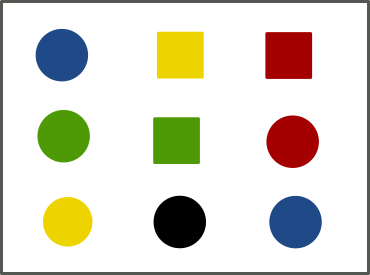
Practice reading existentials against a single boxed universe of objects.
Quantifier prefix + zo'u
Here's the logic-flavored template for building these sentences:
[Quantifiers + Variables] zo'u [The Sentence using those variables]
- da, de, di
- The variables (the things we're talking about). If you don't give an explicit number, they default to "at least one."
- zo'u
- The marker that separates the "inventory list" (the prenex) from the actual sentence.
su'o pa da zo'u da cukla There is at least one thing such that it is round. (Something is round.)
re da zo'u da pelxu There are exactly two things such that they are yellow. (Two things are yellow.)
One very important rule: the order of variables in the list matters! Saying "there is some X and then some Y" isn't always the same as saying it the other way around.
In many simple cases, you can actually fold that list of variables directly into the sentence itself—though we'll stick to the explicit version for now.
Think of it like this: the variables you introduce at the start "bind" to the words in the sentence that follows. Reordering them can change their "scope," which changes the entire meaning. For example, "for every person, there's a favorite hat" is a very different claim than "there's a single favorite hat that belongs to everyone." Formal logic is a deep topic, but for now, just remember: order matters, and the domain of discourse determines what "exists."
Figures: exhausting a small domain
When only finitely many objects are in play, you can test existential claims by case analysis—plug each candidate in and count how many satisfy the inner property. The original lesson walked through grids like these (including a toy “who likes whom” relation) to show why the order of quantifiers in the prenex matters.
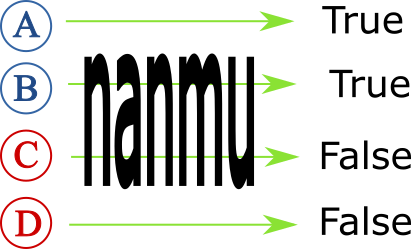
Grid-style check: how many referents satisfy “is a man” inside the domain.
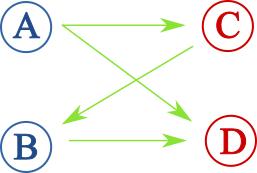
Four people with arrows for likes—used to evaluate nested quantifiers.
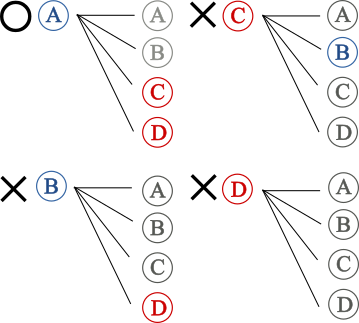
Nested search: for each outer assignment, test the inner existential.
Since we're just scratching the surface here, I highly recommend checking out the quantifier chapters in the CLL for full tables and more formal exercises. This little "Back Alley" is only here to point you toward the machinery!
Lesson 29. Letter words: lerfu, bu, and boi
Wait — there's more?
Hey, think of it as New Game Plus. You've cleared the main story; now we get into the hidden rooms.
…Who are you again?

Sevan. Your sister? We live in the same house?
Oh. Right. When did you get into Lojban?
About two lessons before you. Anyway, first topic: letter words.
What is a lerfu?
You already know that Lojban uses Latin letters. Back in Lesson 2, you learned how to name them:
- Consonant letter names:
[consonant] + y + .→ by., cy., sy., zy. … - Vowel letter names:
. + [vowel] + bu→ .abu, .ebu, .ibu, .obu, .ubu
A word used as a letter name is called a lerfu (letter/symbol word).
- lerfu
- x1 is a letter/symbol representing x2 in alphabet/writing system x3
So by. is the Lojban name for the letter "b" and .abu is the name for "a". Got it. But I never heard about the period . or apostrophe '. What are those called?
Good catch. They're special:
- Period
.→ denpa bu ("pause-letter") - Apostrophe
'→ .y'y. (literally the cmavo .y. spoken as a lerfu — two glottal pauses around the schwa)
- denpa
- x1 waits for x2 (event) while doing x3, until x4 begins
So denpa bu is literally the "waiting letter." A pause. That's kind of poetic.
Also works for letters Lojban doesn't normally use, like h, q, or w. Since ' already sounds like an "h", people often write h as .y'y. bu ("an h-like letter"). And q is typically .ky. bu ("a k-like letter"), since q in most languages sounds like k.
bu: turn any word into a letter-symbol
The real power tool here is bu. Stick bu after almost any Lojban word, and it becomes a lerfu — a symbol standing for that word.
Common examples you'll see in practice:
.ui bu → 😊 (the happiness-letter) .iu bu → ❤️ (the love-letter) denpa bu →
.(the pause-letter)
So .ui bu is literally the emoji :)? That's delightful. Can I put bu after any Lojban word?

Almost. A few words eat up whatever comes right after them before bu gets a chance to act:
- zo, zoi, la'o, lo'u — all of these grab the next word or next passage as a quotation before bu can form a lerfu.
So zo bu doesn't make a "zo-letter"; it quotes the word bu itself.
Edge case, sure. I'll remember: quotation words come first.
A string of lerfu = one sumti
Here's something subtle. Consider this sentence:
.abu dunda by. cy. A gives bc.
Wait — "a gives bc"? Not "a gives b to c"?
Exactly. by. cy. is a sequence of lerfu and sequences are treated as a single sumti — the string "bc". So the sentence has only two arguments: the giver (a) and the thing given (bc).
Word spacing doesn't matter: by.cy. and by. cy. both mean the letter string "bc".
So how do I say "a gives b to c"?
Use boi to explicitly end the lerfu (or number) sequence:
- boi
- terminator for lerfu strings and number sequences
.abu dunda by. boi cy. a gives b to c.
boi cuts the lerfu string at that point. So cy. stays separate, filling x₃ of dunda as the recipient. Okay, I'll remember that one.
boi works with numbers too. If you ever see something like li pa by. (the number 1 followed by the letter b), writing li pa boi by. keeps them from fusing into a hybrid string.
Acronym name words
Last topic: how to Lojbanize acronyms like NASA, FBI, CD, or BPFK.
The official recipe:
- Spell out each letter with its Lojban lerfu name.
- If two vowel-name lerfu come next to each other, insert an apostrophe between them.
- Add any consonant at the very end (the last consonant lerfu already in the string is convenient, or use n, or use the first letter of the source culture's word for the organisation).
la .ny'abusy'abus. → NASA
la .cydyd. → CD
la .fyby'ibun. → FBI
la .bypyfykyk. → BPFK
So every letter is just spelled out in Lojban order, smooshed together, with a final consonant tacked on?
Exactly. The last consonant makes it a proper cmevla (remember: name words must end in a consonant). As long as it's intelligible, you have some flexibility — some people drop all the bu parts and just use the Lojban letter names directly, others invent shortcuts. Communicability is the real rule.
Huh. So Lojban texters probably have their own abbreviation styles by now.
Almost certainly. The language grows with its speakers.
Lesson 30. Advanced name words: stress and forbidden clusters
You know what bugged me about Lesson 3? Koshon said cmevla can have stress somewhere other than the second-to-last syllable, and then Sora just yelled "let's ignore that!" and we moved on.
Classic Sora. Okay, let's fix it. This lesson is about two things: marking non-default stress, and the consonant clusters that are never allowed anywhere in Lojban.
Non-default stress in cmevla
You know the default: stress the second-to-last syllable, ignoring y.
But names from other languages don't always fit that pattern. Lojban lets you override it: capitalize the letters of the stressed syllable.
la .akasakas. → akaSAkas (stress falls naturally on second-to-last: -sa-) la .aKAsakas. → AKAsakas (stress on the first syllable, marked explicitly) la .iaTSUxacin. → iaTSUxacin (八つ橋 — stress on the second syllable)
Just capitalize the whole stressed syllable?
Technically it's enough to capitalize just the vowel, but capitalizing the whole syllable is easier to read. Either way is valid.
Some writers also use diacritical marks — like la .akásakas. — but that's non-ASCII and not everyone can type it. Capitals work everywhere.
So the two forms la .akasakas. and la .aKAsakas. represent the same name with different stress placements, not two different words.
Exactly. It's an accent record, not a spelling distinction.
One practical point: whether to preserve the original accent is up to personal taste. Some people think Lojbanization should change the accent (it's part of adapting the word). Others want to keep the original as close as possible. Both views are reasonable.
Forbidden consonant clusters
Now the important list. Lojban avoids certain sound combinations — usually because they're easy to mishear or because they don't fit the word-boundary system. Here are the key forbidden patterns:
Never allowed in Lojban (at word junctions or within a word):
- Double consonants —
kk,dd,pp,ss… any consonant repeated back-to-back. - Mixed voice in obstruents — e.g.
pv,gs,td,gk… pairing a voiced obstruent (b d g v z j) with an unvoiced one (p t k f s c x). (r l m n are not obstruents and can mix freely.) - The sibilant cluster —
cs,sc,jz,zj— these sounds are too similar and blend together. - Specific forbidden pairs:
cx,kx,xc,xk,mz - Specific forbidden triples:
ndj,ndz,ntc,nts
That's a lot. Do I have to memorise all of those to make a cmevla?
For everyday Lojbanization you mostly need rules 1 and 2 — they cover the vast majority of cases. The others are rarer. And the fix is always the same: insert a y between the two problem consonants.
Problem: London →
ndis allowed, but the finalnwould give us .londyn. — wait, that's fine actually. Problem: Marx →rxis fine. But Marx + s at the end: .markss. — double-s! Fix: .markyss. or simply .marks.
So y is the universal lubricant between stuck consonants.
Exactly. And two more vowel rules to watch when making name words:
Vowel rules in cmevla:
- i and u become semivowels (y-glide and w-glide) when they appear after a consonant and before another vowel. To avoid this if you don't want it, double the vowel: giia for
ぎゃ, niio forにょ. - Any two non-i/u vowels in a row need an apostrophe between them: o'u, e'a, etc.
So "Tokyo" (東京 = Toukyou) would be .tokiion. to avoid the kyo glide becoming a semivowel?
Yep, or .tokion. if you're fine with the kyo-glide. Either is defensible. The point is that the parser can still tell the words apart.
Try a few yourself:
Exercise
Lojbanize the following names. Remember: the word must end in a consonant, no forbidden clusters, apostrophes between non-i/u vowel pairs.
- Kyoto (京都 — Kyouto)
- Miku (ミク)
- Zhang (张 — the Chinese surname, approximately "Djang")
Okay:
- .kiioton. —
kiowould makekia semivowel beforeo, so I doubled thei. Or just .kiioton. / .kioton. if I'm okay with the glide. - .mikun. or just .mik. — straightforward.
- .djans. or .djang. wait, final
ng→ I need a consonant… .djangn. — hmm,gnis allowed (voiced+nasal). Actually just .djans. or .djan. is fine too.
All reasonable. Option variety is a feature, not a bug. The community will converge on popular forms for well-known names.
Lesson 31. Sound equals text — Lojban's audio-visual design
So wait — Sevan showed me earlier that you can type .o'imuXAGjisofyBAKnicuZVAtilePURdi (all one string, no spaces) and a Lojban parser can still tell what every word is?
Yes. That's not a trick — it's a core design property called audio-visual isomorphism (AVi for short).
Iso-what-now?
"Isomorphism" means "same shape." The idea is:
- Any properly spoken Lojban utterance can be uniquely written down.
- Any properly written Lojban text can be uniquely read aloud.
This is stricter than most languages. In Japanese, for example, a string of hiragana like くるまでまとう could parse as "waiting by car" or "waiting until [he] comes" — the boundary between words is ambiguous. Lojban forbids that.
How word shapes make boundaries unambiguous
Recall the three word types (Lesson 3):
- brivla — has a consonant cluster in the first five letters, ends in a vowel.
- cmavo — no internal consonants except possibly the very first, ends in a vowel.
- cmevla — ends in a consonant.
These shapes were engineered so that once you read a stream of sounds (including where the stress falls), there is exactly one way to cut it into words. Every word boundary is recoverable from the sound alone.
That's why you can ditch spaces if you include stress marking?
Exactly. Spaces are a courtesy to the reader, not a grammatical necessity. Lojban's design makes them optional — as long as stress is explicit, the string is still unambiguous.
(That said: please use spaces when writing to humans. Reserve the spaceless form for puzzles and Twitter character limits.)
Why dots exist
Now you can fully understand why certain dots are required:
- Before vowel-initial words — .i, .abu, .iu, etc. Without the dot, a preceding final vowel might run into the opening vowel and create ambiguity about where one word ends and the next begins.
- After words ending in y — .y. is a cmavo; the trailing dot keeps it from being read as the start of the next word.
- Around cmevla — la .soran. has a dot at each end, clearly marking the name as a single unit separate from surrounding words.
All three rules are there for the same reason: to keep word boundaries clear.
So "omajinaï" (Koshon's word for the dots back in Lesson 2) was actually "word boundary markers"!
Right. Koshon skipped the explanation to keep Lesson 2 simple. Now you know.
The bigger picture
This design has a few practical consequences:
What AVi enables:
- Parsers work cleanly. Because word boundaries are always recoverable, programs like ilmentufa (the camxes parser) can parse Lojban text exactly as a speaker would hear it.
- Lojban creates new words carefully. Every new gismu and lujvo has to pass morphological checks — forbidden clusters, uniqueness, etc. — precisely to preserve this property.
- Spoken Lojban matches written Lojban. There is no difference between "formal written" and "informal spoken" grammar the way there is in many natural languages.
So the word-shape rules I grumbled about learning aren't arbitrary — they're load-bearing architecture.
Exactly. Lojban is less like a collection of rules-for-rules'-sake and more like an engineered system where each constraint earns its keep. Take out one rule and something else breaks.
That's actually… kind of cool? It's more like a proof than a language.
Some people say exactly that. Whether that's a feature or a bug is left as an exercise for the learner.
Lesson 32. Selma'o — cmavo subcategories
So far I've been collecting cmavo like pocket lint: lo, le, nu, be, poi, noi, cu, ko'a, fa, se … they're everywhere. Is there any system?
Yes! Each cmavo belongs to a selma'o — a syntactic subcategory. Words in the same selma'o behave identically in terms of grammar: you can swap them out without causing a parse error (though the meaning changes, of course).
And what's the selma'o called?
Each selma'o is named after one of its representative members, written in capitals. For example:
- The article class (the "sumti-former" cmavo like lo, le, la …) is called LE.
- The tense class (time-distance markers like zi, za, zu …) is called ZI.
- The abstractors like nu, du'u, ka … are the NU class.
- The selbri negation cmavo na, ja'a are the NA class.
You've actually already been using these names! SE for se/te/ve/xe, FA for fa/fe/fi/fo/fu, COI for coi/co'o/ki'e…
Oh — that's why Koshon kept saying "SE class" and "FA class." They were just giving me the selma'o names all along!
Exactly. The names aren't invented arbitrarily — they're always the simplest or most common member of the class, uppercased. You can find them in any Lojban dictionary next to each cmavo entry.
Swapping within a selma'o
Within a selma'o, any member can replace any other and the sentence will stay grammatical. Only the meaning differs:
lo mlatu — some cats (in reality)
le mlatu — the cat(s) I have in mind
la .soran. — (the entity named Sora)
All three are in LE selma'o, so they all "work" in the same grammatical slot — just with different references.
Right. Same slot, different meaning. That's exactly what selma'o tracks.
One caution: "article" in the English-grammar sense doesn't map perfectly onto any single selma'o. What English calls articles spans multiple Lojban classes. Selma'o is strictly about syntactic behavior, not English grammatical terms.
Sub-numbering within a selma'o
Some selma'o are large enough to sub-divide by meaning. The convention is to append a number to the selma'o name:
- KOhA1 — personal pronouns: mi, do, mi'o, mi'a …
- KOhA2 — demonstratives: ti, ta, tu
- KOhA3 — reflexive/anaphoric: ri, ra, ru, ko'a, fo'a …
All of these are still KOhA (same grammar), but the sub-number tells you which semantic cluster they belong to.
So the big picture is: selma'o tells you the grammar, the number tells you the meaning flavour.
Nicely put. And if you ever want to really map out Lojban's grammar systematically, going through the major selma'o one by one is a great approach. It also helps you notice when you're missing vocabulary — you might know the NU abstractors nu and du'u but realize you've never seen si'o or ni.
Quick selma'o tour of things you already know
| Selma'o | Examples | Role |
|---|---|---|
| LE | lo, le, la | sumti-formers (articles) |
| NU | nu, du'u, ka, ni | abstractors |
| FA | fa, fe, fi, fo, fu | place tags |
| SE | se, te, ve, xe | place converters |
| ZI | zi, za, zu | tense distance |
| PU | pu, ca, ba | tense direction |
| COI | coi, co'o, ki'e | vocatives |
| NA | na, ja'a | bridi negation / affirmation |
| UI | .ui, .oi, .ua, .a'o … | attitudinals |
| KU | ku, kei, ku'o, lo'o … | terminators |
I know all of those! I just didn't know they had names.
Now you do. And whenever you encounter a new cmavo in the wild, your dictionary will tell you its selma'o — which instantly tells you how to use it, even before you know what it means.
Lesson 33. What predicates really mean — and zo'u as a topic marker
Can I ask something I've been wondering about for a while? Those "x₁ loves x₂" definitions — they're in English. But Lojban isn't English. How do I know the English gloss captures the real meaning?
You don't. Not completely. And that's worth talking about.
The limits of "hole-filling" definitions
When you look up a brivla, you see something like:
- prami
- x1 loves x2
That "x₁ loves x₂" is a translation — a Japanese, English, or Russian window into a Lojban concept. Every translation carries the source language's baggage:
- English "loves" has tense built in (present tense default); Lojban prami doesn't care about tense.
- English separates "love" from "like" culturally; Lojban speakers use prami more broadly.
- English "love" is a verb — implying a doer and a receiver in a specific power arrangement; Lojban relations are more neutral.
So the definition is a hint, not a theorem.
Right. The real meaning of a brivla is the relation it names — a pattern in the world — not the English words used to describe it. When you internalize a brivla, you eventually stop translating and just know the shape of what it connects.
Think of it this way: citka names the "eating" relation. Whether that's "eating", "consume", "to eat", "eats" doesn't matter. The relation connects eater and food. That's the concept.
So "minimum description, maximum interpretation" applies to the definitions themselves too, not just the sentences.
Exactly. The place structure tells you what kinds of things are involved, not exactly how to translate every nuance into your native language.
Place structure: why those slots?
Each brivla has its slots because that kind of situation usually involves those participants. A "buying" relation (pleji, vecnu) typically involves a buyer, a seller, a thing sold, and a price — so those are the places. A "waiting" relation (denpa) involves a waiter, an event waited for, a state while waiting, and a trigger — so those are its places.
Less-central participants don't get core slots — they get tags (ba, fi'o, etc.). The design choice is: put the most essential participants in the numbered slots, leave the rest for tags.
And you never have to fill every slot. You say what you mean and let context fill the rest.
Lojban's motto, really: minimum necessary statement, maximum interpretive latitude. Don't say more than you mean.
zo'u — more than a prenex marker
Back in Lesson 28, you used zo'u to write the prenex of an existential statement. But zo'u has a second job: it's a topic marker.
Topic as in… what the sentence is about?
Yes. In most languages, topics and grammatical subjects often coincide, but they're different things. The grammatical x₁ slot in Lojban is whoever fills the first place of the predicate — that might not be what the speaker considers the "topic."
Anything placed before zo'u (any sumti, with or without tags) is marked as the topic of the following sentence.
lo xanto zo'u lo nazbi cu clani As for elephants, the nose is long. (Topic: elephants. Subject: the nose.)
ca lo bavlamdei zo'u mi cliva ti Tomorrow, I'm leaving here. (Topic: tomorrow. Subject: I.)
- xanto
- x1 is an elephant/proboscid of species x2
- nazbi
- x1 is the nose of body x2, nasal passage x3
- clani
- x1 is long in dimension x2, by standard x3
So the elephant sentence — x₁ of clani is the nose, not the elephant, but the elephant is what we're talking about. The topic sits before zo'u, and then the normal predication follows.
Exactly. Compare the same content without explicit topic:
lo nazbi be lo xanto cu clani The nose of an elephant is long.
Grammatically equivalent claim, but the topic/emphasis is different. The zo'u version says: "Here's what we're talking about (elephants), and here's what I'm saying about it (the nose is long)."
In practice, modern Lojban speakers often omit explicit topics and let context carry the weight. But zo'u is there whenever you want to be precise about what the sentence is about, independently of what fills x₁.
So zo'u is doing double duty: prenex-separator in Lesson 28, topic-marker here. Same word.
Same word, same mechanism — you're always separating a "preamble" from the "main claim." In the prenex case, the preamble introduces quantified variables. In the topic case, it introduces what we're discussing. Both are just different kinds of "setup before the sentence proper."
Lesson 34. Tanru brackets: bo, ke … ke'e, and co
Long time no see! Sevan asked me to guest-lecture on tanru grouping.
Koshon knows this better than I do. Also, Sora listens to Koshon.
I do not… okay maybe a little.
Recall from Lesson 6: tanru group left to right by default.
blabi mlatu zdani = ((blabi mlatu) zdani)
That means "a white-cat house" — the house is cat-like (white-cat-type house). Not "a white (cat-house)" (a house for white cats).
Right, and we got burned by that once. So how do we change the grouping?
Three tools: bo, ke/ke'e, and co.
bo — raise binding priority
bo placed between two selbri binds them tighter than the default. Think of it as the multiplication sign in arithmetic: 2 + 3 × 4 evaluates differently from (2 + 3) × 4, and bo is the × sign.
- bo
- Makes the two selbri on either side bind before anything else.
blabi mlatu bo zdani = blabi (mlatu bo zdani) = blabi (mlatu-zdani) A white cat-house. — the house is white; it's a cat-house kind of thing.
blabi bo mlatu zdani = (blabi bo mlatu) zdani = (blabi-mlatu) zdani A white-cat house. — same as the default, emphasized.
Oh! So blabi mlatu bo zdani finally puts the house in charge of being white, not the cat.
Exactly. bo is the quick way to say "glue these two together first."
ke … ke'e — explicit parentheses
If bo is the × sign, ke … ke'e are actual parentheses. Everything between them is treated as one unit before any surrounding selbri are considered.
- ke
- Open grouping bracket for tanru.
- ke'e
- Close grouping bracket (terminator for ke).
blabi ke mlatu zdani ke'e = blabi ( mlatu zdani ) A white cat-house. (Same meaning as the bo example above.)
When would I use ke instead of bo?
When grouping more than two pieces. Watch:
xekri ke melbi kerfa ke'e ke cinla birka ke'e bo ninmu = xekri (melbi kerfa) (cinla birka) bo ninmu A woman with black beautiful-hair and slender arms. Structure: ((xekri (melbi kerfa)) ((cinla birka) ninmu))
- kerfa
- x1 is the hair/fur of body x2 at location x3
- cinla
- x1 is thin/slender in dimension x2, by standard x3
- birka
- x1 is an arm of body x2
So ke'e is the right terminator for ke. Not ku or anything else.
Right. And ke'e is often optional in practice — if it's at the very end of the tanru before a sumti, the parser can figure it out. But when you're nesting multiple brackets, explicit ke'e is much safer.
co — flip the modification direction
co is the trickiest of the three. It does two things together:
- Makes everything to its left the modifier (lower priority).
- Makes everything to its right the head (the modified selbri).
In other words: co reverses the usual left-modifies-right pattern.
- co
- Inverts tanru modification direction; what follows co is the head.
zdani co blabi → a white house (zdani is now the thing being described; blabi is the modifier) bunre mlatu co nimre jisra nelci → an orange-juice-liking brown cat
- nimre
- x1 is a citrus/mandarin of species x2
- jisra
- x1 is juice/liquid from x2
Why would you ever want to reverse the direction? That sounds confusing.
It becomes useful when you want to attach a long modifier phrase (one that includes be/bei sumti slots) to a simpler head. Without co, that gets unwieldy:
Without co (verbose): tu klama be la .latcmatcad. bei le cmana ke ladru nelci ke blabi mlatu
With co (clean): tu ladru nelci ke blabi mlatu co klama be la .latcmatcad. bei le cmana That thing is a milk-loving white-cat that goes from the mountain to Latcmatcad.
Oh — co lets you keep the main concept (klama — "goes") on the right where it's easy to read, and pile the modifiers to the left of co. The arguments after co then belong to klama, not to the stuff on the left.
That's the third feature of co: the sumti following co's right-side selbri fill that selbri's places, not the overall tanru's. It's a convenience for readable tanru with embedded sumti.
Tanru poetry challenge
Now for something fun. Write a short poem using only selbri — no sumti, no tags. Just predicates strung together with .i between them. You can use bo, ke, and co to shape your tanru. The brevity forces you to let the predicates carry everything.
Koshon calls this tanru pemci — predicate poetry.
- pemci
- x1 is a poem with property x2, by author x3, for audience x4
Here's an example:
.i xendo solri bo gusni canci
.i nicte manku klama
.i cladu cliva
.i smaji
(loose translation: The gentle sunlight fades. Night-darkness comes. Loudness departs. Silence.)
- xendo
- x1 is kind/gentle to x2
- solri
- x1 is the sun/star of planet x2
- gusni
- x1 is light illuminating x2 from source x3
- canci
- x1 disappears from x2 (place/view)
- cladu
- x1 is loud/noisy to observer x2, by standard x3
- smaji
- x1 is quiet/silent to observer x2, by standard x3
No nouns, no pronouns, no time words — just pure predicates. And it works. Because Lojban predicates already contain the "is" and "does" without needing extra words.
Tense is optional. Number is optional. Subject is optional. Tanru is ambiguous by design. All of that ambiguity becomes atmosphere in poetry.
Okay I'll try one:
.i barda mlatu
.i cmalu mlatu
.i mutce melbi
.i gleki munje
(Big cat. Small cat. Very beautiful. Happy world.)
I love it.
…I also love it, but I'm not going to say so.