|
English version
|
ni'o ni'o ni'o bau le lojbo
|
original en español
|
Русская версия
|
version française
|
originalo en la hispana
|
|
Tlön, Uqbar, Orbis Tertius
|
ni'o la .tlon. joi la .ukybar. joi la .orbis.tertius.
|
Tlön, Uqbar, Orbis Tertius
|
Тлён, Укбар, Орбис Терциус
|
Tlön, Uqbar, Orbis Tertius
|
Tlön, Uqbar, Orbis Tertius
|
|
by Jorge Luis Borges
|
ni'o la'o sy.Jorge Luis Borges.sy. finti
|
por Jorge Luis Borges
|
Хорхе Луис Борхес
|
par Jorge Luis Borges
|
de Jorge Luis Borges
|
|
English translation by la gleki
|
ni'o la gleki cu fanva fi le lojbo
|
original en español
|
русский перевод la gleki
| |
originalo en la hispana
|
|
Published in 1940
|
ni'o finti de'i nanca bu 1940
| -1940 | -1940 | -1940 | -1940 |
| I |
ni'o ni'o pa mo'o
| I | I | I | I |
|
I owe to the conjunction of a mirror and an encyclopedia the
discovery of Uqbar.
|
.i mi facki fi la ukybar ri'a tu'a lo minra joi lo skecku
|
Debo a la conjunción de un espejo y de una enciclopedia el
descubrimiento de Uqbar.
|
Я обязан соединению зеркала и энциклопедии открытием Укбара.
|
C'est à la conjonction d'un miroir et d'une
encyclopédie que je dois la découverte d'Uqbar.
|
Mi devas al la kunigo de spegulo kaj enciklopedio la malkovron de
Uqbar.
|
|
The mirror disturbed the end of a corridor in a country house on
Calle Gaona, in Ramos Mejía; the encyclopedia is fallaciously called
The Anglo-American Cyclopaedia (New York, 1917) and is a verbatim,
but also lazy, reprint of the Encyclopaedia Britannica of 1902.
|
.i le minra pu ca'o raktu le trixe be le klaji be le nenri be
le nurma dinju be bu'u le klaji be me'e zoi sy.Gaona.sy.
bei bu'u la'o sy.Ramos Mejía.sy. i le skecku cu se srera
se cmene zoi gy.The Anglo-American Cyclopaedia.gy. (to'i
sa'a la glico joi merko skecku toi) (to la .nuiork. de'i
li nanca bu 1917 toi) gi'e satci gi'e ku'i no'e
cinri fukpi la'o gy.Encyclopaedia Britannica.gy. (to'i
sa'a la brito skecku toi) (to de'i li nanca bu 1902 toi)
|
El espejo inquietaba el fondo de un corredor en una quinta de la
calle Gaona, en Ramos Mejía; la enciclopedia falazmente se llama
The Anglo-American Cyclopaedía (New York, 1917) y es una reimpresión
literal, pero también morosa, de la Encyclopaedia Britannica de
1902.
|
Зеркало тревожило конец коридора в загородном доме на улице Гаона в
Рамос-Мехиа; энциклопедия ошибочно называется The Anglo-American
Cyclopaedia [Англо-американская энциклопедия] (Нью-Йорк, 1917 г.) и
представляет собой дословное, но также ленивое переиздание
Encyclopaedia Britannica [Британской энциклопедии] 1902 г. .
|
Le miroir inquiétait le fond d'un couloir d'une villa de
la rue Gaona, à Ramos Mejia ; l'encyclopédie s'appelle
fallacieusement The Anglo-American Cyclopœdia (New York, 1917) et
constitue une réimpression littérale, mais tout aussi fastidieuse,
de l'Encyclopœdia Britannica de 1902.
|
La spegulo maltrankviligis la fonon de koridoro en kampodomo de la
strato Gaona, en Ramos Mejía; la enciklopedio trompe nomiĝas The
Anglo-American Cyclopaedía (Novjorko, 1917) kaj estas litera, sed
ankaŭ malrapida ripresado de la Encyclopaedia Britannica de 1902.
|
|
The event occurred about five years ago.
|
.i fasnu pu la'u le nanca be li ji'i mu
|
El hecho se produjo hará unos cinco años.
|
Событие произошло около пяти лет назад.
|
Le fait se produisit il y a quelque cinq ans.
|
La okazaĵo okazis antaŭ ĉirkaŭ kvin jaroj.
|
|
Bioy Casares had dined with me that night and we were delayed by a
vast controversy about the execution of a novel in the first person,
whose narrator omitted or distorted the facts and incurred various
contradictions, which would allow a few readers - very few readers -
the divination of an atrocious or banal reality.
|
.i la .biois.kasares. jo'u mi pu citka lo vanci sanmi .i
mi'a za'o casnu le nabmi be fi lo nu cfika tu'a
vo'i joi lo nu na'e skicu su'o fasnu gi'a bo
xusra su'o boi su'o va'e jitfa gi'e ciksi fo
su'o natfe vau ja'e lo nu so'u je mo'a tcidu cu
smadi tu'a lo jetnu noi mabla gi'a na'e cizra
|
Bioy Casares había cenado conmigo esa noche y nos demoró una vasta
polémica sobre la ejecución de una novela en primera persona, cuyo
narrador omitiera o desfigurara los hechos e incurriera en diversas
contradicciones, que permitieran a unos pocos lectores -a muy pocos
lectores- la adivinación de una realidad atroz o banal.
|
Биой Касарес ужинал со мной в тот вечер, и нас задержали обширные
дискуссии по поводу исполнения романа от первого лица, где
рассказчик бы опускал или искажал факты и впадал в различные
противоречия, позволяя бы некоторым читателям - очень немногим
читателям - догадываться о жестокой или банальной реальности.
|
Bioy Casarès avait dîné avec moi ce soir-là et nous nous étions
attardés à polémiquer longuement sur la réalisation d'un roman
à la première personne, dont le narrateur omettrait ou défigurerait
les faits et tomberait dans diverses contradictions, qui
permettraient à peu de lecteurs – à très peu de lecteurs – de
deviner une réalité atroce ou banale.
|
Bioy Casares vespermanĝis kun mi tiun vesperon kaj ni prokrastis
vastan polemikon pri la verkado de romano en unua persono, kies
rakontanto preterlasus aŭ distordus la faktojn kaj farus diversajn
kontraŭdirojn, kiuj ebligus al kelkaj legantoj - tre malmultaj
legantoj - antaŭsentadon de terura aŭ banala realo.
|
|
|
|
From the remote depth of the corridor, the mirror stalked us.
|
.i to'o le condi be le klaji be le dinju le minra ca'o
zgana kalte mi'a
|
Desde el fondo remoto del corredor, el espejo nos acechaba.
|
Из дальнего конца коридора за нами шпионило зеркало.
|
Du fond lointain du couloir, le miroir nous guettait.
|
El la malproksima fondujo de la koridoro, la spegulo observis nin.
|
|
We discovered (in the high night such discovery is inevitable) that
there is something monstrous about mirrors.
|
.i mi'a pu facki (to ca le'e tai nicte le nu tai facki na
ka'e se rivbi toi) le du'u lo ka cizra fi su'o da fa
lo'e minra
|
Descubrimos (en la alta noche ese descubrimiento es inevitable) que
los espejos tienen algo monstruoso.
|
Мы обнаружили (поздней ночью такого рода открытие неизбежно), что в
зеркалах есть что-то чудовищное.
|
Nous découvrîmes (à une heure avancée de la nuit cette découverte
est inévitable) que les miroirs ont quelque chose de monstrueux.
|
Ni malkovris (en la malfrua nokto tiu malkovro estas neevitebla) ke
speguloj havas ion monstran.
|
|
Then Bioy Casares remembered that one of the heresiarchs of Uqbar
had declared that mirrors and copulation are abominable, because
they multiply the number of men.
|
.i ba ku la .biois.kasares. morji be di'a ku cusku le se
du'u le pa zerjdafi'i pe la .ukybar. pu xusra le du'u
lo'e nu minra e lo'e nu gletu cu mabla ki'u lo nu le
nei cu rinka lo nu loi remna cu zenba lo ka xokau mei
|
Entonces Bioy Casares recordó que uno de los heresiarcas de Uqbar
había declarado que los espejos y la cópula son abominables, porque
multiplican el número de los hombres.
|
Тогда Биой Касарес вспомнил, что один из ересиархов Укбара заявил,
что зеркала и совокупление отвратительны, ибо они умножают число
людей.
|
Bioy Casarès se rappela alors qu'un des hérésiarques
d'Uqbar avait déclaré que les miroirs et la copulation étaient
abominables, parce qu'ils multipliaient le nombre des hommes.
|
Tiam Bioy Casares rememoris, ke unu el la herezuloj de Uqbar
deklaris, ke speguloj kaj kuniĝo estas abomenindaj, ĉar ili
multiplikas la nombron de homoj.
|
|
|
|
I asked him the origin of that memorable sentence and he replied
that The Anglo-American Cyclopaedia recorded it, in its article on
Uqbar.
|
.i mi pu cpedu fi by.ky. fe lo ka cusku lo sinxa be le krasi be le
ra voi zabna jufra .i by.ky. spusku le se du'u le se cukta be
la'o gy.The Anglo-American Cyclopaedia.gy. cu vreji gi'e
se pagbu le .artigo be la .ukybar.
|
Le pregunté el origen de esa memorable sentencia y me contestó
que The Anglo-American Cyclopaedia la registraba, en su artículo
sobre Uqbar.
|
Я спросил его о происхождении этого достопамятного изречения, и он
ответил, что The Anglo-American Cyclopaedia воспроизводит её в своей
статье об Укбаре.
|
Je lui demandai l'origine de cette mémorable maxime et il me
répondit que The Anglo-American Cyclopœdia la consignait dans son
article sur Uqbar.
|
Mi demandis pri la origino de tiu memorinda sentenco kaj li
respondis, ke The Anglo-American Cyclopaedía registris ĝin en sia
artikolo pri Uqbar.
|
|
The quinta (which we had rented furnished) had a copy of that work.
|
.i le dinju noi mi'a pu te vecnu lo ka ze'a xabju
ke'a voi se nilce cu se zvati le pa fukpi be ra voi cukta
|
La quinta (que habíamos alquilado amueblada) poseía un ejemplar de
esa obra.
|
В доме (который мы сняли с мебелью) был экземпляр этого труда.
|
La villa (que nous avions louée meublée) possédait un exemplaire de
cet ouvrage.
|
La kampodomo (kiun ni luigis meblitan) havis ekzempleron de tiu
verko.
|
|
In the last pages of volume XLVI we came across an article on
Uppsala; in the early part of XLVII, with one on Ural-Altaic
Languages, but not a word on Uqbar.
|
.i fi le so'o boi so'amoi papri be le pa xa moi slecku fa
mi'a pu tcidu le artigo be la'o zoi.Uppsala.zoi .i je fi
le so'o boi so'u moi papri be le pa ze moi slecku pu
go'i le se go'i be lei ural zei altai bangu fe no da pe la
.ukybar.
|
En las últimas páginas del volumen XLVI dimos con un artículo sobre
Upsala; en las primeras del XLVII, con uno sobre Ural-Altaic
Languages, pero ni una palabra sobre Uqbar.
|
На последних страницах XLVI тома мы обнаружили статью об Упсале; в
начале XLVII тома по урало-алтайским языкам, но ни слова об Укбаре.
|
Dans les dernières pages du XLVIe volume nous trouvâmes un article
sur Upsal ; dans les premières du XLVIIe, un autre sur Ural-Altaic
Languages, mais pas un mot sur Uqbar.
|
En la lastaj paĝoj de la volumo XLVI ni trovis artikolon pri Upsala;
en la unuaj de la XLVII, pri Ural-Altaic Languages, sed ne unu
vorton pri Uqbar.
|
|
Bioy, a little embarrassed, interrogated the volumes of the index.
|
.i la .bios. fau le nu ri burna kei cu kucli catlu le slecku be lo
judri be lo valsi
|
Bioy, un poco azorado, interrogó los tomos del índice.
|
Биой, немного смущённый, просмотрел все тома указателя.
|
Bioy, un peu décontenancé, interrogea les tomes de l'index.
|
Bioy, iom konfuzita, demandis la volumojn de la indekso.
|
|
|
|
He exhausted in vain every imaginable spelling: Ukbar, Ucbar,
Ookbar, Oukbahr...
|
.i by.ky. ja'e no da catlu ro lu'a lei se xanri vlatai ku
noi zoi zoi.Ukbar.zoi .e zoi.Ucbar.zoi .e zoi.Ookbar.zoi .e
zoi.Oukbahr.zoi me ke'a
|
Agotó en vano todas las lecciones imaginables: Ukbar, Ucbar, Ookbar,
Oukbahr...
|
Напрасно он перебрал все написания, которые только можно себе
представить: Ukbar, Ucbar, Ooqbar, Ookbar, Oukbahr...
|
Il épuisa en vain toutes les leçons imaginables : Ukbar, Ucbar,
Ookbar, Oukbahr…
|
Li vane elĉerpis ĉiujn eblajn lecionojn: Ukbar, Ucbar, Ookbar,
Oukbahr...
|
|
Before leaving, he told me that it was a region of Iraq or of Asia
Minor.
|
.i ca lo nu by.ky. pu'o cliva kei ri cusku fi mi fe le se
du'u ra diklo la .irak. a le cmalu xadzo
|
Antes de irse, me dijo que era una región del Irak o del Asia Menor.
|
Перед уходом он сказал мне, что это регион Ирака или Малой Азии.
|
Avant de s'en aller, il me dit que c'était une région de
l'Irak ou de l'Asie Mineure.
|
Antaŭ foriro, li diris al mi, ke ĝi estas regiono de Irako aŭ
Mez-Azio.
|
|
I confess that I nodded with some discomfort.
|
.i sei mi stace mi tugni cusku fo tu'a le stedu be mi fau le nu
mi na'e kufra
|
Confieso que asentí con alguna incomodidad.
|
Признаюсь, я кивнул с некоторым дискомфортом.
|
J'avoue que j'acquiesçai avec une certaine gêne.
|
Mi konfesas, ke mi konsentis iom maltrankvile.
|
|
I conjectured that this undocumented country and this anonymous
heresiarch were a fiction improvised by Bioy's modesty to
justify a statement.
|
.i mi pu smadi le du'u le bi'u nai na'e se skicu
gugde .e le bi'u nai zerjdafi'i ne me'e nai cu se
finti byky. ki'u lo nu ri cumla kei fi lo nu le se xusra cu se
birti
|
Conjeturé que ese país indocumentado y ese heresiarca anónimo eran
una ficción improvisada por la modestia de Bioy para justificar una
frase.
|
Я предположил, что эта недокументированная страна и этот анонимный
ересиарх были выдумкой, сымпровизированной скромностью Биоя для
оправдания утверждения.
|
Je conjecturai que ce pays sans papiers d'identité et cet
hérésiarque anonyme étaient une fiction improvisée par la modestie
de Bioy pour justifier une phrase.
|
Mi konjektis, ke tiu ne-dokumentita lando kaj tiu anonima herezulo
estis improvizita fikcio de la modesteco de Bioy por pravigi frazon.
|
|
The fruitless examination of one of Justus Perthes' atlases
strengthened my doubt.
|
.i le nu lanli pa le cartu pe la .iustus.pertes. cu jalge le nu
facki no da .e le nu mi zenba lo ka senpi
|
El examen estéril de uno de los atlas de Justus Perthes fortaleció
mi duda.
|
Бесплодное изучение одного из атласов Юстуса Пертеса укрепило мои
сомнения.
|
L'examen stérile d'un des atlas de Justus Perthes me
confirma dans mon doute.
|
La sterila esploro de unu el la atlasoj de Justus Perthes fortigis
mian dubon.
|
|
The next day, Bioy called me from Buenos Aires.
|
.i pu ku ca lo bavlamdei byky. fonsku benji fi mi fo la
.buenos.aires.
|
Al día siguiente, Bioy me llamó desde Buenos Aires.
|
На следующий день Биой позвонил мне из Буэнос-Айреса.
|
Le lendemain, Bioy me téléphona de Buenos Aires.
|
La sekvintan tagon, Bioy telefonis al mi el Buenos-Ajreso.
|
|
He told me that he was looking at the article on Uqbar, in the XLVI
volume of the Encyclopedia.
|
.i byky. cusku fi mi fe le se du'u le nei ca ca'o catlu le
artigo be la .ukybar. bei sepa'u le pa xa moi slecku be
sepa'u la brito skecku
|
Me dijo que tenía a la vista el artículo sobre Uqbar, en el volumen
XLVI de la Enciclopedia.
|
Он сказал мне, что перед ним лежит статья об Укбаре в XLVI томе
Энциклопедии.
|
Il me dit qu'il avait sous les yeux l'article sur Uqbar,
dans le XLVIe tome de l'Encyclopédie.
|
Li diris al mi ke li havis antaŭ si la artikolon pri Uqbar, en
volumo XLVI de la Enciklopedio.
|
|
The name of the heresiarch was not mentioned, but there was a note
on his doctrine, formulated in words almost identical to those
repeated by him, although -perhaps- literarily inferior.
|
.i le cmene be le zerjdafi'i na se cusku .i ku'i pa da
notci le se krici pe selkritru bu gi'e so'e va'e
dunli le pu se cusku be byky gi'e bo ku'i ba'e
la'a zmadu fi lo ka mabla lo ka se tarmi
|
No constaba el nombre del heresiarca, pero sí la noticia de su
doctrina, formulada en palabras casi idénticas a las repetidas por
él, aunque -tal vez- literariamente inferiores.
|
Там не было имени ересиарха, но была заметка о его учении,
сформулированном в словах, почти идентичных тем, что повторил он
сам, хотя, может быть, и уступающих им в литературном смысле.
|
Le nom de l'hérésiarque n'y figurait pas, mais on y
trouvait bien sa doctrine, formulée en des termes presque identiques
à ceux qu'il m'avait répétés, quoique – peut-être —
littérairement inférieurs.
|
La nomo de la heresiarĥo ne estis menciita, sed la novaĵo pri lia
doktrino estis formulis en preskaŭ identaj vortoj al tiuj, kiujn li
ripetis, kvankam eble iom malpli literaturaj.
|
|
He had recalled: Copulation and mirrors are abominable.
|
.i byky. pu morji cusku zoi .glic.Copulation and mirrors are
abominable.glic. (to'i sa'a lo'e nu gletu .e
lo'e nu minra cu mabla toi)
|
Él había recordado: Copulation and mirrors are abominable.
|
Он тогда вспомнил: «Copulation and mirrors are abominable»
[«совокупление и зеркала отвратительны»].
|
Il s'était souvenu de : Copulation and mirrors are abominable.
|
Li rememoris: Copulation and mirrors are abominable.
|
|
The text of the Encyclopedia said: For one of these Gnostics, the
visible universe was an illusion or (more precisely) a sophism.
|
.i notci sepa'u le se skecku fa "lu ni'o sei se jinvi
be pa le bi'u nai prije le ka se zgana munje cu ka se xanri
gi'e sei zmadu satci se'u tcica
|
El texto de la Enciclopedia decía: Para uno de esos gnósticos, el
visible universo era una ilusión o (más precisamente) un sofisma.
|
В тексте Энциклопедии говорилось: Для одного из этих гностиков
видимая вселенная была иллюзией или (точнее) софизмом.
|
Le texte de l'Encyclopédie disait : Pour un de ces gnostiques,
l'univers visible était une illusion ou (plus précisément) un
sophisme.
|
La teksto en la Enciklopedio diris: Por unu el tiuj gnostikuloj, la
videbla universo estis iluzio aŭ (pli precize) sofismo.
|
|
Mirrors and fatherhood are hateful because they multiply and
disseminate that universe.
|
.i lo'e nu minra .e lo'e nu rorci cu se xebni (to'i
sa'a zoi .glic.mirrors and fatherhood are hateful.glic. toi)
ki'u lo nu ri'a lo'e nei cu zenba lo ka xo kau mei
kei gi'e preja vau fa loi pagbu be le munje li'u"
|
Los espejos y la paternidad son abominables (mirrors and fatherhood
are hateful) porque lo multiplican y lo divulgan.
|
Зеркала и отцовство ненавистны (mirrors and fatherhood are hateful),
потому что они умножают и распространяют эту вселенную.
|
Les miroirs et la paternité sont abominables (mirrors and fatherhood
are abominable) parce qu'ils le multiplient et le divulguent.
|
La speguloj kaj patreco estas abomenindaj (mirrors and fatherhood
are hateful) ĉar ili multiplikas kaj disvastigas ĝin.
|
|
I told him, without disrespecting the truth, that I would like to
see that article.
|
.i mi stace cusku fi byky. fe le se du'u mi djica lo nu mi
viska le cukta be le artigo
|
Le dije, sin faltar a la verdad, que me gustaría ver ese artículo.
|
Я сказал ему совершенно искренне, что хотел бы увидеть эту статью.
|
Je lui dis, sans manquer à la vérité, que j'aimerais voir cet
article.
|
Mi diris al li, sen malvereco, ke mi ŝatus vidi tiun artikolon.
|
|
A few days later he brought it.
|
.i ba ku la'u lo djedi be li so'o byky. mo'u bevri le
cukta
|
A los pocos días lo trajo.
|
Через несколько дней он её принёс.
|
Il me l'apporta quelques jours plus tard.
|
Post kelkaj tagoj li alportis ĝin.
|
|
Which surprised me, because the scrupulous map indices in
Ritter's Erdkunde completely ignored the name of Uqbar.
|
.i le nu go'i cu spaji mi ki'u lo nu le'i judri be lo
stuzi be'o poi se liste lo satci pe la'o
.dotc.Erdkunde.dotc. pe fi'e la'o .dotc.Ritter.dotc. cu
ba'e na se cmima zo .ukybar.
|
Lo cual me sorprendió, porque los escrupulosas índices cartográficos
de la Erdkunde de Ritter ignoraban con plenitud el nombre de Uqbar.
|
Что меня удивило, потому что скрупулёзные картографические указатели
в Erdkunde [Землеведение] Риттера полностью игнорировали название
"Укбар".
|
Ce qui me surprit, car les scrupuleux index cartographiques de la
Erdkunde de Ritter ignoraient complètement le nom d'Uqbar.
|
Tio min surprizis, ĉar la zorgaj kartografiaj indeksoj de
Ritter's Erdkunde tute ne menciis la nomon Uqbar.
|
|
The volume that Bioy brought was indeed the XLVI of the
Anglo-American Cyclopaedia.
|
.i le slecku noi byky. mo'u bevri cu je'a pa xa moi slecku
be se pa'u la'o .glic.Anglo-American Cyclopaedia.glic.
|
El volumen que trajo Bioy era efectivamente el XLVI de
la Anglo-American Cyclopaedia.
|
Том, который принёс Биой, действительно был XLVI томом
Anglo-American Cyclopaedia.
|
Le volume qu'apporta Bioy était effectivement le XLVIe de
l'Anglo-American Cyclopœdia.
|
La volumo, kiun alportis Bioy, efektive estis la XLVI-a volumo de la
Anglo-American Cyclopaedia.
|
|
On the half-title page and on the spine, the alphabetical indication
(Tor-Ups) was that of our copy, but instead of 917 pages it
consisted of 921.
|
.i le cmepapri e le te bakfu be fi le cukta cu te tcidu zo tor
ce'o ups vu'o noi sinxa le se kuspe be loi artigo .i
ku'i le cukta cu se papri 921 da seba'i lo nu nei 921 de
|
En la falsa carátula y en el lomo, la indicación alfabética
(Tor-Ups) era la de nuestro ejemplar, pero en vez de 917 páginas
constaba de 921.
|
На суперобложке и на корешке буквенное обозначение (Тор-Упс) было
как у нашего экземпляра, но вместо 917 страниц оно состояло из 921.
|
Sur le faux frontispice et le dos du volume, l'indication
alphabétique (Tor-Ups) était celle de notre exemplaire ; mais, au
lieu de 917 pages, le livre en contenait 921.
|
Sur la falsa kovrilo kaj sur la dorso, la alfabetika indiko
(Tor-Ups) estis tiu de nia ekzemplero, sed anstataŭ 917 paĝoj, ĝi
havis 921.
|
|
|
|
Those four additional pages comprised the article on Uqbar; not
foreseen (as the reader will have noticed) by the alphabetical
indication.
|
.i lei vo se jmina papri cu te tcidu le artigo be la ukybar
gi'e na jai rinka (to le tcidu be dei ka'e didnu toi)
tu'a le sinxa be le se kuspe be loi artigo
|
Esas cuatro páginas adicionales comprendían al artículo sobre Uqbar;
no previsto (como habrá advertido el lector) por la indicación
alfabética.
|
Эти четыре дополнительные страницы включали статью об Укбаре, не
предусмотренную (как заметит читатель) алфавитным указателем.
|
Ces quatre pages additionnelles comprenaient l'article sur
Uqbar, non prévu (comme le lecteur l'aura remarqué) par
l'indication alphabétique.
|
Tiuj kvar aldonaĵaj paĝoj enhavis la artikolon pri Uqbar; ne
antaŭvidita (kiel eble rimarkis la leganto) laŭ la alfabetika
indiko.
|
|
|
|
We later found that there was no other difference between the
volumes.
|
.i ba za ku mi'a facki le du'u panra fi tu'a
la'e di'u
|
Comprobamos después que no hay otra diferencia entre los volúmenes.
|
Позже мы определили, что нет никакой другой разницы между томами.
|
Nous constatâmes ensuite qu'il n'y avait pas d'autre
différence entre les volumes.
|
Poste ni konstatis, ke ne ekzistas alia diferenco inter la volumoj.
|
|
Both (as I think I have indicated) were reprints of the tenth
Encyclopaedia Britannica.
|
.i le re cukta (to mi krici le du'u mi pu cusku toi) cu fukpi
la brito skecku ku poi pa no moi
|
Los dos (según creo haber indicado) son reimpresiones de la
décima Encyclopaedia Britannica.
|
Оба являются (как я полагаю, уже указывал) перепечатками десятого
тома Encyclopaedia Britannica.
|
Tous deux (comme je crois l'avoir indiqué) sont des
réimpressions de la dixième Encyclopœdia Britannica.
|
Ambedu (kiel mi verŝajne jam montris) estas represoj de la deka
Encyclopaedia Britannica.
|
|
Bioy had acquired his copy in one of many auctions.
|
.i by.ky. pu jinga le ka ponse le fukpi kei fo pa le so'i nu
gubni vecnu
|
Bioy había adquirido su ejemplar en uno de tantos remates.
|
Биой приобрёл свой экземпляр на одном из многих аукционов.
|
Bioy avait acquis son exemplaire dans une des nombreuses ventes aux
enchères.
|
Bioy aĉetis sian ekzempleron en unu el multaj aŭkcioj.
|
|
We read the article carefully.
|
.i mi'a tcidu le artigo fau le nu jundi
|
Leímos con algún cuidado el artículo.
|
Мы прочитали внимательно статью.
|
Nous lûmes l'article avec un certain soin.
|
Ni legis la artikolon kun iom da atento.
|
|
The passage recalled by Bioy was perhaps the only surprising one.
|
.i le pa jufra poi bycy. pu cusku cu se steci lo ka jai spaji
|
El pasaje recordado por Bioy era tal vez el único sorprendente.
|
Отрывок, о котором вспомнил Биой, был, пожалуй, единственным
удивительным.
|
Le passage rappelé par Bioy était peut-être le seul surprenant.
|
La pasagxo rememorita de Bioy eble estis la sola surpriza.
|
|
The rest seemed very plausible, very much in keeping with the
general tone of the play, and (of course) a bit boring.
|
.i le drata pagbu cu simlu lo ka mutce lakne gi'e mutce sarxe
le tarmi be le se finti gi'e li'a jai se badri
|
El resto parecía muy verosímil, muy ajustado al tono general de la
obra y (como es natural) un poco aburrido.
|
Остальное казалось очень правдоподобным, вполне соответствующим
общему тону работы и (что естественно) немного скучным.
|
Le reste paraissait très vraisemblable, en rapport étroit avec le
ton général de l'ouvrage et (cela va de soi) un peu ennuyeux.
|
La resto ŝajnis tre verŝajna, tre kongrua kun la ĝenerala tono de la
verko, kaj (kiel estas natura) iom enuiga.
|
|
Re-reading it, we discovered under its rigorous prose a fundamental
vagueness.
|
.i ca lo nu mi'a mo'u za'u re'u tcidu kei
mi'a dacki le du'u le carmi prosa cu se jicmu lo smuni poi
na'e satci
|
Releyéndolo, descubrimos bajo su rigurosa escritura una fundamental
vaguedad.
|
Перечитав его, мы обнаружили, что под строгим почерком скрывается
фундаментальная неясность.
|
En le relisant, nous découvrîmes sous son style rigoureux une
imprécision fondamentale.
|
Relegante ĝin, ni malkovris sub ĝia rigora skribo fundamentan
vagecon.
|
|
Of the fourteen names that appeared in the geographical part, we
only recognized three - Khorasan, Armenia, Erzerum -, interpolated
in the text in an ambiguous way.
|
.i klesi lei 14 cmene poi se pilno tu'a le pagbu pe le jai tai
tutra ku'o lo ka se slabu mi'a vau fa lei ci po'o da
ku noi du la xorasan joi la armenias joi la erzerum vu'o noi se
jmina fi le te gerna tai lo nu le smuni na zenba lo ka se jimpe
|
De los catorce nombres que figuraban en la parte geográfica, sólo
reconocimos tres -Jorasán, Armenia, Erzerum-, interpolados en el
texto de un modo ambiguo.
|
Из четырнадцати названий, фигурировавших в географической части, мы
узнали только три - Хорасан, Армения, Эрзерум -, вставленные в текст
двусмысленным образом.
|
Des quatorze noms qui figuraient dans la partie géographique, nous
n'en reconnûmes que trois – Khorassan, Arménie, Erzeroum, –
interpolés dans le texte d'une façon ambiguë.
|
El la dek kvar nomoj, kiuj aperis en la geografia parto, ni rekonis
nur tri - Jorasano, Armenio, Erzerumo -, interplekitaj en la teksto
iom dube.
|
|
Of the historical names, only one: the impostor Smerdis the
magician, invoked more as a metaphor.
|
.i go'i lei cmene be lo laldo fa lei pa po'o da ku noi du
lu'o lu'i la smerdis voi te makfa lu'u noi se pilno
fi tu'a lo so'i va'e lo ka metfo
|
De los nombres históricos, uno solo: el impostor Esmerdis el mago,
invocado más bien como una metáfora.
|
Из исторических имён - только одно: маг-самозванец Смердис,
упомянутый скорее как метафора.
|
Des noms historiques, un seul : l'imposteur Smerdis le mage,
invoqué plutôt comme une métaphore.
|
El la historiaj nomoj, nur unu: la trompanto Esmerdis la sorĉisto,
alvokita pli kiel metaforo.
|
|
The note seemed to specify the borders of Uqbar, but its nebulous
landmarks were rivers and craters and ridges of that very region.
|
.i le notci cu simlu lo ka notci lei korbi be la ukybar be'o ku
noi ku'i linji lu'i le na'e satci lu'u noi se
cmima le rirxe .a le cukla skuro be le tumla be'o .a le derxi
be lo cmana be ba'e le bi'u nai se diklo
|
La nota parecía precisar las fronteras de Uqbar, pero sus nebulosos
puntos de referencias eran ríos y cráteres y cadenas de esa misma
región.
|
В заметке, казалось, были указаны границы Укбара, но её туманными
ориентирами были реки, кратеры и горные хребты этого самого региона.
|
La note semblait préciser les frontières d'Uqbar, mais ses
nébuleux points de repère étaient des fleuves, des cratères et des
chaînes de cette même région.
|
La noto ŝajnis precizigi la limojn de Uqbar, sed ĝiaj nebulozaj
referencaj punktoj estis riveroj kaj krateroj kaj montaroj de tiu
sama regiono.
|
|
We read, for example, that the lowlands of Tsai Khaldun and the Axa
delta defined the southern border and that wild horses breed on the
islands of that delta.
|
.i mi'a pu tcidu fe mu'a le se du'u lei dizlo tumla
be la tsaixaldun be'o joi le ve rirxe be fo la aksa cu jimte le
snanu kei .i go'i le se du'u za'u cilce xirma cu
xabju le za'u daplu be le bi'u nai ve rirxe
|
Leímos, verbigracia, que las tierras bajas de Tsai Jaldún y el delta
del Axa definen la frontera del sur y que en las islas de ese delta
procrean los caballos salvajes.
|
Мы прочли, например, что низменности Цай-Халдун и дельта Аксы
определяют южную границу и что на островах этой дельты размножаются
дикие лошади.
|
Nous lûmes, par exemple, que les terres basses de Tsal Jaldoum et le
delta de l'Axa définissent la frontière sud et que, dans les
îles de ce delta, les chevaux sauvages procréent.
|
Legis, ekzemple, ke la malaltaj teroj de Tsai Jaldun kaj la
deltregiono de Axa difinas la sudad limon, kaj ke sur la insuloj de
tiu deltregiono naskiĝas sovaĝaj ĉevaloj.
|
|
That, at the top of page 918.
|
.i tcidu lu'i la'e di'u le 918 moi papri
|
Eso, al principio de la página 918.
|
Это всё в верхней части страницы 918.
|
Cela, au début de la page 918.
|
Tio estas en la komenco de paĝo 918.
|
|
In the historical section (page 920) we learned that as a result of
the religious persecutions of the thirteenth century, the Orthodox
sought refuge on these islands, where their obelisks still remain
and where it is not uncommon to unearth their stone mirrors.
|
.i fo le pagbu pe le citri (to 920 moi papri toi) mi'a cilre le
du'u ja'e lo nu kalte le se lijda ca le 13 moi
sorna'acedra kei le krici cu zukte fi lo nu ri se marbi le
za'u daplu bi'u nai noi bu'u ke'a lo pixra kamji
pe le krici ca'o stali gi'e cafne fa lo nu kakpa loi dertu
lo rokci pixra pe le krici
|
En la sección histórica (página 920) supimos que a raíz de las
persecuciones religiosas del siglo trece, los ortodoxos buscaron
amparo en las islas, donde perduran todavía sus obeliscos y donde no
es raro exhumar sus espejos de piedra.
|
Из исторического раздела (стр. 920) мы узнали, что в результате
религиозных гонений XIII века правоверные искали убежища на
островах, где до сих пор сохранились их обелиски и где нередко
выкапывают их каменные зеркала.
|
Dans la partie historique (page 920) nous apprîmes qu'à la
suite des persécutions religieuses du XIIIe siècle, les orthodoxes
cherchèrent refuge dans les îles, où subsistent encore leurs
obélisques et où il n'est pas rare d'exhumer leurs miroirs
de pierre.
|
En la historieca parto (paĝo 920) ni lernis, ke post religiaj
persekutoj en la dektria jarcento, la ortodoksuloj serĉis rifuĝon en
la insuloj, kie ankoraŭ persistas iliaj obeliskoj kaj kie ne estas
malofta eltrovi iliajn ŝtonajn spegulojn.
|
|
The language and literature section was brief.
|
.i le pagbu poi notci lo bangu e lo'e se cukta cu tordu
|
La sección idioma y literatura era breve.
|
Секция языка и литературы была короткой.
|
La partie langue et littérature était brève.
|
La parto pri lingvo kaj literaturo estis mallonga.
|
|
A single memorable trait: he noted that the literature of Uqbar was
of a fantastic nature and that its epics and legends never referred
to reality, but to the two imaginary regions of Mlejnas and Tlön...
|
.i lo ka jerna lo ka se morji cu steci le du'u le mirgumi cu
cusku le se du'u lo'e se prosa be bu'u la ukybar cu
xanri .e le se du'u ro da poi se ranmi cu srana le se zvati be
le mirgumi be'o na e lei re xanri stuzi poi du la mleinas joi
la .tlon. i go'i ge'e
|
Un solo rasgo memorable: anotaba que la literatura de Uqbar era de
carácter fantástico y que sus epopeyas y sus leyendas no se referían
jamás a la realidad, sino a las dos regiones imaginarias de Mlejnas
y de Tlön...
|
Запомнилась одна особенность: в нем отмечалось, что литература
Укбара носила фантастический характер и что его эпосы и легенды
никогда не относились к реальности, но к двум воображаемым областям
Млехнаса и Тлёна...
|
Un seul trait mémorable : la littérature d'Uqbar était de
caractère fantastique, ses épopées et ses légendes ne se
rapportaient jamais à la réalité, mais aux deux régions imaginaires
de Mlejnas et de Tlön…
|
Unu memorinda trajto: notis, ke la literaturo de Uqbar estas
fantastika kaj ke ĝiaj epopeoj kaj legendoj neniam rilatas al la
realo, sed al la du imagaj regionoj de Mlejnas kaj Tlön...
|
|
The bibliography listed four volumes that we have not found so far,
although the third—Silas Haslam: History of the Land Called Uqbar,
1874— figures in Bernard Quaritch's bookstore catalogs (1).
|
.i le notci be loi krasi cu se pagbu le vo slecku ku noi mi'a
nu'o penmi .i je ku'i le cimoi noi se cmene zoi
.glic.Silas Haslam: History of the Land Called Uqbar.glic. gi'e
jai se detri li nanca bu 1874 cu cmima le se liste pe la'o
gy.Bernard Quaritch.gy. (to pamai toi)
|
La bibliografía enumeraba cuatro volúmenes que no hemos encontrado
hasta ahora, aunque el tercero -Silas Haslam: History of the Land
Called Uqbar, 1874-figura en los catálogos de librería de Bernard
Quaritch (1).
|
В библиографии перечислены четыре тома, которые мы до сих пор не
нашли, хотя третий — «Silas Haslam: History of the Land Called
Uqbar» [«Сайлэс Хэйзлем: История земли, называемой Укбар»], 1874 г.
— указан в каталогах книжных магазинов Бернарда Куорича (1).
|
La bibliographie énumérait quatre volumes que nous n'avons pas
trouvés jusqu'à présent, bien que le troisième – Silas Haslam :
History of the land called Uqbar, 1874 – figure dans les catalogues
de librairie de Bernard Quaritch{1}.
|
La bibliografio listigis kvar volumojn, kiujn ni ĝis nun ne trovis,
kvankam la tria -Silas Haslam: Historio de la Lando Nomiĝanta Uqbar,
1874- aperas en la librejo-katalogoj de Bernard Quaritch (1).
|
|
The first, Lesbare und lesenswerthe Bemerkungen über das Land Ukkbar
in Klein-Asien, dates from 1641 and is the work of Johannes
Valentinus Andreä.
|
.i le pamoi noi se cmene zoi .dotc.Lesbare und lesenswerthe
Bemerkungen über das Land Ukkbar in Klein-Asien.dotc. cu jai se
detri le nanca bu 1641 gi'e cukta fi la'o dotc.Johannes
Valentinus Andreä.dotc.
|
El primero, Lesbare und lesenswerthe Bemerkungen über das Land
Ukkbar in Klein-Asien, data de 1641 y es obra de Johannes Valentinus
Andreä.
|
Первая книга, Lesbare und lesenswerthe Bemerkungen über das Land
Ukkbar in Klein-Asien [«Приятные и достойные прочтения сведения о
стране Укбар в Малой Азии» (нем.)], датируется 1641 годом и является
работой Йоханнеса Валентинуса Андреа.
|
Le premier, Lesbare und lesenswerthe Bemerkungen über das Land
Ukkbar in Klein-Asien, date de 1641 et est l'œuvre de Johannes
Valentinus Andréa.
|
La unua, Lesbare und lesenswerthe Bemerkungen über das Land Ukkbar
in Klein-Asien, estas el 1641 kaj verko de Johannes Valentinus
Andreä.
|
|
The fact is significant; a couple of years later, I came across that
name in the unexpected pages of De Quincey (Writings, thirteenth
volume) and learned that it was that of a German theologian who, at
the beginning of the seventeenth century, described the imaginary
community of the Rosicrucians - that others later founded, in
imitation of what he had prefigured.
|
.i le fatci cu vajni .i ba la'u lo nanca be li so'o mi
penmi tcidu le bi'u nai cmene le noi na jai se kanpe vau papri
be le cukta be fi la'o .glic.DeQuincey.glic. be me'e
"lu lei se finti .i pa ci moi slecku li'u" gi'e
cilre le du'u ra cmene le pa dotco ceiskepre noi ca le krasi be
le 17 moi sorna'acedra cu skicu le pa xanri cecmu be le
rozykrucypre be'o noi lo drata ba ganzu fi ke'a ta'i
lo nu jai gau zasti fai lo fukpi be le jai xanri be le ceiskepre
|
El hecho es significativo; un par de años después, di con ese nombre
en las inesperadas páginas de De Quincey (Writings, decimotercero
volumen) y supe que era el de un teólogo alemán que a principios del
siglo XVII describió la imaginaria comunidad de la Rosa-Cruz -que
otros luego fundaron, a imitación de lo prefigurado por él.
|
Этот факт знаменателен: пару лет спустя я наткнулся на это имя на
неожиданных страницах Де Куинси («Writings» [«Сочинения»], том
тринадцатый) и узнал, что это имя немецкого теолога, который в
начале XVII века описал воображаемое сообщество розенкрейцеров -
которое другие позже основали в подражание тому, что он предвещал.
|
Le fait est significatif ; quelques années plus tard, je trouvai ce
nom dans les pages inattendues de De Quincey (Writings, treizième
volume) et j'appris que c'était celui d'un théologien
allemand qui, au début du XVIIe siècle, avait décrit la communauté
imaginaire de la Rose-Croix – que d'autres fondèrent ensuite à
l'instar de ce qu'il avait préfiguré.
|
La fakto estas signifa; kelkajn jarojn poste, mi renkontis tiun
nomon en la neatenditaj paĝoj de De Quincey (Writings, dektria
volumo) kaj sciis, ke ĝi estas de germana teologo, kiu en la komenco
de la deksepa jarcento priskribis la imagan komunumon de la
Rozo-Kruco -kiun poste aliaj fondis, imitante tion, kion li
antaŭvidis.
|
|
That night we visited the National Library.
|
.i ca le lamji nicte mi'a mo'u klama la natmi ckumuzga
|
Esa noche visitamos la Biblioteca Nacional.
|
В тот вечер мы посетили Национальную библиотеку.
|
Ce soir-là nous visitâmes la Bibliothèque Nationale.
|
Tiu nokto ni vizitis la Nacian Bibliotekon.
|
|
In vain we exhausted atlases, catalogues, yearbooks of geographical
societies, travelers' and historians' memoirs: no one had
ever been to Uqbar.
|
.i ja'e no da mi'a tadni lo cartu e lo liste e lo nanca
cukta be fi lo cecmu be lo tutskepre .i go'i lo cukta be lo se
morji be lo litru a lo certu be tu'a lo citri .i no ra pu zvati
la ukybar.
|
En vano fatigamos atlas, catálogos, anuarios de sociedades
geográficas, memorias de viajeros e historiadores: nadie había
estado nunca en Uqbar.
|
Напрасно мы рылись в атласах, каталогах, ежегодниках географических
обществ, мемуарах путешественников и историков: никто никогда не
бывал в Укбаре.
|
En vain nous fatiguâmes atlas, catalogues, annuaires de sociétés
géographiques, mémoires de voyageurs et d'historiens : personne
n'était jamais allé en Uqbar.
|
Vane ni serĉis en atlasoj, katalogoj, jarlibroj de geografiaj
societoj, vojaĝaĵoj kaj historiografioj: neniu iam estis en Uqbar.
|
|
The general index of Bioy's encyclopedia did not record that
name either.
|
.i le ralju liste pe le skecku pe byky na si'a liste lo se
cmima be le cmene
|
El índice general de la enciclopedia de Bioy tampoco registraba ese
nombre.
|
В общем указателе энциклопедии Биоя это название тоже не значилось.
|
L'index général de l'encyclopédie de Bioy ne consignait
pas non plus ce nom.
|
La ĝenerala indekso de la enciklopedio de Bioy ankaŭ ne registris
tiun nomon.
|
|
The following day, Carlos Mastronardi (to whom I had referred the
matter) noticed in a bookstore on Corrientes and Talcahuano the
black and gold spines of the Anglo-American Cyclopaedia...
|
.i ca le bavla'i djecitsi la'o .span.Carlos
Mastronardi.span. noi mi pu skicu tu'a le nabmi ke'a ganse
bu'u le zarci be lo cukta bei bu'u la'o
.span.Corrientes.span. joi la'o .span.Talcahuano.span. fe
su'oi te bakfu be su'oi lo ne pa'u lo xekri .e lo
carmi pelxu ku slecku be sepa'u la'o gy.The Anglo-American
Cyclopaedia.gy.
|
Al día siguiente, Carlos Mastronardi (a quien yo había referido el
asunto) advirtió en una librería de Corrientes y Talcahuano los
negros y dorados lomos de la Anglo-American Cyclopaedía...
|
На следующий день Карлос Мастронарди (которому я сообщил об этом)
заметил в книжном магазине на Корриентес и Талькауано черно-золотые
корешки Anglo-American Cyclopaedia...
|
Le lendemain, Carlos Mastronardi (à qui j'avais conté
l'affaire) remarqua dans une librairie située au coin des rues
Corrientes et Talcahuano les dos noir et or de l'Anglo-American
Cyclopœdia…
|
La sekvintan tagon, Carlos Mastronardi (al kiu mi menciis la aferon)
rimarkis en librejo ĉe Corrientes kaj Talcahuano la nigrajn kaj
orajn dorsojn de la Anglo-Amerika Ciklopedio...
|
|
He entered and interrogated Volume XLVI.
|
.i ra mo'u klama le nenri gi'e tadni le pa xa moi slecku
|
Entró e interrogó el volumen XLVI.
|
Он зашёл и посмотрел том XLVI.
|
Il entra et interrogea le XLVIe volume.
|
Li eniris kaj esploris la volumon XLVI.
|
|
Naturally, he did not find the slightest trace of Uqbar.
|
.i li'a ra facki fi no da pe la .ukybar.
|
Naturalmente, no dio con el menor indicio de Uqbar.
|
Естественно, он не нашёл ни малейшего намёка на Укбар.
|
Naturellement, il ne trouva pas la moindre trace d'Uqbar.
|
Kompreneble, li ne trovis eĉ la plej malgrandan signon de Uqbar.
|
| II |
ni'o ni'o re mo'o
| II | II | II | II |
|
Some limited and waning memory of Herbert Ashe, an engineer of the
southern railways, persists in the hotel at Adrogué, among the
effusive honeysuckle and in the illusory depths of the mirrors.
|
.i le noi se jimte gi'e jdika vau jai se morji be fi la erbert
ac noi enge lei snanu te trene ku'o ca'o ku zvati le xotli
la'o .span.Adrogué.span. gi'e jbini le za'u na'e
rinju sparkaprifoliace'ai gi'e nenri le mucti condi be fi
le za'u minra
|
Algún recuerdo limitado y menguante de Herbert Ashe, ingeniero de
los ferrocarriles del Sur, persiste en el hotel de Adrogué, entre
las efusivas madreselvas y en el fondo ilusorio de los espejos.
|
Некоторое ограниченное и угасающее воспоминание о Герберте Эше,
инженере Южных железных дорог, ещё сохраняется в отеле
"Адроге", среди буйной жимолости и в иллюзорной глубине
зеркал.
|
À l'hôtel d'Adrogué, parmi les chèvrefeuilles débordants
et dans le fond illusoire des miroirs, persiste quelque souvenir
limité et décroissant d'Herbert Ashe, ingénieur des Chemins de
fer du Sud.
|
Iom da limigita kaj malpliiĝanta memoro pri Herbert Ashe, inĝeniero
de la Suda Fervojo, persistas en la hotelo de Adrogué, inter la
entuziasmaj kaprifolioj kaj en la iluzia fondujo de la speguloj.
|
|
|
|
In life he suffered from unreality, like so many Englishmen; dead,
he is not even the ghost that he already was then.
|
.i fi le nu ra jmive kei fa ra renvi lo ka te simlu lo ka ra na
zasti .i ra noi nau morsi ku'o co'u pruxi ji'a
|
En vida padeció de irrealidad, como tantos ingleses; muerto, no es
siquiera el fantasma que ya era entonces.
|
В жизни он страдал от нереальности, как и многие англичане; будучи
мёртвым, он даже не уже даже не тот призрак, которым был тогда.
|
Sa vie durant, il souffrit d'irréalité, comme tant
d'Anglais ; mort, il n'est même plus le fantôme qu'il
était déjà alors.
|
En vivo li suferis de nerealismo, kiel multaj anglaj homoj;
mortinta, li ne estas eĉ la fantomo, kiu li jam estis tiam.
|
|
He was tall and listless and his tired rectangular beard had once
been red.
|
.i ra pu clani gi'e na'e plana. i je le jai se tatpi je
kurfa xejykre be ra pu pu xunre
|
Era alto y desganado y su cansada barba rectangular había sido roja.
|
Он был высоким и худощавым, а его усталая прямоугольная борода
когда-то была рыжей.
|
Il était grand et désœuvré, sa barbe rectangulaire fatiguée avait
été rousse.
|
Li estis alta kaj senenergia, kaj lia laca kvadrata barbo estis
ruĝa.
|
|
I understand that he was a widower with no children.
|
.i mi jijnu le du'u ra pu co'u se speni gi'e se panzi
no da
|
Entiendo que era viudo, sin hijos.
|
Как я понял, он был вдовцом, бездетным.
|
Je crois qu'il était veuf, sans enfants.
|
Mi komprenas, ke li estis vidvo sen infanoj.
|
|
Every few years he would go to England: to visit (I judge from some
photographs he showed us) a sundial and some oak trees.
|
.i ta'e ce'e paroi lo nanca be li so'o ra klama (to
mi nusna fo tu'a le so'o pixra noi pu ku gau mi'a
catlu toi) le glico tumla te zu'e lo nu ra zgana pa soljunla e
so'o cindu tricu
|
Cada tantos años iba a Inglaterra: a visitar (juzgo por unas
fotografías que nos mostró) un reloj de sol y unos robles.
|
Каждые несколько лет он ездил в Англию: посмотреть (судя по
некоторым фотографиям, которые он нам показывал) на солнечные часы и
на несколько дубов.
|
Tous les trois ou quatre ans il allait en Angleterre pour visiter
(j'en juge d'après des photographies qu'il nous
montra) un cadran solaire et quelques chênes.
|
Ĉiuj kelkaj jaroj li iris al Anglio: por viziti (mi juĝas laŭ kelkaj
fotoj, kiujn li montris al ni) sunhorloĝon kaj kverkojn.
|
|
My father had established with him (the verb is excessive) one of
those English friendships that begin by excluding confidence and
very quickly omit dialogue.
|
.i le patfu be mi pu jitro ra (to le bridi cu dukse toi) lo ka pendo
tai le'e nu glico poi nu ca ro cfari cu zukte rivbi lo ka lacri
gi'e ta'e tavla
|
Mi padre había estrechado con él (el verbo es excesivo) una de esas
amistades inglesas que empiezan por excluir la confidencia y que muy
pronto omiten el diálogo.
|
Мой отец завязал с ним (этот глагол здесь чрезмерен) одни из тех
английских дружеских отношений, которые начинаются с исключения
доверительных признаний и очень быстро обходятся без диалога.
|
Mon père s'était lié avec lui (le verbe est excessif)
d'une de ces amitiés anglaises qui commencent par exclure la
confidence et qui bientôt omettent le dialogue.
|
Mia patro havis kun li (la verbo estas troa) unu el tiuj anglaj
amikecoj, kiuj komenciĝas per ekskludo de konfido kaj baldaŭ omisas
dialogon.
|
|
They used to have an exchange of books and newspapers; they used to
play chess, taciturnly...
|
.i le'i re prenu pu ta'e simxu lo ka plicru fi lo cukta e
lo karni kei e lo ka jivna fi tu'a lo caxmati fa ce'u
ce'u noi smaji
|
Solían ejercer un intercambio de libros y de periódicos; solían
batirse al ajedrez, taciturnamente...
|
Они было обменивались книгами и газетами, было играли в шахматы,
молчаливо...
|
Ils avaient pris l'habitude d'échanger des livres et des
journaux et de s'affronter aux échecs, sans mot dire…
|
Ili kutimis interŝanĝi librojn kaj gazetojn; ili kutimis batali ĉe
ŝako, silente...
|
|
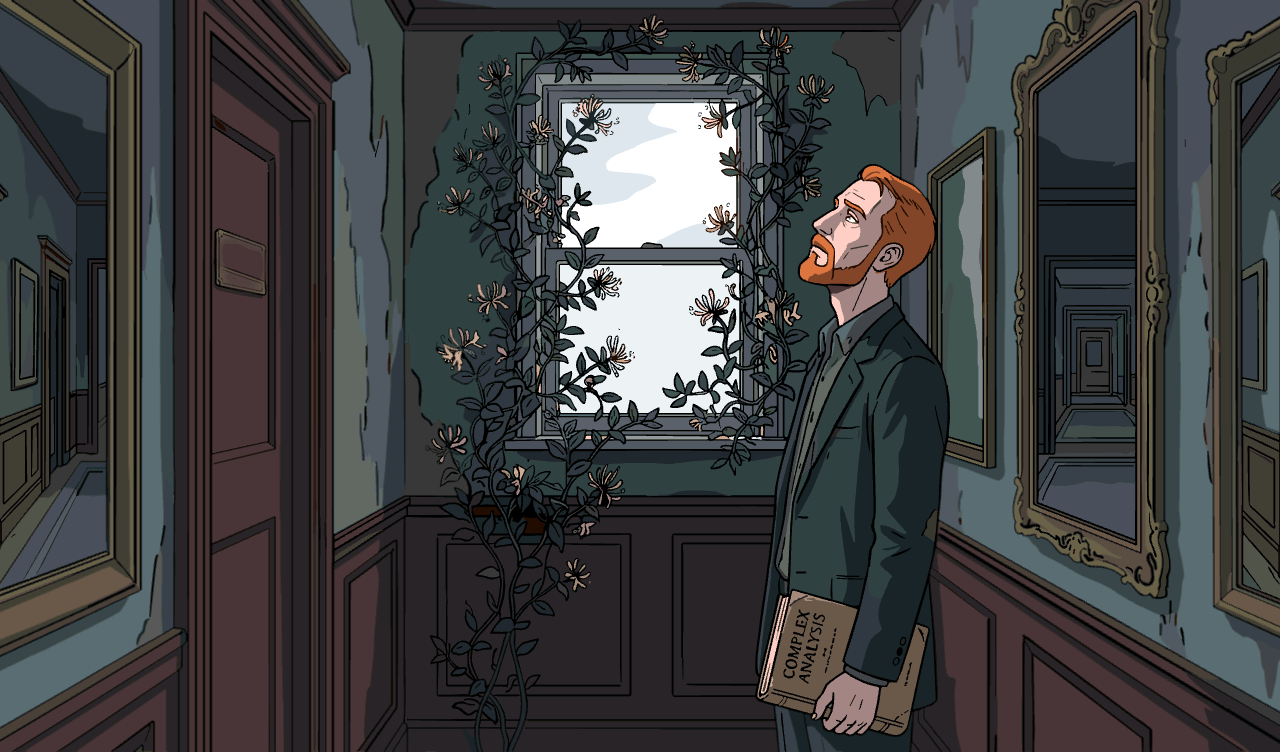
I remember him in the hotel corridor, with a math book in his hand,
sometimes looking at the irrecoverable colors of the sky.
|
.i mi vedli lo ka pu zgana lo nu ra zvati le nenri klaji be le xotli
gi'e jgari le cukta be lo cmaci le xance be ra gi'e
ta'e nai catlu le tsani noi skari lo ka ru'i cenba
|
Lo recuerdo en el corredor del hotel, con un libro de matemáticas en
la mano, mirando a veces los colores irrecuperables del cielo.
|
Я помню его в коридоре гостиницы, с учебником по математике в руке,
иногда глядящим на неповторимые цвета неба.
|
Je me le rappelle dans le couloir de l'hôtel, un livre de
mathématiques à la main, regardant parfois les couleurs
irrécupérables du ciel.
|
Mi memoras lin en la koridoro de la hotelo, kun matematika libro en
la mano, rigardante foje la neatingeblajn kolorojn de la ĉielo.
|
|
One afternoon, we discussed the duodecimal numeral system (in which
twelve is written 10).
|
.i ca pa lerci donri mi'a casnu le si'o saclu fi li pa re
(to le saclu be me'o pa no bei li pa re du le saclu be
me'o pa re bei li pa re toi)
|
Una tarde, hablamos del sistema duodecimal de numeración (en el que
doce se escribe 10).
|
Однажды днём мы обсуждали двенадцатеричную систему счисления (в
которой двенадцать записывается как 10).
|
Un après-midi, nous parlâmes du système duodécimal de numération
(dans lequel douze s'écrit 10).
|
Unu vesperon ni parolis pri duodekuma nombrosistemo (en kiu dek du
estas skribata 10).
|
|
Ashe said that he was just translating I don't know what tables
from duodecimal to sexagesimal (in which sixty is written 10).
|
.i la .ac. cusku le se du'u (to'u ri pu fanva sa'u lo
se tcidu be fi lo noi na'e jai se djuno mi vau gredile vau lo
se gerna be fi lo saclu be fi li pa no lo se gerna be fi lo saclu be
fi li xa no (to li xa no ju'u pa no du li pa no ju'u xa no
toi)
|
Ashe dijo que precisamente estaba trasladando no sé qué tablas
duodecimales a sexagesimales (en las que sesenta se escribe 10).
|
Эш сказал, что он просто переводил не знаю какие таблицы из
двенадцатеричных в шестидесятеричные (в которой шестьдесят
записывается как 10).
|
Ashe dit qu'il était précisément en train de traduire je ne
sais quelles tables duodécimales en tables sexagésimales (dans
lesquelles soixante s'écrit 10).
|
Ashe diris, ke li precize transigas iujn duodekumajn tabelojn al
sesdekumaj (en kiu sesdek estas skribata 10).
|
|
He added that this work had been entrusted to him by a Norwegian: in
Rio Grande do Sul.
|
.i le go'i cu jmina cusku le se du'u le te gunka ri te
minde le norgo bu'u la'o .braz.Rio Grande do Sul.braz.
|
Agregó que ese trabajo le había sido encargado por un noruego: en
Rio Grande do Sul.
|
Он добавил, что эту работу ему поручил норвежец: в
Риу-Гранди-ду-Сул.
|
Il ajouta que ce travail lui avait été commandé par un Norvégien,
dans le Rio Grande do Sul.
|
Li aldonis, ke tiun laboron li ricevis de norvego: en Rio Grande do
Sul.
|
|
We had known him for eight years and he had never mentioned his stay
in that region...
|
.i mi'a pu se slabu ra ze'a lo nance be li 8 .i je ra no
roi cusku su'o srana lo nu ra pu zvati bu'u bu
|
Ocho años que lo conocíamos y no había mencionado nunca su estadía
en esa región...
|
Восемь лет были мы с ним знакомы, но он никогда не упоминал о своём
пребывании в этом регионе...
|
Huit ans que nous le connaissions et il n'avait jamais
mentionné son séjour dans cette région…
|
Ok jarojn ni konis lin kaj li neniam menciis sian restadon en tiu
regiono...
|
|
We talked about pastoral life, capangas, the Brazilian etymology of
the word gaucho (which some old Uruguayans still pronounce gaúcho)
and nothing more was said - God forgive me - about duodecimal
functions.
|
.i mi'a casnu lo'e nu xabju lo nurma e lo'e jai gau
zekri e le brazo krasi be zoi zoi.gaucho.zoi. noi se fanva fi le
bankle be so'o le laldo urguuaio fu zoi zoi.gaúcho.zoi. i cusku
no drata pe (to ko fraxu mi doi cevni toi) lo'e nu fanva lo
saclu be fi li pa re
|
Hablamos de vida pastoril, de capangas, de la etimología brasilera
de la palabra gaucho (que algunos viejos orientales todavía
pronuncian gaúcho) y nada más se dijo -Dios me perdone- de funciones
duodecimales.
|
Мы говорили о пастушеской жизни, капангах [бандитах], бразильской
этимологии слова "гаучо" (которое некоторые старые
уругвайцы до сих пор произносят как gaúcho), и больше ничего не было
сказано — прости меня Господи! — о двенадцатеричных функциях.
|
Nous parlâmes de vie pastorale, de capangas, de l'étymologie
brésilienne du mot gaucho (que quelques vieux Uruguayens prononcent
encore gaoucho) et nous ne dîmes rien de plus – Dieu me pardonne –
des fonctions duodécimales.
|
Ni parolis pri pastra vivo, pri kapangaoj, pri la brazila etimologio
de la vorto "gaŭĉo" (kiun kelkaj maljunaj orientanoj
ankoraŭ prononcas "gaŭĉo") kaj nenio plu estis dirita -
Dio pardonu min - pri duodekumaj funkcioj.
|
|
In September 1937 (we were not at the hotel) Herbert Ashe died of a
ruptured aneurysm.
|
.i de'i li nanca bu 1937 masti bu 9 (to mi'a na zvati le
xotli toi) la .xerbert.ac. co'a morsi ja'e lo nu lo punli
be lo vasru be loi ciblu cu spoja
|
En setiembre de 1937 (no estábamos nosotros en el hotel) Herbert
Ashe murió de la rotura de un aneurisma.
|
В сентябре 1937 года (нас не было в отеле) Герберт Эш умер от
разрыва аневризмы.
|
En septembre 1937 (nous n'étions pas à l'hôtel) Herbert
Ashe mourut de la rupture d'un anévrisme.
|
En septembro de 1937 (ni ne estis en la hotelo) Herbert Ashe mortis
pro rumpo de aneurismo.
|
|
Days before, he had received a sealed and certified package from
Brazil.
|
.i pu la'u pa djedi be li so'o ra cpacu le pa bakfu noi se
stela gi'e se pikta
|
Días antes, había recibido del Brasil un paquete sellado y
certificado.
|
За несколько дней до этого он получил запечатанный и
проштемпелёванный пакет из Бразилии.
|
Quelques jours auparavant, il avait reçu du Brésil un paquet cacheté
et recommandé.
|
Kelkajn tagojn antaŭe, li ricevis pakaĵon el Brazilo, kun sigelo kaj
atestilo.
|
|
|
|
It was a book in large octavo.
|
.i nenri fa le pa cukta noi barda oktavo
|
Era un libro en octavo mayor.
|
Это была книга в формате ин-октаво.
|
C'était un grand in-octavo.
|
Estis libro en okavo.
|
|
Ashe left it at the bar, where - months later - I found it.
|
.i la ac cliva ra bu'u le barja noi ba la'u le masti be li
za'u mi penmi ra ke'a
|
Ashe lo dejó en el bar, donde -meses después- lo encontré.
|
Эш оставил её в баре, где - спустя несколько месяцев спустя - я её и
нашёл.
|
Ashe le laissa au bar où – plusieurs mois après – je le trouvai.
|
Ashe lasis ĝin en la bariĉjo, kie -monatojn poste- mi trovis ĝin.
|
|
I began to leaf through it and felt an astonished and light vertigo
that I will not describe, because this is not the story of my
emotions but of Uqbar and Tlön and Orbis Tertius.
|
.i mi co'a jai gau carna fai le papri gi'e manci gi'e
cinmo lo ka pu'o de'a cikna .i ai mi na skicu le nu
go'i .i ki'u bo lisri le nu mi cinmo na .e tu'a
.ukybar. joi la .tlon. joi la .orbis.tertius.
|
Me puse a hojearlo y sentí un vértigo asombrado y ligero que no
describiré, porque ésta no es la historia de mis emociones sino de
Uqbar y Tlön y Orbis Tertius.
|
Я стал её листать и почувствовал изумление и лёгкое головокружение,
которое не буду описывать, потому что это история не моих эмоций, но
Укбара, Тлёна и Орбис Терциус.
|
Je me mis à le feuilleter et j'éprouvai un vertige étonné et
léger que je ne décrirai pas, car il ne s'agit pas de
l'histoire de mes émotions, mais d'Uqbar, de Tlön et
d'Orbis Tertius.
|
Mi ekflustrumis ĝin kaj sentis mirindan kaj leviĝantan vertigon,
kiun mi ne priskribos, ĉar ĉi tiu ne estas la historio de miaj
emocioj, sed de Uqbar kaj Tlön kaj Orbis Tertius.
|
|
On a night in Islam called the Night of Nights, the secret doors of
heaven open wide and the water in the pitchers is sweeter; If those
doors were opened, I wouldn't feel what I felt that afternoon.
|
.i ca pa nicte po la islam zi'e poi se cmene "lu traji be
fi lo'i nicte li'u" le za'u sivni vorme pe le
tsani co'a kalri .ica bo le djacu poi se kabri co'i zenba
lo ka titla .i da'i .u'e ganai le vorme cu kalri gi mi
nu'o cinmo le se cnimo be mi bei ca le do'i fanmo be le
donri
|
En una noche del Islam que se llama la Noche de las Noches se abren
de par en par las secretas puertas del cielo y es más dulce el agua
en los cántaros; si esas puertas se abrieran, no sentiría lo que en
esa tarde sentí.
|
В ночь, которая в исламе называется Ночь Ночей, тайные врата рая
широко раскрываются, и вода в кувшинах становится слаще; открылись
бы эти врата, и тогда бы я не почувствовал того, что чувствовал в
тот вечер.
|
Au cours d'une nuit de l'Islam qu'on appelle la Nuit
des Nuits, les portes secrètes du ciel s'ouvrent toutes grandes
et l'eau est plus douce dans les cruches ; si ces portes
s'ouvraient, je n'éprouverais pas ce que j'éprouvai
cet après-midi-là.
|
En nokto de la Islamo nomata la Nokto de la Noktoj, la sekretaj
ĉielaj pordoj malfermiĝas larĝe kaj la akvo en la kruĉoj estas pli
dolĉa; se tiuj pordoj malfermiĝus, mi ne sentus tion, kion mi sentis
en tiu vespero.
|
|
The book was written in English and consisted of 1001 pages.
|
.i le cukta cu cukta lo jufra poi glico ku'o gi'e se papri
pa no no pa da
|
El libro estaba redactado en inglés y lo integraban 1001 páginas.
|
Книга была написана на английском языке и состояла из 1001 страницы.
|
Le livre était rédigé en anglais et comprenait 1001 pages.
|
La libro estis verkitaj en la angla kaj enhavis 1001 paĝojn.
|
|
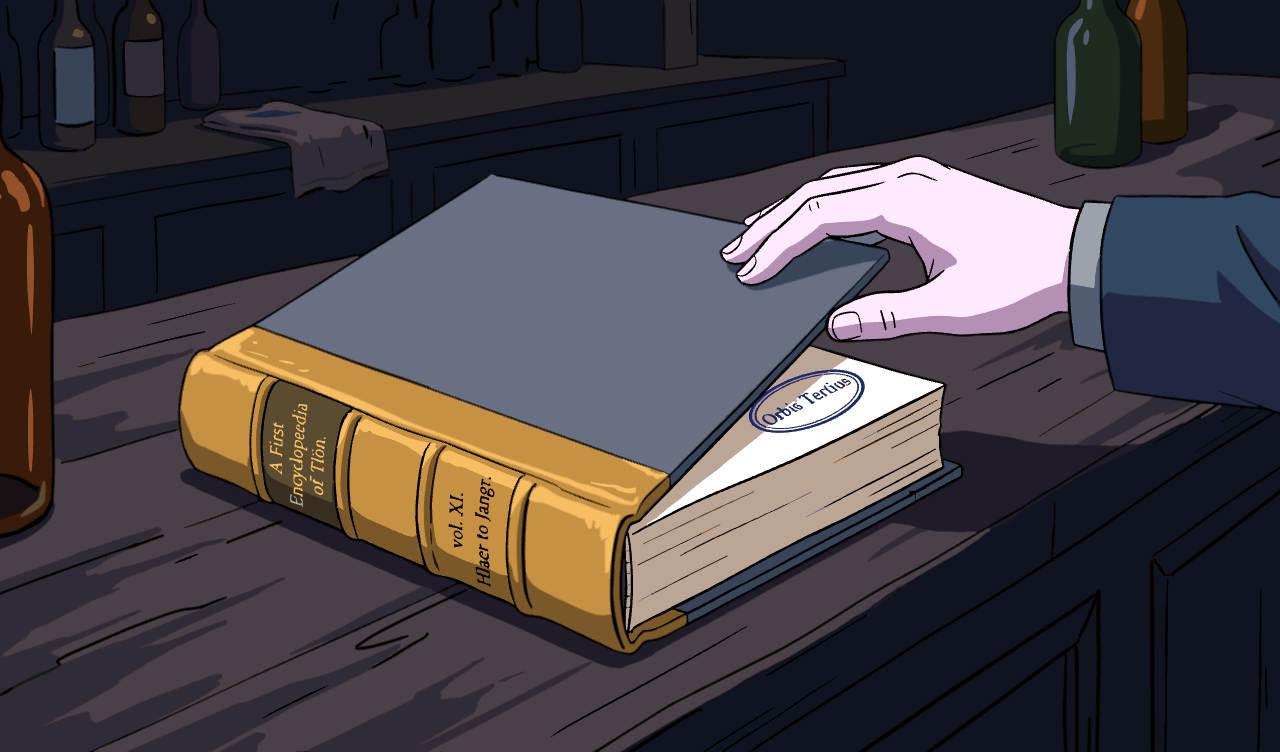
On the yellow leather spine I read these curious words that the
false cover repeated: A First Encyclopaedia of Tlön. vol. XI. Hlaer
to Jangr.
|
.i fi le pelxu skapi te bakfu fa mi tcidu le valsi ku voi ji'a
se tcidu fi le barty gacri zi'e voi du "lu pa moi skecku
la .tlon. i pa pa moi slecku fe'e co'a la'o
.latm.Hlaer.latm. fe'e co'u la'o .latm.Jangr.latm.
|
En el amarillo lomo de cuero leí estas curiosas palabras que la
falsa carátula repetía: A First Encyclopaedia of Tlön. vol. XI.
Hlaer to Jangr.
|
На жёлтом кожаном корешке я прочитал любопытные слова, которые
повторялись на суперобложке: «A First Encyclopaedia of Tlen, vol.
XI. Hlaer to Jangr» [«Первая энциклопедия Тлёна. том XI. от Хлаер до
Янгр»].
|
Sur le dos en cuir jaune je lus ces mots curieux que reproduisait le
faux frontispice : A First Encyclopœdia of Tlön. Vol. XI. Hlaer to
Jangr.
|
Sur la flavkolora leda bindo mi legis tiujn kuriozajn vortojn, kiujn
la falsa kovrilo ripetis: A First Encyclopaedia of Tlön. vol. XI.
Hlaer al Jangr.
|
|
There was no indication of date or place.
|
.i no da sinxa le detri .a le stuzi
|
No había indicación de fecha ni de lugar.
|
Не было никаких указаний ни на дату, ни на место.
|
Il n'y avait aucune indication de date ni de lieu.
|
Ne estis indiko pri dato aŭ loko.
|
|
|
|
On the first page and on a sheet of tissue paper that covered one of
the colored plates he had stamped a blue oval with this inscription:
Orbis Tertius.
|
.i fe le pamoi papri e le boxfo be loi pelji be'o poi gacri pa
le skari boxfo cu prina fa le blanu cukla e la'e zoi
.latm.Orbis Tertius.latm.
|
En la primera página y en una hoja de papel de seda que cubría una
de las láminas en colores había estampado un óvalo azul con esta
inscripción: Orbis Tertius.
|
На первой странице и на листе папиросной бумаги, покрывавшем один из
цветных листов, был напечатан синий овал с такой надписью: Orbis
Tertius [Орбис Терциус, Третий мир (лат.)].
|
À la première page et sur une feuille de papier de soie qui
recouvrait une des planches en couleurs était imprimé un ovale bleu
avec cette inscription : Orbis Tertius.
|
Sur la unua paĝo kaj sur silka papero, kiu kovris unu el la koloraj
bildoj, estis presita blua ovalo kun tiu inskribo: Orbis Tertius.
|
|
Two years ago I had discovered in a volume of a certain practical
encyclopedia a cursory description of a false country; now chance
provided me with something more precious and more arduous.
|
.i pu la'u le nanca be li re mi penmi fi le pa slecku be se
pa'u le pa tadjycku fe le tordu uencu be lo nu skicu le pa
xanri gugde .i ca ku mi se funca tu'a su'o zmadu be fi lo
ka jadni gi'e pluja
|
Hacía dos años que yo había descubierto en un tomo de cierta
enciclopedia práctica una somera descripción de un falso país; ahora
me deparaba el azar algo más precioso y más arduo.
|
Два года назад я обнаружил в одном из томов практической
энциклопедии краткое описание ложной страны; теперь случай
приготовил для меня нечто более ценное и более трудное.
|
Deux ans auparavant j'avais découvert dans un volume d'une
certaine encyclopédie pratique la description sommaire d'un
faux pays ; à présent le hasard me procurait quelque chose de plus
précieux et de plus ardu.
|
Jam du jarojn antaŭe mi malkovris en volumo de iu praktika
enciklopedio mallarĝan priskribon de falsa lando; nun hazardo donis
al mi ion pli preĝe kaj pli malfacile atingeblan.
|
|
Now I had in my hands a vast methodical fragment of the total
history of an unknown planet, with its architectures and its decks,
with the fear of its mythologies and the murmur of its languages,
with its emperors and its seas, with its minerals and its birds and
their fish, with their algebra and their fire, with their
theological and metaphysical controversy.
|
.i ca ku mi jgari fi le ka xance vau le vreji be fo lo barda bei fe
le pagbu be le satci citri be ko'a voi fange terdi .i je me lo
se terdi be ko'a fa lo finti be lo te morna be fi lo zdani fe
lo finti be lo kelci karda fa lo terpa be lo se ranmi fa lo se bangu
be lo simlu be lo ka se cmoni kei fa lo balnoltru .i je ko'a se
xamsi da gi'e te kunra gi'e terdi lo cipni e lo finpe .i
je me lo se terdi be ko'a fa lo pilno be lo algebra fa lo pilno
be lo fagri fa lo darlu tu'a lo cevni a lo se jetnu
|
Ahora tenía en las manos un vasto fragmento metódico de la historia
total de un planeta desconocido, con sus arquitecturas y sus
barajas, con el pavor de sus mitologías y el rumor de sus lenguas,
con sus emperadores y sus mares, con sus minerales y sus pájaros y
sus peces, con su álgebra y su fuego, con su controversia teológica
y metafísica.
|
Теперь у меня в руках был обширный методически составленный фрагмент
полной истории неизвестной планеты, с её архитектурой и её
игральными картами, со страхами её мифологий и бормотанием её
языков, с её императорами и её морями, с её полезными ископаемыми и
её птицами и её рыбами, с её алгеброй и её огнём, с её богословскими
и метафизическими противоречиями.
|
À présent j'avais entre les mains un vaste fragment méthodique
de l'histoire totale d'une planète inconnue, avec ses
architectures et ses querelles, avec la frayeur de ses mythologies
et la rumeur de ses langues, avec ses empereurs et ses mers, avec
ses minéraux et ses oiseaux et ses poissons, avec son algèbre et son
feu, avec ses controverses théologiques et métaphysiques.
|
Nun mi havis en la manoj vastan metodaĵon de la tuta historio de
nekonata planedo, kun ĝiaj arĥitekturoj kaj kartaroj, kun la teruro
de ĝiaj mitologioj kaj la bruado de ĝiaj lingvoj, kun ĝiaj
imperiestroj kaj maroj, kun ĝiaj mineraloj kaj birdoj kaj fiŝoj, kun
ĝia algebro kaj fajro, kun ĝia teologia kaj metafizika disputo.
|
|
All of this articulated, coherent, with no visible doctrinal purpose
or parodic tone.
|
.i le vreji cu cukta lo nu makcu je manfo lo ka ciksi te zu'e
nai za'a lo nu da krici gi'e za'a na ckasu
|
Todo ello articulado, coherente, sin visible propósito doctrinal o
tono paródico.
|
Все это чётко описано, связно, без видимой доктринального намерения
или пародийного тона.
|
Tout cela articulé, cohérent, sans aucune visible intention
doctrinale ou parodique.
|
Ĉio tio estis artikulita, kohereca, sen videbla doktrina intenco aŭ
parodia tono.
|
|
In the "eleventh volume" of which I speak there are
allusions to subsequent and preceding volumes.
|
.i le se slecku be le pa ze moi cu .anci le se slecku be le lidne .e
le se lidne
|
En el "onceno tomo" de que hablo hay alusiones a tomos
ulteriores y precedentes.
|
В «одиннадцатом томе», о котором я говорю, есть отсылки к
последующим и предыдущим томам.
|
Dans le XIe tome dont je parle, il y a des allusions à des volumes
ultérieurs et précédents.
|
En la "dek unua volumo", pri kiu mi parolas, estas aludoj
al pli postaj kaj antaŭaj volumoj.
|
|
Néstor Ibarra, in a now classic article in the N.R.F., has denied
that these companion volumes exist; Ezequiel Martínez Estrada and
Drieu La Rochelle have refuted, perhaps victoriously, that doubt.
|
.i la'o sy.Néstor Ibarra.sy. cu cusku fo lo ka te notci fi da
ne nyryfy zi'e noi nau klasiko .i go'i le se du'u
jitfa fa le du'u le za'u kansa slecku cu zasti .i
la'o sy.Ezequiel Martínez Estrada.sy. e la'o sy.Drieu La
Rochelle.sy. co'i darlu le ju'o cu'i jetnu le
di'u se xusra
|
Néstor Ibarra, en un artículo ya clásico de la N. R. F., ha negado
que existen esos aláteres; Ezequiel Martínez Estrada y Drieu La
Rochelle han refutado, quizá victoriosamente, esa duda.
|
Нестор Ибарра в уже ставшей классикой статье в N. R. F. [«Nouvelle
Ruvue Fransaise» – «Новое французское обозрение» (фр.)] отрицал
существование этих томов; Эсекьель Мартинес Эстрада и Дриё Ла Рошель
опровергли, возможно, победоносно, это сомнение.
|
Néstor Ibarra, dans un article déjà classique de la N.R.F., a nié
l'existence de ces compléments ; Ezequiel Martinez Estrada et
Drieu la Rochelle ont réfuté, peut-être victorieusement, ce doute.
|
Néstor Ibarra, en jam klasika artikolo de N. R. F., neis la ekziston
de tiuj aliaj volumoj; Ezequiel Martínez Estrada kaj Drieu La
Rochelle refutis, eble venke, tiun dubon.
|
|
The fact is that until now the most diligent inquiries have been
fruitless.
|
.i vajni ku'i fa lo nu ro pu nu sisku ca'o jalge no prali
|
El hecho es que hasta ahora las pesquisas más diligentes han sido
estériles.
|
Дело в том, что до сих пор самые усердные расследования были
безрезультатны.
|
Le fait est que jusqu'à présent les enquêtes les plus
diligentes ont été stériles.
|
La fakto estas, ke ĝis nun la plej diligentoj esploroj estis
senfruktaj.
|
|
In vain we have diarranged the libraries of the two Americas and of
Europe.
|
.i ja'e no prali mi'a jai gau kalsa fai le za'u le
sorcu be lo cukta be'o noi me le stuzi be ke'a fa le bemro
e le ketco e le ropno
|
En vano hemos desordenado las bibliotecas de las dos Américas y de
Europa.
|
Напрасно мы наводили беспорядок в библиотеках обеих Америк и Европы.
|
C'est en vain que nous avons bouleversé les bibliothèques des
deux Amériques et d'Europe.
|
Vane ni disordigis la bibliotekojn de la du Amerikoj kaj de Eŭropo.
|
|
Alfonso Reyes, fed up with these inferior fatigues of a police
nature, proposes that we all undertake the work of reconstructing
the many and massive volumes that are missing: ex ungue leonem.
|
.i la'o sy.Alfonso Reyes.sy. ja'e le nu ri tatpi le nu tai
sisku cu stidi fi mi'a fe lo ka za'u re'u finti le se
slecku be le so'i mei noi nu'o se penmi .i va'i zbasu
le cinfo le jgalu be ri
|
Alfonso Reyes, harto de esas fatigas subalternas de índole policial,
propone que entre todos acometamos la obra de reconstruir los muchos
y macizos tomos que faltan: ex ungue leonem.
|
Альфонсо Рейес, сытый по горло этими дополнительными трудами
полицейского свойства, предлогает всем нам взяться за работу по
реконструированию этих многочисленных и массивных томов, которых
теперь не хватает: ex ungue leonem [по когтю воссоздать льва
(лат.)].
|
Alfonso Reyes, excédé de ces fatigues subalternes de caractère
policier, propose qu'à nous tous nous entreprenions le travail
de reconstituer ex ungue leonem les tomes nombreux et massifs qui
manquent.
|
Alfonso Reyes, lacigita de tiuj subalternaj policaj penadoj,
proponas, ke ni ĉiuj kune ataku la laboron de rekonstrui la multajn
kaj masivajn mankantajn volumojn: ex ungue leonem.
|
|
He calculates, between truth and mockery, that a generation of
Tlönists can suffice.
|
.i ra sruma tai lo nu su'o va'e xalbo gi'e su'o
va'e ckasu vau le du'u lo nu pa da zo'u rorci
so'i tlon zei skepre poi se cecmu da cu banzu
|
Calcula, entre veras y burlas, que una generación de tlönistas puede
bastar.
|
Он рассчитал, полусерьёзно-полушутя, что одного поколения тлёнистов
может быть достаточно.
|
Il estime, sérieux et badin à la fois, qu'une génération de
tlönistes peut y suffire.
|
Li kalkulas, inter seriozeco kaj ŝerco, ke unu generacio de
tlönistoj povas sufiĉi.
|
|
That risky computation brings us back to the fundamental problem:
Who invented Tlön? The plurality is inevitable, because the
hypothesis of a single inventor - of an infinite Leibniz working in
darkness and modesty - has been unanimously discarded.
|
.i le di'u se kanji be fo lo se darsi cu bapli lo nu ma'a
za'ure'u kucli tu'a le jicmu nabmi goi la'e
"lu ma cecmu gi'e finti la tlon li'u" .i le nu
lei finti cu so'i mei na ka'e se ribvi .i ki'u bo le
sidbo be le du'u finti fa pa da noi du la leibnits pe'a
poi sivni je cumla gunka cu (to'e se zanru ro ma'a
|
Ese arriesgado cómputo nos retrae al problema fundamental: ¿Quiénes
inventaron a Tlön? El plural es inevitable, porque la hipótesis de
un solo inventor -de un infinito Leibniz obrando en la tiniebla y en
la modestia- ha sido descartada unánimemente.
|
Это смелый расчёт возвращает нас к фундаментальной проблеме: кем
были изобретатели Тлёна? Множественное число неизбежно, потому что
гипотеза единственного изобретателя — бесконечного Лейбница,
работающего во тьме и скромности, — была единогласно отброшена.
|
Ce calcul hasardeux nous ramène au problème fondamental : Qui
inventa Tlön ? Le pluriel est inévitable, car l'hypothèse
d'un seul inventeur – d'un Leibniz infini travaillant dans
les ténèbres et dans la modestie – a été écartée à l'unanimité.
|
Tiu riska kalkulo revenigas nin al la fundamenta demando: Kiu
inventis Tlön? La pluralo estas neevitebla, ĉar la hipotezo de unu
sola inventisto - de senfina Leibniz aganta en mallumo kaj modesteco
- estis unuanime forĵetita.
|
|
It is conjectured that this brave new world is the work of a secret
society of astronomers, biologists, engineers, metaphysicians,
poets, chemists, algebraists, moralists, painters, geometers...
|
.i smadi le du'u ti voi se darsi je cnino munje cu jai te gunka
fi le sivni cecmu be lo kesytadni e lo mivytadni e lo enge e lo
jetytadni e lo te pemci e lo xumtadni e lo mekytadni e lo madytadni
e lo te pixra e lo taircmacytadni e lo drata
|
Se conjetura que este brave new worldes obra de una sociedad secreta
de astrónomos, de biólogos, de ingenieros, de metafísicos, de
poetas, de químicos, de algebristas, de moralistas, de pintores, de
geómetras...
|
Предполагается, что этот brave new world [дивный новый мир (англ.)]
— работа тайного общества астрономов, биологов, инженеров,
метафизиков, поэтов, химиков, алгебраистов, моралистов, художников,
геометров...
|
On conjecture que ce brave new world est l'œuvre d'une
société secrète d'astronomes, de biologues, d'ingénieurs,
de métaphysiciens, de poètes, de chimistes, d'algébristes, de
moralistes, de peintres, de géomètres…
|
Supozas, ke tiu brave new world estas verko de sekreta societo de
astronomoj, biologoj, inĝenieroj, metafizikistoj, poetoj, kemikoj,
algebristoj, moralistoj, pentristoj, geometristoj...
|
|
directed by an obscure man of genius.
|
.i je go'i le du'u le se cecmu cu se bende pa sivni stati
|
dirigidos por un oscuro hombre de genio.
|
во главе с темным гением.
|
dirigée par un obscur homme de génie.
|
dirigitaj de mistera viro de genio.
|
|
There are plenty of individuals who master these diverse
disciplines, but not those capable of invention and even less those
capable of subordinating invention to a rigorous systematic plan.
|
.i bu'u le munje ku so'i mei fa loi prenu poi certu
tu'a la'e poi saske vau di'u ije so'u mei fa loi
tende be lo ka finti .i je me'i xo'e mei fa loi kakne be
lo ka finti lo te platu
|
Abundan individuos que dominan esas disciplinas diversas, pero no
los capaces de invención y menos los capaces de subordinar la
invención a un riguroso plan sistemático.
|
Людей, сведущих в этих различных дисциплинах, много, но немного тех,
кто способен изобретать, и ещё меньше тех, кто способен подчинить
изобретение строгому систематическому плану.
|
Les individus qui dominent ces disciplines diverses abondent, mais
non les hommes capables d'invention et moins encore ceux qui
sont capables de subordonner l'invention à un plan systématique
rigoureux.
|
Estas abundas individuoj, kiuj regas tiujn diversajn disciplinojn,
sed ne tiuj kapablaj je inventado kaj eĉ malpli tiuj kapablaj
submeti la inventadon al rigora sistema plano.
|
|
That plan is so vast that each writer's contribution is
infinitesimal.
|
.i le platu cu tai barda .i ja'e bo ro da poi me le finti
zo'u le ni vajni fa le se finti be da cu du li ji'i no
|
Ese plan es tan vasto que la contribución de cada escritor es
infinitesimal.
|
Этот план настолько обширен, что вклад каждого писателя бесконечно
мал.
|
Ce plan est si vaste que la contribution de chaque écrivain est
infinitésimale.
|
Tiu plano estas tiel vasta, ke la kontribuo de ĉiu verkisto estas
infimega.
|
|
At first Tlön was believed to be mere chaos, an irresponsible
license of the imagination; now it is known that it is a cosmos and
the intimate laws that govern it have been formulated, at least
provisionally.
|
.i ca le cfari la tlon cu te jinvi fe le du'u ri kalsa
gi'e na'e se fuzme te pikta xanri .i ku'i ka'u
bu'o nau ku le go'i cu te jinvi fe le du'u munje fi
le se skicu be fo lo rauva'e
|
Al principio se creyó que Tlön era un mero caos, una irresponsable
licencia de la imaginación; ahora se sabe que es un cosmos y las
íntimas leyes que lo rigen han sido formuladas, siquiera en modo
provisional.
|
Сначала Тлён считался просто хаосом, безответственной вольностью
воображения; теперь известно, что это космос, и сокровенные законы,
управляющие им, сформулированы, хотя бы условно.
|
Au début, on crut que Tlön était un pur chaos, une irresponsable
licence de l'imagination ; on sait maintenant que c'est un
cosmos, et les lois intimes qui le régissent ont été formulées, du
moins provisoirement.
|
Komence oni kredis, ke Tlön estas nur kaoso, senzorga permeso de la
imagpovo; nun oni scias, ke ĝi estas kosmo kaj la intimaj leĝoj,
kiuj regas ĝin, estas formulis, eĉ se nur provizore.
|
|
Let it suffice for me to recall that the apparent contradictions of
the Eleventh Volume are the fundamental stone of the proof that the
others exist: so lucid and so just is the order that has been
observed in it.
|
.i .ei be'u cu'i mi za'u re'u xusra le du'u
le sinxa be lo natfe be'o pe le se slecku be le pa pa moi cu
jicmu je nibli lo nu lo drata slecku cu zasti .i le se go'i cu
jetnu lo du'u tai sampu gi'e tai prane vau fa le stura pe
le se slecku zi'e poi ka'e se zgana
|
Básteme recordar que las contradicciones aparentes del Onceno Tomo
son la piedra fundamental de la prueba de que existen los otros: tan
lúcido y tan justo es el orden que se ha observado en él.
|
Мне достаточно напомнить, что кажущиеся противоречия одиннадцатого
тома являются краеугольным камнем доказательства существования
остальных: настолько ясен и справедлив порядок, который в нем
наблюдается.
|
Qu'il me suffise de rappeler que l'ordre observé dans le
XIe tome est si lucide et si juste que les contradictions apparentes
de ce volume constituent la pierre angulaire de la preuve que les
autres existent.
|
Sufiĉas rememori, ke la ŝajnaj kontraŭdiroj de la Dekunua Tomo estas
la fundamenta ŝtono de la pruvo, ke ekzistas la aliaj: tiel klara
kaj justa estas la ordo, kiu estas observita en ĝi.
|
|
The popular magazines have divulged, with pardonable excess, the
zoology and the topography of Tlön; I think that their transparent
tigers and their towers of blood do not deserve, perhaps, the
continuous attention of all men.
|
.i so'i da misno gi'e te fraxu cafne karni cu se pagbu
su'o artigo be loi jmive pe la tlon ge'u e loi stuzi pe ri
.i pe'i loi blaci tirxu pe la tlon ge'u e loi vi'i
ve'u dinju vasru be loi ciblu na ju'o cu'i jerna lo
ka ranji se jundi loi prenu
|
Las revistas populares han divulgado, con perdonable exceso, la
zoología y la topografía de Tlön; yo pienso que sus tigres
transparentes y sus torres de sangre no merecen, tal vez, la
continua atención de todos los hombres.
|
Популярные журналы сделали всеобщим достоянием, с простительным
излишеством, зоологию и топографию Тлёна; я думаю, что его
прозрачные тигры и кровавые башни, возможно, не заслуживают
постоянного внимания всех людей.
|
Les revues populaires ont divulgué, avec un excès pardonnable, la
zoologie et la topographie de Tlön ; je pense que ses tigres
transparents et ses tours de sang ne méritent pas, peut-être,
l'attention continuelle de tous les hommes.
|
Popularaj revuoj troe disvastigis la zoologion kaj la topografion de
Tlön; mi pensas, ke ĝiaj tralumaj tigroj kaj ĝiaj sango-turoj eble
ne meritas la daŭran atenton de ĉiuj homoj.
|
|
I dare to ask for a few minutes for your concept of the universe.
|
.i e'o mi zi le mentu be li so'u mo'u ciksi le sidbo
be le munje
|
Yo me atrevo a pedir unos minutos para su concepto del universo.
|
Осмелюсь попросить несколько минут для его представления о
Вселенной.
|
J'ose demander quelques minutes pour exposer sa conception de
l'univers.
|
Mi kuraĝas peti kelkajn minutojn por via koncepto pri la universo.
|
|
Hume noted for all time that Berkeley's arguments did not admit
of the slightest rebuttal and do not cause the slightest conviction.
|
.i la'o gy.Hume.gy. cusku fi ro jai balvi fe lo se du'u le
se xusra be la'oi gy.Berkeley.gy. na ka'e natfe gi'e
na ka'e su'o va'e lo ka se birti
|
Hume notó para siempre que los argumentos de Berkeley no admiten la
menor réplica y no causan la menor convicción.
|
Юм заметил на все времена, что аргументы Беркли не допускают ни
малейшего опровержения и не вызывают ни малейшей убежденнности.
|
Hume nota pour toujours que les arguments de Berkeley
n'admettaient pas la moindre réplique et n'entraînaient
pas la moindre conviction.
|
Hume por ĉiam rimarkis, ke la argumentoj de Berkeley ne toleras la
plej malgrandan riproĉon kaj ne kaŭzas la plej malgrandan konvinkon.
|
|
This opinion is completely true in its application to the earth;
completely false in Tlön.
|
.i le se go'i noi se jinvi cu jetnu tu'a la ted gi'e
ku'i jitfa tu'a la tlon
|
Ese dictamen es del todo verídico en su aplicación a la tierra; del
todo falso en Tlön.
|
Это мнение совершенно верно примененительно к Земле; совершенно
ложно к Тлёну.
|
Cette opinion est tout à fait juste quand on l'applique à la
terre ; tout à fait fausse dans Tlön.
|
Tiu juĝo estas tute vera en ties apliko al la tero; tute malvera en
Tlön.
|
|
The nations of that planet are - congenitally - idealist.
|
.i lo'e se terdi be ra pu ze'e djuno fo lo po'o xanri
|
Las naciones de ese planeta son -congénitamente- idealistas.
|
Народы той планеты - от рождения - идеалисты.
|
Les peuples de cette planète sont – congénitalement – idéalistes.
|
La nacioj de tiu planedo estas -de naskiĝo- idealistaj.
|
|
Their language and the derivations of his language - religion,
letters, metaphysics - presuppose idealism.
|
.i le bangu be le go'i fa le se krasi be le bangu be'oi
noi lo lijda e lo lerfu e lo jetyske cu me ke'a cu se jicmu le
si'o djuno fo lo xanri
|
Su lenguaje y las derivaciones de su lenguaje -la religión, las
letras, la metafísica- presuponen el idealismo.
|
Его язык и производные от его языка — религия, литература,
метафизика — предполагают идеализм.
|
Leur langage et les dérivations de celui-ci – la religion, les
lettres, la métaphysique – présupposent l'idéalisme.
|
Ilia lingvo kaj la deriviĝoj de ilia lingvo -la religio, la
literaturo, la metafiziko- supozas la idealismon.
|
|
The world for them is not a contest of objects in space; it is a
heterogeneous series of independent acts.
|
.i le munje be ga'a le go'i na du lo'i te jivna be fi
lo dacti bu'u lo canlu gi'e ku'i du lo'i nu
zukte poi vrici zi'e poi simxu lo ka na rinka
|
El mundo para ellos no es un concurso de objetos en el espacio; es
una serie heterogénea de actos independientes.
|
Мир для них — это не состязание объектов в пространстве; это
разнородный ряд независимых действий.
|
Pour eux, le monde n'est pas un ensemble d'objets dans
l'espace ; c'est une série hétérogène d'actes
indépendants.
|
La mondo por ili ne estas konkuro de objektoj en la spaco; ĝi estas
miksita serio de sendependaj agoj.
|
|
It is successive, temporal, not spatial.
|
.i ri stura lo te porsi be lo ka balvi gi'a cabna kei e nai
lo'i se canlu
|
Es sucesivo, temporal, no espacial.
|
Он последовательный, временной, а не пространственной.
|
Il est successif, temporel, non spatial.
|
Ĝi estas sinsekva, tempa, ne spaca.
|
|
There are no nouns in Tlön's conjectural Ursprache, from which
the "current" languages and dialects are derived: there
are impersonal verbs, qualified by monosyllabic suffixes (or
prefixes) of adverbial value.
|
.i le dzena be ro za'e ca bangu be bu'u la tlon na se
gerna tu'a lo sumti valsi .i ku'i pilno lo lujvo poi
brisni fi lo porsi be fi lo se cmima be no cmebasti zi'e poi se
li'enrafsi be pa slaka gi'e se selyli'enrafsi be ri
|
No hay sustantivos en la conjetural Ursprache de Tlön, de la que
proceden los idiomas "actuales" y los dialectos: hay
verbos impersonales, calificados por sufijos (o prefijos)
monosilábicos de valor adverbial.
|
Отсутствуют существительные в предполагаемом Ursprache [праязык
(нем.)] Тлёна, от которого прроисходят «нынешние» языки и диалекты:
есть безличные глаголы, определяемые односложными суффиксами (или
префиксами) наречного значения.
|
Il n'y a pas de substantifs dans la conjecturale Ursprache de
Tlön, d'où proviennent les langues « actuelles » et les
dialectes : il y a des verbes impersonnels, qualifiés par des
suffixes (ou des préfixes) monosyllabiques à valeur adverbiale.
|
En la konjektita Ursprache de Tlön ne ekzistas substantivoj, el kiuj
devenas la "nunaj" lingvoj kaj dialektoj: estas
senpersonaj verboj, kvalifitaj per monosilabaj sufiksoj (aŭ
prefiksoj) kun adverba signifo.
|
|
For example: there is no word that corresponds to the word
"moon", but there is a verb that would be in English would
be "to moon" or "to moonate." "The moon
arose over the river" is said "hlör u fang axaxaxas
mlö" that is, in its order: "upward behind the
lasting-flow mooned". (Xul Solar briefly translates it as: up
after onflowingly moonated).
|
.i mu'a no da valsi lo ka lunra .i ku'i su'o da gismu
lo ka ca'o lunra gi'a ca'a lunra .i "lu le lunra
co'a galtu fi le rirxe" cu se fanva fu zoi .tlon.hlör u
fang axaxaxas mlö.tlon. noi simsa fi tu'a le porsi fe "lu
mo'i ga'u (to ti'a ru'i flecu toi) mluni
li'u" (to la xul.solar. pu sutra fanva ra fu "lu
fi'o galtu fi'o trixe fi'o flecu ca'o lunra toi)
|
Por ejemplo: no hay palabra que corresponda a la palabra luna, pero
hay un verbo que sería en español lunecer o lunar. "Surgió la
lunasobre el río" se dice "hlör u fang axaxaxas
mlö" o sea en su orden: hacia arriba (upward) detrás
duradero-fluir luneció. (Xul Solar traduce con brevedad: upa tras
perfluyue lunó).
|
Например: нет слова, которое соответствовало бы слову
"луна", но есть глагол, который был бы по-русски
"лунировать" или "лунеть". "Луна взошла над
рекой", переводится как "hlör u fang axaxaxas mlö",
то есть по порядку: вверху позади истечения лунировало. (Xul Solar
кратко перевёл это "наверху позади поточно залунело").
|
Par exemple : il n'y a pas de mot qui corresponde au mot lune,
mais il y a un verbe qui serait en français lunescer ou luner. La
lune surgit sur le fleuve se dit hlör u fang axaxaxas mlö soit, dans
l'ordre : vers le haut (upward) après une fluctuation
persistante, il luna. (Xul Solar traduit brièvement : il
hop-après-fluence-luna. Upward, behind the onstreaming it mooned.)
|
Ekzemple: ne ekzistas vorto, kiu korespondus al la vorto
"luno", sed estas verbo, kiu estus en la hispana
"lunecer" aŭ "lunar". "La luno leviĝis
super la rivero" estas dirata "hlör u fang axaxaxas
mlö", tio estas en sia ordo: supren malantaŭ daŭra-flui
lunecis. (Xul Solar tradukas mallonge: supre malantaŭ perfluis
lunis).
|
|
The above refers to the languages of the southern hemisphere.
|
.i la'e di'u srana le za'u bangu be tu'a le
snanu plinyxadba
|
Lo anterior se refiere a los idiomas del hemisferio austral.
|
Вышеизложенное относится к языкам южного полушария.
|
Ce qui précède se rapporte aux langues de l'hémisphère austral.
|
La antaŭaĵo rilatas al la lingvoj de la suda
|
|
In those of the northern hemisphere (of whose Ursprache there are
very few data in the Eleventh Volume) the primordial unit is not the
verb, but the monosyllabic adjective.
|
.i lo'e bangu be tu'a le berti plinyxadba be'o noi
so'u da vreji fo le pa pa moi slecku cu se jicmu lo'e
valsi be lo ka fasnu kei na .e lo'e valsi be lo ka se jinzi
be'o poi se pagbu pa slaka
|
En los del hemisferio boreal (de cuya Ursprache hay muy pocos datos
en el Onceno Tomo) la célula primordial no es el verbo, sino el
adjetivo monosilábico.
|
В языках северного полушария (о которых в одиннадцатом томе
Ursprache очень мало информации) первичным элементом является не
глагол, а односложное прилагательное.
|
Pour celles de l'hémisphère boréal (sur l'Ursprache duquel
il y a fort peu de renseignements dans le XIe tome) la cellule
primordiale n'est pas le verbe, mais l'adjectif
monosyllabique.
|
En la norda hemisfero (pri kies Ursprache ekzistas tre malmultaj
informoj en la Onzecan Volumon), la unuaĵo ne estas la verbo, sed la
unusilaba adjektivo.
|
|
The noun is formed by accumulation of adjectives.
|
.i le'e za'e sumti cu se zbasu fe loi valsi be lo steci
|
El sustantivo se forma por acumulación de adjetivos.
|
Существительное образуется путём накопления прилагательных.
|
Le substantif se forme par une accumulation d'adjectifs.
|
La substantivo formas per akumulado de adjektivoj.
|
|
"Moon" is not said: it is said "air-light over
dark-round" or "orange-dim-of-the-sky" or some other
aggregation.
|
.i lu'i le lunra na se cusku .i cusku "lu se kai vacri
gusni ne'i le se kai manku cukla li'u" a "lu
narju kandi co tsani li'u" a su'o drata gunma
|
No se dice luna: se dice aéreo-claro sobre
oscuro-redondo o anaranjado-tenue-del cielo o cualquier otra
agregación.
|
Не говорят "луна": говорят "воздушно-чистое на
темно-круглом или рыже-тусклом-неба" или какое-нибудь другое
сочетание.
|
On ne dit pas lune, mais aérien-clair-sur-rond-obscur ou
orangé-ténu-du-ciel ou n'importe quelle autre combinaison.
|
Oni ne diras luno: oni diras aera-hela super malhela-ronda aŭ
oranĝa-malhel-hela de la ĉielo aŭ ian ajnan aldonon.
|
|
In the case selected, the mass of adjectives corresponds to a real
object; but this is purely fortuitous.
|
.i "lu bu zo'u le tanru cu sinxa su'o zasti dacti .i
ku'i le nu go'i cu cunso
|
En el caso elegido la masa de adjetivos corresponde a un objeto
real; el hecho es puramente fortuito.
|
В данном случае масса прилагательных соответствует реальному
предмету; но это чистая случайность.
|
Dans le cas choisi, la masse d'adjectifs correspond à un objet
réel ; le fait est purement fortuit.
|
En la elektita kazo, la amaso de adjektivoj kongruas kun reala
objekto; la fakto estas pure hazarda.
|
|
In the literature of this hemisphere (as in Meinong's
subsistent world) ideal objects abound, summoned and dissolved in a
moment, according to poetic needs.
|
.i ro da ganai prosa fi le xabju be le di'u plinyxadba gi prosa
lo simsa be le jinzi munje ne fi'e la meinong bei lo ka se
zasti le tarmi poi zasni lo ka gau lo te pemci co'a ja
co'u zasti
|
En la literatura de este hemisferio (como en el mundo subsistente de
Meinong) abundan los objetos ideales, convocados y disueltos en un
momento, según las necesidades poéticas.
|
В литературе этого полушария (как и в субстанциональном мире
Мейнонга) изобилуют идеальные объекты, которые возникают и исчезают
в одно мгновение, в соответствии с поэтическими потребностями.
|
Dans la littérature de cet hémisphère (comme dans le monde
subsistant de Meinong) abondent les objets idéaux, convoqués et
dissous en un moment, suivant les besoins poétiques.
|
En la literaturo de tiu hemisfero (kiel en la daŭra mondo de
Meinong) abundas laj idealaj objektoj, konvokitaj kaj disfanditaj en
momento, laŭ poeziaj bezonoj.
|
|
They are determined, sometimes, by mere simultaneity.
|
.i ka'u dunda lo ka se cmene lu'o lo simxu be lo ka cabna
sa'u
|
Los determina, a veces, la mera simultaneidad.
|
Иногда они определяются простой одновременностью.
|
Ils sont quelquefois déterminés par la pure simultanéité.
|
Ili estas determinataj, kelkfoje, nur de samtempo.
|
|
There are objects composed of two terms, one visual and the other
auditory: the color of the sunrise and the remote cry of a bird.
|
.i ka'u su'o da tarmi loi re de ku noi du lu'o lo se
viska ce lo se tirna vu'o noi mu'a du lo skari be lo ka
tolfarlu solri be'o ce lo sance be lo ka darno nu lo cipni cu
cmoni
|
Hay objetos compuestos de dos términos, uno de carácter visual y
otro auditivo: el color del naciente y el remoto grito de un pájaro.
|
Есть предметы, состоящие из двух понятий, одного зрительного и
другого слухового: цвет восхода солнца и отдалённый крик птицы.
|
Il y a des objets composés de deux termes, l'un de caractère
visuel et l'autre auditif : la couleur de l'aurore et le
cri lointain d'un oiseau.
|
Estas objektoj kunmetitaj el du terminoj, unu de vizuala karaktero
kaj la alia de aŭda: la koloro de la leviĝo kaj la malproksima krio
de birdo.
|
|
There are of many terms: the sun and the water against the
swimmer's chest, the vague tremulous pink that can be seen with
closed eyes, the sensation of one who is carried away by a river and
also by sleep.
|
.i su'o da tarmi loi so'i de .i mu'a tarmi lo solri
joi loi djacu poi lamji lo cutne be lo limna .i ja tarmi lo
na'e klani je slilu xunblabi poi ka'e se zgana fi lo ka se
kanla lo ganlo .i ja tarmi lo se lifri be su'o da poi ke'a
ri'a tu'a lo rirxe lu'u a lo nu ke'a co'a
sipna kei ca'o co'u jundi
|
Los hay de muchos: el sol y el agua contra el pecho del nadador, el
vago rosa trémulo que se ve con los ojos cerrados, la sensación de
quien se deja llevar por un río y también por el sueño.
|
Есть объекты, состоящие из многих: солнце и вода на груди пловца,
смутный трепещущий розовый цвет, видимый при закрытых глазах,
ощущение, что тебя уносит река, а также сон.
|
Il y en a de nombreux : le soleil et l'eau contre la poitrine
du nageur, le rose vague et frémissant que l'on voit les yeux
fermés, la sensation de quelqu'un qui se laisse emporter par un
fleuve et aussi par le rêve.
|
Estas multaj el ili: la suno kaj la akvo kontraŭ la brusto de
naĝanto, la vaga tremanta rozkoloro, kiu estas vidata per fermaj
okuloj, la sento de tiu, kiu estas portata de rivero kaj ankaŭ de
dormo.
|
|
Those second-degree objects can be combined with others; the
process, by certain abbreviations, is practically infinite.
|
.i ka'u le tai dacti noi se dzena fi lo ka efku fi li re
ta'e simxu lo ka kansa .i pruce fo tu'a lo tordu krati be
lo jufra gi'e cimni to'u
|
Esos objetos de segundo grado pueden combinarse con otros; el
proceso, mediante ciertas abreviaturas, es prácticamente infinito.
|
Эти объекты второй степени можно комбинировать с другими; процесс, с
помощью определённых сокращений, практически бесконечен.
|
Ces objets au second degré peuvent se combiner avec d'autres ;
le processus, au moyen de certaines abréviations, est pratiquement
infini.
|
Tiuj objektoj de dua grado povas kombiniĝi kun aliaj; la procezo,
per certaj mallongigoj, estas praktike senfina.
|
|
There are famous poems composed of a single huge word.
|
.i za'u da miskempavyvlapemci
|
Hay poemas famosos compuestos de una sola enorme palabra.
|
Есть известные поэмы, состоящие из одного огромного слова.
|
Il y a des poèmes fameux composés d'un seul mot énorme.
|
Estas famaj poemoj, kiuj konsistas el unu sola enorma vorto.
|
|
This word integrates a poetic object created by the author.
|
.i le tai lujvo cu sinxa lo dacti poi ke'a se finti lo te pemci
be ke'a
|
Esta palabra integra un objeto poético creado por el autor.
|
В этом слове интегрируется поэтический объект, созданный автором.
|
Ce mot intègre un objet poétique créé par l'auteur.
|
Tiu vorto formas poezian objekton, kreitan de la verkisto.
|
|
The fact that no one believes in the reality of nouns makes,
paradoxically, their number endless.
|
.i le du'u no da pe bu'u ra krici tu'a lo'e
fasnu poi fatri xanri cu se jalge lo nu le lujvo cu klani li
ci'i
|
El hecho de que nadie crea en la realidad de los sustantivos hace,
paradójicamente, que sea interminable su número.
|
Тот факт, что никто не верит в реальность существительных,
парадоксальным образом делает их число бесконечным.
|
Le fait que personne ne croie à la réalité des substantifs rend,
paradoxalement, leur nombre interminable.
|
La fakto, ke neniu kredas je la realo de substantivoj, paradokse,
igas ilian nombron senfina.
|
|
The languages of Tlön's northern hemisphere possess all the
nouns of the Indo-European languages and many others.
|
.i lo'e bangu be tu'a le berti plinyxadba be la tlon cu
simsa lo'e xindo je ropno bangu lo ka se gerna tu'a
lo'e po'o nai sumti valsi poi se smuni le'e se slabu
be mi'o
|
Los idiomas del hemisferio boreal de Tlön poseen todos los nombres
de las lenguas indoeuropeas y otros muchos más.
|
Языки северного полушария Тлёна обладают всеми существительными
индоевропейских языков и многими другими.
|
Les langues de l'hémisphère boréal de Tlön possèdent tous les
noms des langues indo-européennes – et bien d'autres encore.
|
La lingvoj de la norda hemisfero de Tlön havas ĉiujn nomojn de la
indoeŭropaj lingvoj kaj multajn aliajn.
|
|
It is no exaggeration to say that the classical culture of Tlön
comprises only one discipline: psychology.
|
.i ba'u cu'i le klasiko kulnu be la tlon cu se pagbu pa
saske noi du le menske
|
No es exagerado afirmar que la cultura clásica de Tlön comprende una
sola disciplina: la psicología.
|
Не будет преувеличением сказать, что классическая культура Тлёна
включает в себя только одну дисциплину: психологию.
|
Il n'est pas exagéré d'affirmer que la culture classique
de Tlön comporte une seule discipline : la psychologie.
|
Ne estas troa aserto diri, ke la klasika kulturo de Tlön enhavas nur
unu disciplinon: psikologion.
|
|
The others are subordinate to it.
|
.i ri se vipsi le drata
|
Las otras están subordinadas a ella.
|
Остальные подчинены ей.
|
Les autres lui sont subordonnées.
|
La aliaj estas subordigitaj al ĝi.
|
|
I have said that the men of that planet conceive the universe as a
series of mental processes, which do not develop in space but
successively in time.
|
.i ke'u lo'e se terdi be ra cu jijnu fi le munje fe lo ka
porsi fi lo'i pruce be fo lo'i se pensi fe lo ka na sepli
fi lo canlu gi'e balvi jo purci
|
He dicho que los hombres de ese planeta conciben el universo como
una serie de procesos mentales, que no se desenvuelven en el espacio
sino de modo sucesivo en el tiempo.
|
Я уже говорил, что люди этой планеты представляют себе вселенную как
серию ментальных процессов, разворачивающихся не в пространстве, а
последовательно во времени.
|
J'ai dit que les hommes de cette planète conçoivent
l'univers comme une série de processus mentaux, qui ne se
développent pas dans l'espace mais successivement dans le
temps.
|
Mi diris, ke la homoj de tiu planedo konceptas la universon kiel
serion de mensaj procezoj, kiuj ne okazas en spaco, sed sukcesas en
tempo.
|
|
Spinoza attributes to his inexhaustible divinity the attributes of
extension and thought; nobody would understand in Tlön the
juxtaposition of the first (which is only typical of certain states)
and the second - which is a perfect synonym of the cosmos -.
|
.i la spinoza pu xusra le du'u le vitno cevni pe le nei cu
ckaji lo ka se canlu e lo ka pensi .i no prenu pe la tlon pu jimpe
le du'u makau te frica lo ka se canlu noi nalkau ku'o lo
ka pensi noi ka munje
|
Spinoza atribuye a su inagotable divinidad los atributos de la
extensión y del pensamiento; nadie comprendería en Tlön la
yuxtaposición del primero (que sólo es típico de ciertos estados) y
del segundo -que es un sinónimo perfecto del cosmos-.
|
Спиноза приписывает своему неисчерпаемому божеству атрибуты
протяжённости и мысли; никто не понял бы в Тлёне противопоставления
первого (что характерно лишь для определённых состояний) и второго,
являющегося совершенным синонимом космоса.
|
Spinoza attribue à son inépuisable divinité les attributs de
l'étendue et de la pensée ; personne dans Tlön ne comprendrait
la juxtaposition du premier (qui est seulement typique de certains
états) et du second – qui est un synonyme parfait du cosmos.
|
Spinozo atribuas al sia senelstara dio la atributojn de etendo kaj
pensado; en Tlön neniu komprenus la kunmeton de la unua (kiu estas
nur karakteriza por certaj statoj) kaj de la dua - kiu estas
perfekta sinonimo de la kosmo-.
|
|
In other words, they do not conceive that the spatial endures in
time.
|
.i va'i le prenu na sruma le du'u su'o se canlu cu
renvi su'o da su'o de
|
Dicho sea con otras palabras: no conciben que lo espacial perdure en
el tiempo.
|
Другими словами, они не представляют себе пространственное как
протяжённое во времени.
|
Soit dit en d'autres termes : ils ne conçoivent pas que le
spatial perdure dans le temps.
|
Dirite per aliaj vortoj: ili ne konceptas, ke la spaca daŭro estas
en la tempo.
|
|
The perception of a cloud of smoke on the horizon and then of the
burning field and then of the half-extinguished cigarette that
produced the blaze is considered an example of association of ideas.
|
.i lo ka ganse lo smoka be bu'u lo tankoi be'o joi lo
foldi poi ca'o jelca joi loi sigja poi pu'o co'u
jelca cu mupli lo ka te sidbo lo gunma
|
La percepción de una humareda en el horizonte y después del campo
incendiado y después del cigarro a medio apagar que produjo la
quemazón es considerada un ejemplo de asociación de ideas.
|
Восприятие дыма на горизонте, а затем горящего поля, а затем
полупотушенной сигареты, которая произвела горение, считается
примером ассоциации идей.
|
La perception d'une fumée à l'horizon, puis du champ
incendié, puis de la cigarette à moitié éteinte qui produisit le
feu, est considérée comme un exemple d'association
d'idées.
|
La percepto de fumingo en la horizonto kaj poste de la bruligita
kampo kaj poste de la duonfuma cigaredo, kiu kaŭzis la bruladon,
estas konsiderata kiel ekzemplo de ideo-asocio.
|
|
This monism or complete idealism invalidates all science.
|
.i le tai jetnu be lo du'u loi ro da pa mei a lo du'u
ka'e djuno fi lo po'o xanri cu natfe lo du'u lo saske
cu xamgu
|
Este monismo o idealismo total invalida la ciencia.
|
Этот тотальный монизм или идеализм обесценивает науку.
|
Ce monisme ou idéalisme total invalide la science.
|
Ĉi tiu monismo aŭ tuta idealismo nuligas la sciencon.
|
|
To explain (or judge) a fact is to link it to another; such linkage,
in Tlön, is a later state of the subject, which cannot affect or
illuminate the previous state.
|
.i fi'o se tcaci ra ro da poi fasnu zo'u lo ka ciksi
gi'a pajni vau da cu ka facki lo du'u da ckini makau .i je
lo nu tai facki cu balvi da gi'e na ka'e ku galfi
gi'a bo ciksi vau da noi purci
|
Explicar (o juzgar) un hecho es unirlo a otro; esa vinculación, en
Tlön, es un estado posterior del sujeto, que no puede afectar o
iluminar el estado anterior.
|
Объяснить (или определить) один факт — значит связать его с другим;
эта связь, по Тлёну, есть более позднее состояние субъекта, которое
не может повлиять на предыдущее состояние или прояснить его.
|
Expliquer (ou juger) un fait c'est l'unir à un autre ; cet
enchaînement, dans Tlön, est un état postérieur du sujet, qui ne
peut affecter ou éclairer l'état antérieur.
|
Espliki (aŭ juĝi) fakton signifas ligi ĝin kun alia; tiu ligo, en
Tlön, estas posta stato de la subjekto, kiu ne povas afekti aŭ
lumigi la antaŭan staton.
|
|
Every mental state is irreducible: the mere fact of naming it -
i.e., of classifying it - imports a falsification.
|
.i ro da poi nu pensi cu na ka'e zenba lo ka tordu .i je
ji'a lo nu te cmene da noi va'i nu pajni lo du'u da
cmima lo te girzu be ma kau cu nu ciksi fo lo jitfa
|
Todo estado mental es irreductible: el mero hecho de nombrarlo -id
est, de clasificarlo- importa un falseo.
|
Каждое ментальное состояние ни к чему не сводимо: сам факт его
наименования, то есть его классификации, вносит искажение.
|
Tout état mental est irréductible : le simple fait de le nommer – id
est, de le classer – implique une falsification.
|
Ĉiu menso-stato estas nedividigebla: la simpla fakto de nomi ĝin
-t.e., klasifiki ĝin- signifas falsigon.
|
|
From this it could be deduced that there are no sciences in Tlön -
not even reasoning.
|
.i va'i da'i nibli lo nu no da saske bu'u la tlon e
lo ji'a nu no de nu jinvi
|
De ello cabría deducir que no hay ciencias en Tlön -ni siquiera
razonamientos.
|
Отсюда можно было бы заключить, что в Тлёне нет наук, даже
рассуждений.
|
On pourrait en déduire qu'il n'y a pas de sciences dans
Tlön – ni même de raisonnements.
|
El tio sekvas, ke ne ekzistas sciencoj en Tlön -eĉ ne raciokalkuloj.
|
|
The paradoxical truth is that they exist, in almost innumerable
numbers.
|
.i ranxi fa lo nu lei saske cu su'o mei gi'e sa'e
ci'i mei
|
La paradójica verdad es que existen, en casi innumerable número.
|
Парадоксальная истина заключается в том, что они есть, причём в
почти бесчисленном количестве.
|
La vérité paradoxale est qu'elles existent, en nombre presque
innombrable.
|
La paradoksa vero estas, ke ili ekzistas, en preskaŭ nesekretebla
nombro.
|
|
What happens with philosophies happens with nouns in the northern
hemisphere.
|
.i ro tcini be lo'e saske be lo jetnu cu tcini lo'e sumti
valsi pe le berti plinyxadba
|
Con las filosofías acontece lo que acontece con los sustantivos en
el hemisferio boreal.
|
С философскими учениями происходит то же, что с существительными в
северном полушарии.
|
Pour les philosophies il en va de même que pour les substantifs dans
l'hémisphère boréal.
|
Filozofioj okazas same kiel substantivoj en la norda hemisfero.
|
|
The fact that every philosophy is by definition a dialectical game,
a Philosophie des Als Ob, has contributed to multiplying them.
|
.i le du'u ro saske be lo jetnu cu se smuni lo ka nunkei darlu
gi'e va'i me la'o dotc.Philosophie des Als Ob.dotc.
noi se fanva fu "lu saske be lo tarmi be lo xanri jetnu cu se
jalge lo nu lei saske cu zenba lo ka xo kau mei
|
El hecho de que toda filosofía sea de antemano un juego dialéctico,
una Philosophie des Als Ob, ha contribuido a multiplicarlas.
|
Тот факт, что каждая философия - это диалектическая игра, этакая
Philosophie des Als Ob [философия Как Если Бы (нем).], способствовал
умножению их количества.
|
Le fait que toute philosophie soit a priori un jeu dialectique, une
Philosophie des Als Ob, a contribué à les multiplier.
|
La fakto, ke ĉiu filozofio estas antaŭe dialektika ludo, Philosophie
des Als Ob, kontribuis al ilia multiplikiĝo.
|
|
There is an abundance of incredible systems, but either nicely
architectured or of sensational type.
|
.i so'i da cizra ciste gi'e ku'i ga ciste lo zabna gi
te ke mutce cinmo
|
Abundan los sistemas increíbles, pero de arquitectura agradable o de
tipo sensacional.
|
Существует множество невероятных систем, но либо приятного
построения, либо сенсационного типа.
|
Les systèmes incroyables abondent, mais ils ont une architecture
agréable ou sont de type sensationnel.
|
Estas multaj nekredeblaj sistemoj, sed kun agrabla arkitekturo aŭ
sensaciaj.
|
|
Tlön's metaphysicians do not seek truth or even plausibility:
they seek wonder.
|
.i le tadni be lo jicmu be bu'u la tlon sisku lo ka jetnu
gi'a ji'a ue lakne na e lo ka se manci
|
Los metafísicos de Tlön no buscan la verdad ni siquiera la
verosimilitud: buscan el asombro.
|
Метафизики Тлёна не ищут истины или даже правдоподобия: они ищут
удивления.
|
Les métaphysiciens de Tlön ne cherchent pas la vérité ni même la
vraisemblance : ils cherchent l'étonnement.
|
La metafizikistoj de Tlön ne serĉas la veron, eĉ ne la verŝajnon:
ili serĉas la mirindon.
|
|
They judge that metaphysics is a branch of fantastic literature.
|
.i le nei cu pajni le du'u le'i saske be lo jetnu cu klesi
le'i se ranmi
|
Juzgan que la metafísica es una rama de la literatura fantástica.
|
Они считают, что метафизика есть отрасль фантастической литературы.
|
Ils jugent que la métaphysique est une branche de la littérature
fantastique.
|
Ili juĝas, ke metafiziko estas branĉo de fantastika literaturo.
|
|
They know that a system is nothing other than the subordination of
all aspects of the universe to any one of them.
|
.i le nei cu djuno le du'u lo ka ciste cu ka ro da poi tcila le
munje zo'u da vipsi fi ce'u
|
Saben que un sistema no es otra cosa que la subordinación de todos
los aspectos del universo a uno cualquiera de ellos.
|
Они знают, что любая система есть не что иное, как подчинение всех
аспектов мироздания какому-либо одному из них.
|
Ils savent qu'un système n'est pas autre chose que la
subordination de tous les aspects de l'univers à l'un
quelconque d'entre eux.
|
Ili scias, ke sistemo estas nenio alia ol la subordigo de ĉiuj
aspektoj de la universo al iu ajn el ili.
|
|
Even the phrase "all aspects" is rejectable, because it
supposes the impossible addition of the present moment and the past
ones.
|
.i ji'a "lu ro tcila li'u" mabla ni'i lo nu
ri jai nibli lo nu jmina su'o da zo'u lo jai cabna be da
lo jai purci be da kei noi na cumki
|
Hasta la frase "todos los aspectos" es rechazable, porque
supone la imposible adición del instante presente y de los
pretéritos.
|
Даже фраза «все аспекты» неприемлема, поскольку предполагает
невозможность сложения настоящего момента и прошлых.
|
La phrase tous les aspects doit même être rejetée, car elle suppose
l'addition impossible de l'instant présent et des passés.
|
Eĉ la frazo "ĉiuj aspektoj" estas refuzebla, ĉar ĝi
supozas la neeblan aldono de la nuna momento kaj la pasintaj.
|
|
The plural "the past moments" is not licit either, because
it supposes another impossible operation...
|
.i "lu le za'u purci li'u" noi sinxa lo
za'u mei cu si'a na jai se curmi .i ni'i bo le nei cu
jai nibli lo pruce poi na cumki
|
Tampoco es lícito el plural "los pretéritos", porque
supone otra operación imposible...
|
Также недопустимо множественное число "прошлые", поскольку
оно подразумевает ещё одну невозможную операцию...
|
Le pluriel les passés n'est pas légitime non plus, car il
suppose une autre opération impossible…
|
Ankaŭ la pluralo "la pasintaj" ne estas permesata, ĉar ĝi
supozas alian neeblan operacion...
|
|
One of the schools of Tlön goes so far as to deny time: it reasons
that the present is indefinite, that the future has no reality
except as a present hope, that the past has no reality except as a
present memory (2).
|
.i pa da ckule la tlon lo du'u no da temci .i le te go'i
cu se krinu lo du'u ro da poi cabna zo'u lo ka balvi be da
cu ka xanri gi'e se pacna ca da .i go'i lo du'u ro da
poi cabna zo'u lo ka purci be da cu ka xanri gi'e se morji
ca da (to'i re mai .i fi la 159 moi papri be la'e "lu
nu lanli lo'e menli lu'u poi cukta fi la rasel gi'e
se finti de'i li nanca bu 1921 cu tcidu lo du'u la rasel
cu smadi lo du'u le plini cu se zbasu pu la'u le mentu be
li so'u .i go'i fa ri joi lei remna noi lu'a
ke'a cu za'e morji lo xanri purci ianaidai toi)
|
Una de las escuelas de Tlön llega a negar el tiempo: razona que el
presente es indefinido, que el futuro no tiene realidad sino como
esperanza presente, que el pasado no tiene realidad sino como
recuerdo presente(2).
|
Одна из школ Тлёна заходит так далеко, что отрицает время: она
утверждает, что настоящее неопределённо, что будущее нереально,
кроме как в виде надежды в настоящем, что прошлое нереально, кроме
как виде воспоминания в настоящем (2).
|
Une des écoles de Tlön en arrive à nier le temps ; elle raisonne
ainsi : le présent est indéfini, le futur n'a de réalité
qu'en tant qu'espoir présent, le passé n'a de réalité
qu'en tant que souvenir présent{2}.
|
Unu el la lernejoj de Tlön negas la tempon: ĝi argumentas, ke la
nuna estas nedifinita, ke la estonta havas realon nur kiel nuna
espero, ke la pasinta havas realon nur kiel nuna memoro(2).
|
|
Another school declares that all time has already passed and that
our life is just the twilight memory or reflection, and undoubtedly
falsified and mutilated, of an irrecoverable process.
|
.i pa da drata ckule fi lo du'u ro de ba'o fasnu e lo
du'u le se renvi be ma'a cu te vreji ga lo na'e satci
se morji gi fi lo minra noi ju'o cai mo'u cenba gi'e
spofu vau ri'a lo pruce be fo lo na ka'e fatne
|
Otra escuela declara que ha transcurrido ya todo el tiempo y que
nuestra vida es apenas el recuerdo o reflejo crepuscular, y sin duda
falseado y mutilado, de un proceso irrecuperable.
|
Другая школа заявляет, что всё время уже прошло и что наша жизнь
есть лишь сумеречное воспоминание или отражение, несомненно
искажённое и изувеченное, необратимого процесса.
|
Une autre école déclare que tout le temps est déjà révolu et que
notre vie est à peine le souvenir ou le reflet crépusculaire, et
sans doute faussé et mutilé, d'un processus irrécupérable.
|
Alia lernejo deklaras, ke la tuta tempo jam pasis kaj nia vivo estas
nur la krepuska memoro aŭ reflekto, sen dubo falsita kaj mutilita,
de irekuperebla procezo.
|
|
Another, that the history of the universe - and in it our lives and
the most tenuous detail of our lives - is the writing produced by a
subordinate god in order to communicate with a demon.
|
.i pa da drata cu go'i fi lo du'u le citri be le munje
be'oi noi pagbu ke'a fa le se renvi be ma'a be'o
e le tcecmalu tcila be le se renvi be ma'a cu se ciska lisri fi
le pa vipsi cevni gi'e se finti fi lo nu ri tavla le pa mabla
crida
|
Otra, que la historia del universo -y en ellas nuestras vidas y el
más tenue detalle de nuestras vidas- es la escritura que produce un
dios subalterno para entenderse con un demonio.
|
Другая, что история вселенной, а в ней и наша жизнь, и мельчайшие
подробности нашей жизни — это сочинение, созданное неким
второстепенным богом, чтобы общаться с демоном.
|
Une autre, que l'histoire de l'univers – et dans celle-ci
nos vies et le plus ténu détail de nos vies – est l'écriture
que produit un dieu subalterne pour s'entendre avec un démon.
|
Alia, ke la historio de la universo -kaj en ili niaj vivoj kaj la
plej delikataj detaloj de niaj vivoj- estas la skribo, kiun
produktas suba dio por kompreni sin kun demono.
|
|
Another, that the universe is comparable to those cryptographies in
which not all symbols are valid and that only what happens every
three hundred nights is true.
|
.i pa da drata cu go'i fi lo du'u le munje cu simsa
lo'e mifra be fi lo ka naku ro da ganai sinxa be ce'u gi
jai sarcu lo nu djuno fi ce'u .i go'i lo du'u no
drata be lo efku be nu'i lo nicte li su'o lo ka bavlamdei
cu fatci
|
Otra, que el universo es comparable a esas criptografías en las que
no valen todos los símbolos y que sólo es verdad lo que sucede cada
trescientas noches.
|
Другая, что Вселенная сравнима с теми криптограммами, в которых не
все символы имеют значение и что истинно только то, что происходит
через каждые триста ночей.
|
Une autre, que l'univers est comparable à ces cryptographies
dans lesquelles tous les symboles n'ont pas la même valeur et
que seul est vrai ce qui arrive toutes les trois cents nuits.
|
Alia, ke la universo estas komparebla al tiuj ĉifroj, en kiuj ne
ĉiuj simboloj validas, kaj nur vero estas tio, kio okazas ĉiuj
tricentaj noktoj.
|
|
Another, that while we sleep here, we are awake elsewhere and that
thus each man is two men.
|
.i pa da drata cu go'i fi lo du'u ro da poi me ma'a
zo'u ca gi da bu'u de sipna gi da bu'u lo drata cu
cikna e lo du'u va'i ro prenu cu gunma re prenu
|
Otra, que mientras dormimos aquí, estamos despiertos en otro lado y
que así cada hombre es dos hombres.
|
Другая, что пока мы спим здесь, мы бодрствуем в другом месте, и,
таким образом, каждый человек — это два человека.
|
Une autre, que pendant que nous dormons ici, nous sommes éveillés
ailleurs et qu'ainsi chaque homme est deux hommes.
|
Alia, ke dum ni dormas ĉi tie, ni estas vekaj aliloke, kaj tiel ĉiu
homo estas du homoj.
|
|
Among the doctrines of Tlön, none has deserved as much scandal as
materialism.
|
.i traji lo ka xo kau roi darlu fi ce'u kei lo'i se krici
pe la tlon fa le si'o lo ka marji cu ka ka'e zasti
gi'e na se xanri
|
Entre las doctrinas de Tlön, ninguna ha merecido tanto escándalo
como el materialismo.
|
Среди учений Тлёна ни одно не заслужило такого скандала, как
материализм.
|
Parmi les doctrines de Tlön, aucune n'a suscité autant de
scandale que le matérialisme.
|
Inter la doktrinoj de Tlön, neniu meritis tiom da skandalo kiel la
materialismo.
|
|
Some thinkers have formulated it, with less clarity than fervor,
like someone who advances a paradox.
|
.i so'o na'o pensi cu ciksi le di'u sidbo lo
na'e se jimpe e ku'i lo te cinmo tai lo nu da stidi
tu'a lo natfe
|
Algunos pensadores lo han formulado, con menos claridad que fervor,
como quien adelanta una paradoja.
|
Некоторые мыслители сформулировали его не столько ясно, сколько
пылко, как если бы кто-то выдвигал парадокс.
|
Quelques penseurs l'ont formulé, avec moins de clarté que de
ferveur, comme qui avance un paradoxe.
|
Kelkaj pensantoj esprimis ĝin, kun malpli klareco ol fervoro, kiel
tiu, kiu antaŭenigas paradokson.
|
|
To facilitate the understanding of this inconceivable thesis, a
heresiarch of the eleventh century (3) devised the sophism of the
nine copper coins, whose scandalous renown is equivalent in Tlön to
that of the Eleatic aporias.
|
.i tezu'e lo nu lo ka jimpe fi le se xusra cu frili ce'e
fa le finti be le zekri lijda be'o ne le papamoi be le'i
sorna'acedra (to'i .i ci mai ji'u le si'o saclu
fi li pa re lo ka sorna'acedra cu ka nanca li pa vo vo toi) cu
finti le cizra se darlu poi lisri le so sicni zi'e noi simsa fi
le ka mabla misno kei fe le velian zei ranji pe le munje be
mi'o
|
Para facilitar el entendimiento de esa tesis inconcebible, un
heresiarca del undécimo siglo(3) ideó el sofisma de las nueve
monedas de cobre, cuyo renombre escandaloso equivale en Tlön al de
las aporías eleáticas.
|
Чтобы облегчить понимание этого непостижимого тезиса, один ересиарх
одиннадцатого века (3) придумал софизм о девяти медных монетах,
скандальная известность которого эквивалентна в Тлёне таковой для
элейских апорий.
|
Pour faciliter la compréhension de cette thèse inconcevable, un
hérésiarque du XIe siècle{3} imagina le sophisme des neuf pièces de
cuivre, dont le renom scandaleux équivaut dans Tlön à celui des
apories éléatiques.
|
Por faciligi la komprenon de tiu nekomprensebla tezo, hereziarko de
la dekunua jarcento elpensis la sofismon de la naŭ kupraj moneroj,
kies skandala famo egalas en Tlön al la eleatiaj aporioj.
|
|
There are many versions of this "specious reasoning",
which vary the number of coins and the number of finds; here is the
most common:
|
.i le'i so'i da tarmi be le ve skicu be ra voi cizra nu
pensi cu vrici lo ka lisri le xo kau sicni e la xo kau roi penmi .i
la'e di'e fadni
|
De ese "razonamiento especioso" hay muchas versiones, que
varían el número de monedas y el número de hallazgos; he aquí la más
común:
|
Есть много версий этого «умозрительного рассуждения», которые
варьируют количество монет и количество находок; вот самая
распространённая из них:
|
De ce « raisonnement spécieux » il existe de nombreuses versions,
qui font varier le nombre des pièces et le nombre de fois
qu'elles furent trouvées ; voici la plus commune :
|
Pri tiu "verŝajna rezonado" estas multaj versioj, kiuj
ŝanĝas la nombron de moneroj kaj la nombron de trovitaĵoj; jen la
plej komuna:
|
|
On Tuesday, X crosses a deserted road and loses nine copper coins.
|
.i ca le reldei xy klama fo lu'i le kunti dargu gi'e snuti
te farlu le so tunka sicni gi'e cirko lo ka ralte ri
|
El martes, X atraviesa un camino desierto y pierde nueve monedas de
cobre.
|
Во вторник X переходит пустынную дорогу и теряет девять медных
монет.
|
Le mardi, X traverse un chemin désert et perd neuf pièces de cuivre.
|
Mardon, X trairas dezertan vojon kaj perdas naŭ kuprajn monerojn.
|
|
On Thursday, Y finds four coins along the way, somewhat rusted from
Wednesday's rain.
|
.i ca le vondei ybu penmi fi le dargu fe le vo sicni noi su'o
va'e lo ka fusra le carvi be ca le cibdei
|
El jueves, Y encuentra en el camino cuatro monedas, algo
herrumbradas por la lluvia del miércoles.
|
В четверг Y находит на дороге четыре монеты, немного заржавевшие от
дождя среды.
|
Le jeudi, Y trouve sur le chemin quatre pièces, un peu rouillées par
la pluie du mercredi.
|
Ĵaŭdon, Y trovas sur la vojo kvar monerojn, iom rujnitajn de la
merkredo-pluvo.
|
|
On Friday, Z discovers three coins on the road.
|
.i ca le mumdei zy penmi le ci sicni le dargu
|
El viernes, Z descubre tres monedas en el camino.
|
В пятницу Z обнаруживает на дороге три монеты.
|
Le vendredi, Z découvre trois pièces sur le chemin.
|
Vendredon, Z malkovras tri monerojn sur la vojo.
|
|
On Friday morning, X finds two coins in the corridor of his house.
|
.i ca le cerni be le mumdei xy penmi le re sicni le klaji be le
nenri be le zdani be xy
|
El viernes de mañana, X encuentra dos monedas en el corredor de su
casa.
|
В пятницу утром X находит две монеты в коридоре своего дома.
|
Le vendredi matin, X trouve deux pièces dans le couloir de sa
maison.
|
Vendredon matene, X trovas du monerojn en la koridoro de sia domo.
|
|
The heresiarch wanted to deduce from that story the reality - i. e.,
the continuity - of the nine recovered coins. It is absurd (he
claimed) to imagine that four of the coins did not exist between
Tuesday and Thursday, three between Tuesday and Friday afternoon,
two between Tuesday and Friday morning.
|
.i le finti be le zekri lijda pu audji lo ka didni fo tu'a le
lisri fe le nu fatci noi ba'e du le nu le so sicni cu zvati cu
ranji .i da'i fenki fa lo ka jinvi la'e di'e .i le vo
me le sicni na ku co'a le reldei ce'e co'u le vondei
cu zasti .i je le ci me le sicni na ku co'a le reldei ce'e
co'u le lecydo'i be le mumdei cu zasti .i je le re me le
sicni na ku co'a le reldei ce'e co'u le cerni be le
mumdei cu zasti
|
El heresiarca quería deducir de esa historia la realidad -id est la
continuidad- de las nueve monedas recuperadas. Es
absurdo (afirmaba) imaginar que cuatro de las monedas no han
existido entre el martes y el jueves, tres entre e1 martes y la
tarde del viernes, dos entre el martes y la madrugada del viernes.
|
Ересиарх хотел вывести из этой истории реальность — то есть
преемственность — девяти найденных монет. Абсурдно (заявлял он)
предполагать, что четыре монеты не существовали между вторником и
четвергом, три — между вторником и днём пятницы, две — между
вторником и утром пятницы.
|
L'hérésiarque voulait déduire de cette histoire la réalité – id
est, la continuité – des neuf pièces récupérées. Il est absurde
(affirmait-il) d'imaginer que quatre des pièces n'ont pas
existé entre le mardi et le jeudi, trois entre le mardi et
l'après-midi du vendredi, deux entre le mardi et l'aube du
vendredi.
|
La hereziarko volis dedukti el tiu historio la realon - tio estas,
la daŭrecon - de la naŭ retrovitaj moneroj. Estas absurde (li
asertis) imagi, ke kvar el la moneroj ne ekzistis inter mardo kaj
ĵaŭdo, tri inter mardo kaj vendredo posttagmeze, du inter mardo kaj
vendreda frua mateno.
|
|
It is logical to think that they have existed - even in some secret
way, of comprehension forbidden to men - in all the moments of those
three periods.
|
.i racli fa lo ka jinvi le du'u zasti ca le ro mokca pe
la'e di'u tai ju'o cu'i lo nu sivni gi'e na
jai se curmi fai lo nu lo'e prenu cu jimpe
|
Es lógico pensar que han existido -siquiera de algún modo secreto,
de comprensión vedada a los hombres- en todos los momentos de esos
tres plazos.
|
Логично думать, что они существовали — пусть даже каким-то тайным,
недоступным для понимания человеком образом — во все моменты этих
трёх периодов.
|
Il est logique de penser qu'elles ont existé – du moins
d'une manière secrète, incompréhensible pour les hommes –
pendant tous les instants de ces trois délais.
|
Logike estas pensi, ke ili ekzistis - eĉ sekrete, komprenate sole de
la homoj - en ĉiuj momentoj de tiuj tri periodoj.
|
|
The language of Tlön resisted formulating that paradox; most did not
understand it.
|
.i le se gerna pe la tlon cu fanta lo nu skicu le ranxi .i so'i
prenu na jimpe
|
El lenguaje de Tlön se resistía a formular esa paradoja; los más no
la entendieron.
|
Язык Тлёна сопротивлялся формулировке этого парадокса; большинство
его не понимало.
|
Le langage de Tlön se refusait à formuler ce paradoxe ; la plupart
ne le comprirent pas.
|
La lingvo de Tlön rezistis formuli tiun paradokson; la plejmulto ne
komprenis ĝin.
|
|
The defenders of common sense limited themselves, at first, to
denying the veracity of the anecdote.
|
.i lei darlu be le racli be tu'a le kulnu ca le pa moi citsi cu
xusra no drata be le du'u lisri lo jitfa
|
Los defensores del sentido común se limitaron, al principio, a negar
la veracidad de la anécdota.
|
Защитники здравого смысла ограничивались поначалу отрицанием
правдивости этой истории.
|
Les défenseurs du sens commun se bornèrent, au début, à nier la
véracité de l'anecdote.
|
La defendantoj de la saĝa prudento unue simple neis la veron de la
anekdoto.
|
|
They repeated that it was a verbal fallacy, based on the reckless
use of two neologisms, not authorized by use and alien to all severe
thought: the verbs "to find" and "to lose,"
which involve a question of principle, because they presuppose the
identity of the first nine coins and the last ones.
|
.i lei darlu cu so'i roi xusra le du'u sa'u nabmi fi
lo nu pilno le re cnino valsi noi le catni na curmi lo nu pilno
ke'a kei gi'e fange ro ca'a junri pensi gi'e me
ke'a zo penmi e "lu cirko lo ka ralte li'u"
gi'e jai nibli le nu le so sicni ku poi pa moi cu mintu le so
sicni ku poi ro moi
|
Repitieron que era una falacia verbal, basada en el empleo temerario
de dos voces neológicas, no autorizadas por el uso y ajenas a todo
pensamiento severo: los verbos encontrar y perder, que comportan una
petición de principio, porque presuponen la identidad de las nueve
primeras monedas y de las últimas.
|
Они твердили, что это было словесным заблуждением, основанным на
опрометчивом употреблении двух неологизмов, не разрешённых обычаем и
чуждых всякому серьёзному размышлению: глаголов "найти" и
"потерять", которые затрагивают принципиальное
утверждение, ибо предполагают тождество первых девяти монет и
последних.
|
Ils répétèrent que c'était une duperie verbale, fondée sur
l'emploi téméraire de deux néologismes, non autorisés par
l'usage et étrangers à toute pensée sérieuse : les verbes
trouver et perdre, qui comportent une pétition de principe, parce
qu'ils présupposent l'identité des neuf premières pièces
et des dernières.
|
Ili ripetis, ke ĝi estas vorterara trompo, bazita sur temerara uzo
de du neologismaj vortoj, ne permesitaj de la uzo kaj fremdaj al ĉia
severa pensado: la verboj trovi kaj perdi, kiuj implikas peton de
principo, ĉar ili antaŭsupozas la identecon de la naŭ unuaj moneroj
kaj la lastaj.
|
|
They recalled that every noun (man, coin, Thursday, Wednesday, rain)
has only a metaphorical value.
|
.i lei darlu cu za'u re'u notsku le su'u ro sumti
valsi cu se smuni lo po'o metfo
|
Recordaron que todo sustantivo (hombre, moneda, jueves, miércoles,
lluvia) sólo tiene un valor metafórico.
|
Они напоминали, что каждое существительное (человек, монета,
четверг, среда, дождь) имеет только метафорическое значение.
|
Ils rappelèrent que tout substantif (homme, pièce, jeudi, mercredi,
pluie) n'a qu'une valeur métaphorique.
|
Recordis, ke ĉiu substantivo (viro, mono, ĵaŭdo, merkredo, pluvo)
havas nur metaforan signifon.
|
|
They denounced the perfidious circumstance "somewhat rusted
from Wednesday's rain," which presupposes what they are
trying to demonstrate: the persistence of the four currencies,
between Thursday and Tuesday.
|
.i lei darlu cu to'e zanru le cizra vanbi ku goi la'e
"lu su'o va'e lo ka fusra le carvi be ca le cibdei
li'u" zi'e noi sinxa le se xusra noi du'u le vo
sicni ru'i zvati ca le temci be fi le vondei bei fe le reldei
|
Denunciaron la pérfida circunstancia algo herrumbradas por la lluvia
del miércoles, que presupone lo que se trata de demostrar: la
persistencia de las cuatro monedas, entre el jueves y el martes.
|
Они осуждали коварное обстоятельство "немного заржавевшие от
дождя среды", что предполагает то, что пытаются доказать:
неизменность четырёх монет между четвергом и вторником.
|
Ils dénoncèrent la circonstance perfide : un peu rouillées par la
pluie du mercredi, qui présuppose ce qu'il s'agit de
démontrer : la persistance des quatre pièces, entre le jeudi et le
mardi.
|
Vi malkaŝis la perfidan cirkonstancion, iom rujnitaj de la merkreda
pluvo, kiu supozas tion, kion oni provas pruvi: la persisto de la
kvar moneroj, inter la ĵaŭdo kaj la mardo.
|
|
They explained that one thing is equality and another is identity
and they formulated a kind of reductio ad absurdum, that is, the
hypothetical case of nine men who suffer severe pain on nine
successive nights.
|
.i lei darlu cu ciksi fi lo nu le ka dunli na du lo ka mintu .i je
lei go'i cu finti lo nibli be lo cizra be'o poi xanri nu
su'o da ca le so nicte ku poi lu'i ke'a te porsi lo
ka bavlamdei zo'u le so prenu cu cinmo da lo nu le no'a cu
cortu
|
Explicaron que una cosa es igualdad y otra identidad y formularon
una especie de reductio ad absurdum, o sea el caso hipotético de
nueve hombres que en nueve sucesivas noches padecen un vivo dolor.
|
Они объясняли, что одно дело равенство, а другое — тождество, и
сформулировали своего рода reductio ad absurdum [сведение к абсурду
(лат.)], то есть гипотетический случай девяти мужчин, которые девять
ночей подряд страдают от сильной боли.
|
Ils expliquèrent que l'égalité est une chose et que
l'identité en est une autre et ils formulèrent une sorte de
reductio ad absurdum, soit le cas hypothétique de neuf hommes qui au
cours de neuf nuits successives souffrent d'une vive douleur.
|
Vi klarigis, ke unu afero estas egaligo kaj alia estas identeco, kaj
vi formulis ian redukton al absurdo, tio estas hipotetan kazon de
naŭ viroj, kiuj dum naŭ sukcesivaj noktoj suferas vivan doloron.
|
|
Wouldn't it be ridiculous - they questioned - to pretend that
this pain is the same? (4) They said that the heresiarch was moved
only by the blasphemous purpose of attributing the divine category
of being to a few simple coins and that sometimes he denied the
plurality and at other times he did not.
|
.i xunai da'i bebna sei lei darlu cu spusku lo ka zukte tai lo
nu lu'i le so se cinmo cu simxu lo ka mintu li'u"
(to'i vo mai toi) .i lei darlu cu xusra le du'u le finti
be le zekri lijda pu te mukti fi le po'o mabla nu jinvi le
du'u le so'o sampu sicni cu simlu le cevni lo ka zasti .i
go'i le du'u le finti xusra ge va'o da le du'u
le nu so'imei na fasnu fi va'o lo drata le nu so'i
mei cu ja'a fasnu
|
¿No sería ridículo -interrogaron- pretender que ese dolor es el
mismo?(4) Dijeron que al heresiarca no lo movía sino el
blasfematorio propósito de atribuir la divina categoría de ser a
unas simples monedas y que a veces negaba la pluralidad y otras no.
|
Не смешно ли, спрашивали они, утверждать, что эта боль одна и та же?
(4) Они говорили, что ересиархом двигала только кощунственная цель
приписать божественную категорию бытия нескольким простым монетам и
что иногда он отрицал множественность, а иногда нет.
|
Ne serait-il pas ridicule — demandèrent-ils – de prétendre que cette
douleur est la même{4} ? Ils dirent que l'hérésiarque
n'était mu que par le dessein blasphématoire d'attribuer
la divine catégorie d'être à de simples pièces et que tantôt il
niait la pluralité et tantôt pas.
|
Ĉu ne estus ridinde - vi demandis - pretendi, ke tiu doloro estas la
sama? Vi diris, ke la hereziarko moviĝis nur de la blasfemema
intenco atribui la dia kategorio de esti al simplaj moneroj, kaj ke
li foje neis la plurecon kaj aliajn fojojn ne.
|
|
They argued: if equality entails identity, it would also have to be
admitted that the nine coins are one.
|
.i lei darlu cu xusra le du'u ganai lo ka dunli cu ka mintu gi
racli fa lo ka jinvi le du'u le so sicni cu du le pa sicni
|
Argumentaron: si la igualdad comporta la identidad, habría que
admitir asimismo que las nueve monedas son una sola.
|
Они утверждали: если равенство влечёт за собой тождество, то следует
также признать, что девять монет — это одна.
|
Ils argumentèrent : si l'égalité comporte l'identité, il
faudrait aussi admettre que les neuf pièces n'en sont
qu'une seule.
|
Vi argumentis: se egaligo signifas identecon, oni devus ankaŭ
akcepti, ke la naŭ moneroj estas unu sola.
|
|
Incredibly, those rebuttals were not conclusive.
|
.i na'e lakne gi'e fasnu ku'i fa le nu lei natfe na
natfe fi rau da
|
Increíblemente, esas refutaciones no resultaron definitivas.
|
Невероятно, но эти опровержения не были окончательными.
|
Incroyablement, ces réfutations ne furent pas définitives.
|
Nekredeble, tiuj refutoj ne estis definitivaj.
|
|
One hundred years after the problem was stated, a thinker no less
brilliant than the heresiarch but of orthodox tradition formulated a
very daring hypothesis.
|
.i ca le te temci be le nu le nabmi cu se skicu bei le nanca be li
pa no no le pensi noi na mleca fi lo ka mencre kei fe le finti be le
zerjdafi'i gi'e ku'i krici lo fadni cu smadi je xusra
lo cizra noi da'i cmima lo saske
|
A los cien años de enunciado el problema, un pensador no menos
brillante que el heresiarca pero de tradición ortodoxa, formuló una
hipótesis muy audaz.
|
Через сто лет после того, как проблема была поставлена, мыслитель не
менее блестящий, чем ересиарх, но придерживающийся ортодоксальной
традиции, сформулировал очень смелую гипотезу.
|
Cent ans après que le problème eut été énoncé, un penseur non moins
brillant que l'hérésiarque, mais de tradition orthodoxe,
formula une hypothèse très audacieuse.
|
Cent jarojn post la enuncado de la problemo, pensanto ne malpli
brila ol la hereziarko, sed de ortodoksa tradicio, formulis tre
aŭdacan hipotezon.
|
|
This happy conjecture affirms that there is only one subject, that
this indivisible subject is each one of the beings of the universe
and that these are the organs and masks of the divinity.
|
.i le pluka se smadi cu se jinvi du'u pa mei fa loi zukte kei
gi'e du'u du lo mi'u zukte noi na ka'e se fendi
ku'o ro da poi zvati le munje zi'e noi rango gi'e
gacri vau le cevni
|
Esa conjetura feliz afirma que hay un solo sujeto, que ese sujeto
indivisible es cada uno de los seres del universo y que éstos son
los órganos y máscaras de la divinidad.
|
Эта счастливая догадка утверждает, что существует только один
субъект, что этим неделимым субъектом является каждое из существ
вселенной, и что они являются органами и масками божества.
|
Cette heureuse conjecture affirme qu'il y a un seul sujet, que
ce sujet indivisible est chacun des êtres de l'univers et que
ceux-ci sont les organes et les masques de la divinité.
|
Tiu feliĉa konjekturo asertas, ke estas nur unu subjekto, ke tiu
nedividebla subjekto estas ĉiu estaĵo de la universo, kaj ke ili
estas la organoj kaj maskoj de la diaĵo.
|
|
X is Y and is Z.
|
.i xy du ybu boi zy
|
X es Y y es Z.
|
Х есть Y и есть Z.
|
X est Y et Z.
|
X estas Y kaj estas Z.
|
|
Z discovers three coins because he remembers that X lost them; X
finds two in the corridor because he remembers that the others have
been recovered...
|
.i zy. penmi le ci sicni ki'u lenu zy. morji le du'u xy.
pu co'a se canci le ci sicni .i xy. penmi le re sicni vi le
vorme ki'u lenu xy. morji le du'u le drata sicni pu se
penmi
|
Z descubre tres monedas porque recuerda que se le perdieron a X; X
encuentra dos en el corredor porque recuerda que han sido
recuperadas las otras...
|
Z обнаруживает три монеты, потому что помнит, что X их потерял; X
находит две в коридоре, потому что помнит, что остальные были
найдены...
|
Z découvre trois pièces parce qu'il se rappelle qu'elles
ont été perdues par X ; X en trouve deux dans le couloir parce
qu'il se rappelle que les autres ont été récupérées…
|
Z malkovras tri monerojn, ĉar li memoras, ke ili perdiĝis al X; X
trovas du en la koridoro, ĉar li memoras, ke la aliaj estis
retrovitaj...
|
|
The Eleventh Volume makes it clear that three main reasons
determined the total victory of this idealistic pantheism.
|
.i le papamoi slecku cu cukta le noi li'armi ku'o ve ciksi
poi du lo du'u le ci ralju mukti cu rinka lo nu ro da co'a
jinvi le du'u ro da xanri gi'e pruxi
|
El Onceno Tomo deja entender que tres razones capitales determinaron
la victoria total de ese panteísmo idealista.
|
Одиннадцатый том позволяет понять, что три основные причины
определили полную победу этого идеалистического пантеизма.
|
Le XIe tome laisse entendre que trois raisons capitales
déterminèrent la victoire totale de ce panthéisme idéaliste.
|
La Dekunua Tomo subkomprenigas, ke tri ĉefaj kialoj decidis la tutan
venkon de tiu idealisma panteismo.
|
|
The first, the repudiation of solipsism; the second, the possibility
of preserving the psychological base of the sciences; the third, the
possibility of preserving the cult of the gods.
|
.i le pamoi cu nu to'e zanru le si'o jinvi le du'u ro
da xanri le no'a .i le remoi cu nu le'e saske cu se krasi
le saske be le menli .i le cimoi cu nu ca'o zanru le lijda be
fi su'o cevni
|
La primera, el repudio del solipsismo; la segunda, la posibilidad de
conservar la base psicológica de las ciencias; la tercera, la
posibilidad de conservar el culto de los dioses.
|
Во-первых, отказ от солипсизма; во-вторых, возможность сохранения
психологической базы наук; в-третьих, возможность сохранения культа
богов.
|
La première, le rejet du solipsisme ; la deuxième, la possibilité de
conserver la base psychologique des sciences ; la troisième, la
possibilité de conserver le culte des dieux.
|
La unua estas la malakcepto de la solipsismo; la dua estas la ebleco
konservi la psikologian bazon de la sciencoj; la tria estas la
ebleco konservi la kulton de la dioj.
|
|
Schopenhauer (the passionate and lucid Schopenhauer) formulates a
very similar doctrine in the first volume of Parerga und
Paralipomena.
|
.i la copenxauer. noi carmi lo ka cinmo kei gi'e carmi lo ka te
jimpe cu ciska lu'i lo mutce simsa saske poi se cukta le pamoi
selci be zoi .latm.Parerga und Paralipomena.latm.
|
Schopenhauer (el apasionado y lúcido Schopenhauer) formula una
doctrina muy parecida en el primer volumen de Parerga und
Paralipomena.
|
Шопенгауэр (страстный и ясный Шопенгауэр) формулирует очень похожее
учение в первом томе «Parerga und Paralipomena» [Афоризмы и максимы
(греч., нем.)].
|
Schopenhauer (le passionné et lucide Schopenhauer) formule une
doctrine fort semblable dans le premier volume de Parerga und
Paralipomena.
|
Schopenhauer (la pasia kaj klara Schopenhauer) formulis tre similan
doktrinon en la unua volumo de Parerga und Paralipomena.
|
|
The geometry of Tlön comprises two somewhat different disciplines:
the visual and the tactile.
|
.i le taircmaci be bu'u la tlon cu se pagbu lu'a le'i
re saske ku noi simxu lo ka frica zi'e noi du le taircmaci be
lo'e se viska be'o ce le taircmaci be lo'e se palpi
|
La geometría de Tlön comprende dos disciplinas algo distintas: la
visual y la táctil.
|
Геометрия Тлёна включает в себя две несколько различные дисциплины:
зрительную и осязательную.
|
La géométrie de Tlön comprend deux disciplines assez distinctes : la
visuelle et la tactile.
|
La geometrio de Tlön inkluzivas du iom malsamajn disciplinojn: la
vizualan kaj la taktilan.
|
|
The latter correspond to ours and is subordinate to the former.
|
.i le taircmaci be ri cu simsa le taircmaci pe mi'a gi'e
se krasi le lidne taircmaci
|
La última corresponde a la nuestra y la subordinan a la primera.
|
Последняя соответствует нашей и подчинена первой.
|
Cette dernière correspond à la nôtre et on la subordonne à la
première.
|
La lasta korespondas al nia kaj estas subordigita al la unua.
|
|
The basis of visual geometry is the surface, not the point.
|
.i le ka jicmu le taircmaci be lo'e se viska cu ka sefta kei
gi'e nai ka mokca
|
La base de la geometría visual es la superficie, no el punto.
|
Основой зрительной геометрии является поверхность, а не точка.
|
La base de la géométrie visuelle est la surface, non le point.
|
La bazo de la vizuala geometrio estas la surfaco, ne la punkto.
|
|
This geometry ignores parallel lines and declares that the man who
moves modifies the forms that surround him.
|
.i ji'u le taircmaci be lo'e se viska cu na pilno
lo'e re linji poi simxu lo ka na kruca ku'o gi'e
xusra le du'u ro da poi prenu gi'e muvdu zo'u da
cnegau lo'e se tarmi poi jibni da
|
Esta geometría desconoce las paralelas y declara que el hombre que
se desplaza modifica las formas que lo circundan.
|
Эта геометрия игнорирует параллельные линии и заявляет, что человек,
который движется, изменяет формы, которые его окружают.
|
Cette géométrie ignore les parallèles et déclare que l'homme
qui se déplace modifie les formes qui l'entourent.
|
Ĉi tiu geometrio ne konas paralelojn kaj deklaras, ke la homo, kiu
moviĝas, modifas la formojn ĉirkaŭ li.
|
|
The basis of its arithmetic is the notion of indefinite numbers.
|
.i le jicmu be le saske be lo nu kancu bei bu'u la tlon cu
sidbo lo'e namcu poi na'e satci
|
La base de su aritmética es la noción de números indefinidos.
|
В основе арифметики Тлёна лежит понятие неопределённых чисел.
|
La base de son arithmétique est la notion des nombres indéfinis.
|
La bazo de ĝia aritmetiko estas la koncepto de nedifinitaj nombroj.
|
|
They accentuate the importance of the concepts of greater and less,
which our mathematicians symbolize as > and by <.
|
.i basna le nu vajni fa le si'o dubmau ce'o le si'o
dubyme'a vu'o noi le mi'a tadni be le cmaci cu te
sinxa fi zoi zoi.>.zoi ce'o zoi zoi.<.zoi.
|
Acentúan la importancia de los conceptos de mayor y menor, que
nuestros matemáticos simbolizan por > y por <.
|
Подчёркивается важность понятий большего и меньшего, которые наши
математики обозначают символами > и <.
|
Ils accentuent l'importance des concepts de « plus grand » et «
plus petit », que nos mathématiciens symbolisent par > et par
<.
|
Ili emfazas la gravecon de la konceptoj de pli kaj malpli, kiuj niaj
matematikistoj simboligas per > kaj per <.
|
|
They affirm that the operation of counting modifies the quantities
and converts them from indefinite to definite.
|
.i xusra le du'u ro da poi se kancu cu rinka lo nu da cenba lo
ka se xokau mei kei gi'e co'a satci
|
Afirman que la operación de contar modifica las cantidades y las
convierte de indefinidas en definidas.
|
Они утверждают, что операция счета изменяет величины и превращает их
из неопределённых в определённые.
|
Ils affirment que l'opération de compter modifie les quantités
et les convertit d'indéfinies en définies.
|
Ili asertas, ke la operacio de kalkulado modifas la kvantojn kaj
konvertas ilin de nedifinitaj al difinitaj.
|
|
The fact that several individuals who count the same amount achieve
the same result is for psychologists an example of association of
ideas or a good memory exercise.
|
.i le du'u lo'i prenu poi simxu lo ka dunli fi lo ka kancu
fi makau cu simxu lo ka dunli fi lo ka cupra makau cu mupli
ga'a le'e tadni be lo menli lo ka gau du'u lo'i
su'o sidbo lo ka ckini cu simxu a lo ka du'u su'o
prenu ta'e zukte fi lo nu ri morji fi lo vajni
|
El hecho de que varios individuos que cuentan una misma cantidad
logran un resultado igual, es para los psicólogos un ejemplo de
asociación de ideas o de buen ejercicio de la memoria.
|
Тот факт, что несколько человек, считающих одно и то же количество,
достигают одинакового результата, является для психологов примером
ассоциации идей или хорошей тренировки памяти.
|
Le fait que plusieurs individus qui comptent une même quantité
obtiennent un résultat égal est, pour les psychologues, un exemple
d'association d'idées ou de bon entraînement de la
mémoire.
|
La fakto, ke pluraj individuoj, kiuj kalkulas saman kvanton, atingas
saman rezulton, estas por psikologoj ekzemplo de asocio de ideoj aŭ
de bona ekzercado de memoro.
|
|
We already know that in Tlön the subject of knowledge is one and
eternal.
|
.i ma'a ca'o djuno le du'u bu'u la tlon loi
saske cu pamei gi'e cimni
|
Ya sabemos que en Tlön el sujeto del conocimiento es uno y eterno.
|
Мы уже знаем, что в Тлёне предмет познания един и вечен.
|
Nous savons déjà que dans Tlön le sujet de la connaissance est un et
éternel.
|
Ni jam scias, ke en Tlön la subjekto de scio estas unu kaj eterna.
|
|
In literary habits, too, the idea of a unique subject is
all-powerful.
|
.i ji'a le'e nu lisri poi tcaci zo'u le si'o pa
da se prosa cu traji lo ka vlipa
|
En los hábitos literarios también es todopoderosa la idea de un
sujeto único.
|
В литературных привычках также всесильна идея уникального сюжета.
|
Dans les habitudes littéraires, l'idée d'un sujet unique
est également toute-puissante.
|
En literaturaj kutimoj ankaŭ estas ĉiopova la ideo de unika
subjekto.
|
|
It is rare for books to be signed.
|
.i na cafne fa lo nu su'o da zo'u cukta lo se pagbu be da
fi da
|
Es raro que los libros estén firmados.
|
Редко, когда книги подписываются.
|
Il est rare que les livres soient signés.
|
Estas strangaj, ke la libroj ne estas subskribitaj.
|
|
There is no concept of plagiarism: it has been established that all
works are the work of a single author, who is timeless and
anonymous.
|
.i no da sidbo lo zekri nu finti lo fukpi fo ri .i ka'u dai pa
da te prosa gi'e na renvi fi su'o de gi'e na se cmene
su'o di
|
No existe el concepto del plagio: se ha establecido que todas las
obras son obra de un solo autor, que es intemporal y es anónimo.
|
Не существует понятия плагиата: принято считать, что все работы —
работы одного автора, вневременного и анонимного.
|
La notion du plagiat n'existe pas : on a établi que toutes les
œuvres sont l'œuvre d'un seul auteur, qui est intemporel
et anonyme.
|
Ne ekzistas la koncepto de plagio: estas establitaj, ke ĉiuj verkoj
estas verko de unu sola aŭtoro, kiu estas sentempa kaj sennoma.
|
|
The criticics often invent authors: they select two dissimilar works
- the Tao Te Ching and the 1001 Nights, let's say -, attribute
them to the same writer and then scrupulously determine the
psychology of that interesting homme de lettres...
|
.i cafne fa lo nu lo pajni cu finti lo finti .i mu'a cuxna
tu'a lo'i re se cukta ku poi simxu lo ka frica zi'e
noi mu'a la'e la .daudedzin. lu'u ce la'e le pa
noki'o su'i pa nicte lu'u ku'o gi'e smadi
le du'u pa da finti le re se cukta gi'e ja'e bo jundi
tadni le tarmi be le menli be le noi cinri ku'o te cukta
|
La crítica suele inventar autores: elige dos obras disímiles -el Tao
Te King y las 1001 Noches, digamos-, las atribuye a un mismo
escritor y luego determina con probidad la psicología de ese
interesante homme de lettres...
|
Критики часто выдумывают авторов: они выбирают два непохожих друг на
друга произведения - скажем, «Дао дэ цзин» и «1001 ночь», -
приписывают их одному и тому же писателю и затем с тщательностью
определяют психологию этого интересного homme de lettres [литератор
(фр.)]...
|
La critique a coutume d'inventer des auteurs ; elle choisit
deux œuvres dissemblables – disons le Tao Te King et les 1001 Nuits
–, les attribue à un même écrivain, puis détermine en toute probité
la psychologie de cet intéressant homme de lettres{5}.
|
La kritiko kutime inventas aŭtorojn: ĝi elektas du malsamajn verkojn
- diru, la Tao Te King kaj la 1001 Noktoj - atribuas ilin al sama
verkisto kaj poste honeste determinas la psikologion de tiu interesa
literaturoviro...
|
|
Their books are also that different.
|
.i le'e se cukta be fi le za'u mei cu si'a frica
|
También son distintos los libros.
|
Также отличаются их книги.
|
Les livres sont également différents.
|
Ankaŭ la libroj estas malsamaj.
|
|
Those of fiction cover a single plot, with all imaginable
permutations.
|
.i pa da se cfika gi'e se tcila ro xanri cumki
|
Los de ficción abarcan un solo argumento, con todas las
permutaciones imaginables.
|
Художественные рассказы охватывают один сюжет со всеми мыслимыми
перестановками.
|
Ceux de fiction embrassent un seul argument, avec toutes les
permutations imaginables.
|
La fikciaj libroj enhavas nur unu argumenton, kun ĉiuj eblaj
permutaĵoj.
|
|
Those of a philosophical nature invariably contain the thesis and
the antithesis, the rigorous pro and con of a doctrine.
|
.i ka'u dai ro se cukta poi saske lo jetnu cu ciste fi lo se
klesi be lo se darlu ce lo te darlu vu'o noi va'i natfe
gi'e tolna'e vau lo se krici
|
Los de naturaleza filosófica invariablemente contienen la tesis y la
antítesis, el riguroso pro y el contra de una doctrina.
|
Книги философского характера неизменно содержат тезис и антитезис,
строгие аргументы «за» и «против» той или иной доктрины.
|
Ceux de nature philosophique contiennent invariablement la thèse et
l'antithèse, le pour et le contre rigoureux d'une
doctrine.
|
La filozofiaj libroj ĉiam enhavas tezon kaj antitezon, la rigoran
pro kaj kontraŭ de doktrino.
|
|
A book that does not include its counterbook is considered
incomplete.
|
.i ro da poi cukta zo'u ganai no de cukta lo te darlu be lo se
cukta be da gi jinvi le du'u da na mulno
|
Un libro que no encierra su contralibro es considerado incompleto.
|
Книга, в которой нет контркниги, считается неполной.
|
Un livre qui ne contient pas son contre-livre est considéré comme
incomplet.
|
Libro, kiu ne enhavas sian kontraŭlibron, estas konsiderata
nekompleta.
|
|
Centuries and centuries of idealism have not ceased to influence
reality.
|
.i le za'u boi sorna'acedra be lo nu mutske cu na
co'u galfi le zasti
|
Siglos y siglos de idealismo no han dejado de influir en la
realidad.
|
Столетия и века идеализма не переставали влиять на реальность.
|
Des siècles et des siècles d'idéalisme n'ont pas manqué
d'influer sur la réalité.
|
Jarcentoj de idealismo ne ĉesis influi la realon.
|
|
It is not uncommon, in the older regions of Tlön, for the
duplication of lost objects.
|
.i bu'u le laldo diklo be la tlon cu na rirci fi le'i
dacti poi mo'u canci ku'o fe lo ka co'a fukpi je se
fukpi
|
No es infrecuente, en las regiones más antiguas de Tlön, la
duplicación de objetos perdidos.
|
В старых регионах Тлёна нередки случаи, когда дублируются потерянные
предметы.
|
Dans les régions les plus anciennes de Tlön, le dédoublement
d'objets perdus n'est pas rare.
|
Ne estas malofta, en la plej malnovaj regionoj de Tlön, la duobligo
de perditaj objektoj.
|
|
Two people look for a pencil; the first finds it and says nothing;
the second finds a second pencil no less real, but more adjusted to
its expectations.
|
.i pa da poi pinsi zo'u re le prenu cu sisku lo ka du da .i je
le pamoi cu penmi da gi'e na notsku lu'e le nu penmi .i je
le remoi cu penmi pa drata pinsi poi na mleca fi lo ka zasti kei
gi'e ku'i zmadu lo ka kanpe lo nu ce'u se tcila ma
kau
|
Dos personas buscan un lápiz; la primera lo encuentra y no dice
nada; la segunda encuentra un segundo lápiz no menos real, pero más
ajustado a su expectativa.
|
Два человека ищут карандаш; первый находит его и ничего не говорит;
второй находит второй карандаш, не менее реальный, но более
соответствующий его ожиданиям.
|
Deux personnes cherchent un crayon ; la première le trouve et ne dit
rien ; la seconde trouve un deuxième crayon non moins réel, mais
plus conforme à son attente.
|
Du personoj serĉas grafiton; la unua trovas ĝin kaj nenion diras; la
dua trovas duan, ne malpli realan grafiton, sed pli konforman al
siaj atendoj.
|
|
Those secondary items are called hrönir and are, albeit in a snub
form, a bit longer.
|
.i lo'e tai nalyralju dactu cu se cmene zo xronir gi'e ge
ui nai na'e melbi gi ku'i zmadu fi lo ka plixau
|
Esos objetos secundarios se llaman hrönir y son, aunque de forma
desairada, un poco más largos.
|
Эти вторичные предметы называются «хрёнир», и они хотя несколько
менее изящны, зато более удобны.
|
Ces objets secondaires s'appellent hrönir et sont, quoique de
forme disgracieuse, un peu plus longs.
|
Tiuj duaj objektoj estas nomataj "hrönir" kaj estas,
kvankam malrespektite, iom pli longaj.
|
|
Until recently the hrönir were casual children of distraction and
forgetfulness.
|
co'u le lamji cedra tu'a lo'e se cmene be zo xronir
cu snuti jalge lo nu na jundi gi'a de'a morji
|
Hasta hace poco los hrönir fueron hijos casuales de la distracción y
el olvido.
|
До недавнего времени хрёниры были случайными порождениями
рассеянности и забывчивости.
|
Jusqu'à ces derniers temps les hrönir furent les produits
fortuits de la distraction et de l'oubli.
|
Ĝis antaŭ nelonge, la produktado de "hrönir" estis
hazardaj infanoj de distro kaj forgeso.
|
|
It seems unbelievable that its methodical production is barely a
hundred years old, but the Eleventh Volume declares so.
|
.i simlu lo ka na lakne kei fa le te zukte nu cupra ra cu ditcu lo
nanca be li su'e pa no no .i ku'i le papamoi slecku cu
cukta lo nu tai xusra
|
Parece mentira que su metódica producción cuente apenas cien años,
pero así lo declara el Onceno Tomo.
|
Кажется невероятным, что их методическому производству едва
исполнилось сто лет, но одиннадцатый том заявляет об этом.
|
Il semble invraisemblable que leur production méthodique compte à
peine cent ans mais c'est ce que déclare le XIe tome.
|
Ŝajnas nekredeble, ke ilia metoda produktado daŭris nur cent jarojn,
sed tiel asertas la Dekunua Tomo.
|
|
The first attempts were unsuccessful.
|
.i le so'u moi nu troci cu jalge lo nu fliba
|
Los primeros intentos fueron estériles.
|
Первые попытки были бесплодны.
|
Les premiers essais furent stériles.
|
La unuaj provoj estis senfruktaj.
|
|
The modus operandi, however, deserves to be remembered.
|
.i ku'i vajni fa lo nu morji fi le tadji be le nu zukte
|
El modus operandí, sin embargo, merece recordación.
|
Однако modus operandi [способ действия (лат.)] заслуживает
упоминания.
|
Le modus operandi mérite toutefois d'être rappelé.
|
La modus operandi, tamen, meritas rememoron.
|
|
The director of one of the state prisons informed the prisoners that
there were certain tombs in the old bed of a river and promised
freedom to those who brought an important find.
|
.i le jatna be le pa se pinfu cu cusku fi le pinfu fe le se
du'u za'u da mrostu bu'u le loldi be lo ba'o
rirxe gi'e nupre le ka ce'u ganai penmi lo vajni gi ba gau
co'u pinfu
|
El director de una de las cárceles del estado comunicó a los presos
que en el antiguo lecho de un río había ciertos sepulcros y prometió
la libertad a quienes trajeran un hallazgo importante.
|
Начальник одной из государственных тюрем сообщил заключённым, что в
старом русле реки находятся некие захоронения, и пообещал свободу
тому, кто сделает какую-нибудь важную находку.
|
Le directeur d'une des prisons de l'État communiqua aux
prisonniers que dans l'ancien lit d'un fleuve il y avait
certains sépulcres et promit la liberté à ceux qui lui apporteraient
une découverte importante.
|
La direktoro de unu elŝirmejo de la ŝtato informis la malliberulojn
ke en la antaŭa riverfundo estas kelkaj tombejoj kaj promesis
liberecon al tiuj, kiuj alportos gravan trovaĵon.
|
|
During the months that preceded the excavation they were shown
photographic plates of what they were going to find.
|
.i ze'a le masti poi purci le nu kakpa ku'o le pinfu gau
zgana lo pixra be fo lo te kacma bei le ei se penmi
|
Durante los meses que precedieron a la excavación les mostraron
láminas fotográficas de lo que iban a hallar.
|
В течение нескольких месяцев, предшествовавших раскопкам, им
показывали фотопластинки того, что они собирались найти.
|
Pendant les mois qui précédèrent les fouilles on leur montra des
planches photographiques de ce qu'ils allaient trouver.
|
Dum la monatoj antaŭ la elŝirado, oni montris al ili fotografaĵojn
de tio, kion ili trovos.
|
|
That first attempt proved that hope and greed can be inhibiting; a
week's work with the shovel and pickaxe failed to unearth any
hrön other than a rusty wheel, dated after the experiment.
|
.i le pamoi nu troci cu jai tolna'e le du'u lo nu pacna e
lo nu xagji cu ka'e zunti .i le nu gunka ze'a le jeftu lo
ka kakpa fo lo canpa e lo mruli cu rinka lo nu se penmi fa me la
xron na .e le pa furtirse xislu noi na zvati pu le cipra
|
Ese primer intento probó que la esperanza y la avidez pueden
inhibir; una semana de trabajo con la pala y el pico no logró
exhumar otro hrön que una rueda herrumbrada, de fecha posterior al
experimento.
|
Эта первая попытка доказала, что надежда и жадность могут тормозить
дело; за неделю работы киркой и лопатой не удалось откопать ни
одного хрёна, кроме ржавого колеса, датированного временем после
эксперимента.
|
Ce premier essai prouva que l'espoir et l'avidité peuvent
inhiber ; une semaine de travail à la pelle et à la pioche ne
réussit pas à exhumer d'autre hrön qu'une roue couverte de
rouille, de date postérieure à l'expérience.
|
Tiu unua provo pruvis ke espero kaj avido povas inhibi; semajno de
laboro kun ŝovelilo kaj pikilo ne sukcesis elĉerpigi alian hrön ol
rusan ruedon, datitan post la eksperimento.
|
|
This was kept secret and was repeated later in four schools.
|
.i la'e di'u se mipri .i vo da zo'u le cmima be le ve
ckule be da cu gasnu lo simsa ba la'e di'u
|
Éste se mantuvo secreto y se repitió después en cuatro colegios.
|
Это держалось в секрете и позже было повторено в четырёх школах.
|
Celle-ci fut maintenue secrète et répétée ensuite dans quatre
collèges.
|
Tio restis sekreta kaj poste ripetiĝis en kvar lernejoj.
|
|
In three the failure was almost total; in the fourth (whose director
happened to die during the first excavations) the disciples
unearthed - or produced - a gold mask, an archaic sword, two or
three clay amphoras and the greenish and mutilated torso of a king
with an inscription on his chest which has not yet been deciphered.
|
.i ci da zo'u le ve ckule be da cu gasnu lo cipra poi nu
so'a va'e lo ka fliba .i le ve ckule be fo le vo moi noi
le jatna be ke'a ze'a le nu so'u moi nu kakpa kei
co'a morsi cu tolse'a gi'a va'i cupra vau le
solji firgai fe le tcelaldo cladakfu fe lei kliti amfora ku noi re
mei gi'a cimei ku'o fe ro mai le noi milxe crino gi'e
korcu ku'o torso be le nolraitru be'o noi da se ciska fi
le betfu be ke'a gi'e mifra lo na te djuno
|
En tres fue casi total el fracaso; en el cuarto (cuyo director murió
casualmente durante las primeras excavaciones) los discípulos
exhumaron -o produjeron- una máscara de oro, una espada arcaica, dos
o tres ánforas de barro y el verdinoso y mutilado torso de un rey
con una inscripción en el pecho que no se ha logrado aún descifrar.
|
В трёх неудача была почти полной; в четвёртой (начальник которой
случайно умер во время первых раскопок) ученики выкопали — или
создали — золотую маску, архаичный меч, две или три глиняные амфоры
и зеленоватый изуродованный торс царя с надписью на груди, которая
до сих пор не расшифрована.
|
Dans trois l'échec fut presque total ; dans le quatrième (dont
le directeur mourut fortuitement pendant les premières fouilles) les
élèves exhumèrent – ou produisirent – un masque d'or, une épée
archaïque, deux ou trois amphores d'argile et le torse verdâtre
et mutilé d'un roi portant sur la poitrine une inscription
qu'on n'a pas encore réussi à déchiffrer.
|
En tri el ili, la malsukceso estis preskaŭ tuta; en la kvara (kies
direktoro mortis hazarde dum la unuaj elŝiradoj), la lernantoj
elĉerpis - aŭ produktis - oran maskon, arkaikan glavon, du aŭ tri
argilajn amforojn, kaj verdan kaj mutilitan torson de reĝo kun
enskribo sur la brusto, kiu ankoraŭ ne estas sukcese deĉifrita.
|
|
|
|
This is how the inappropriateness of witnesses who knew the
experimental nature of the search was discovered...
|
.i la'e di'u rinka lo nu facki le du'u lo'e
prenu poi djuno lo du'u lo nu tai sisku cu cipra cu na rinka lo
nu snada
|
Así se descubrió la improcedencia de testigos que conocieran la
naturaleza experimental de la busca...
|
Таким образом была обнаружена неуместность свидетелей, знавших об
экспериментальном характере поисков.....
|
C'est ainsi qu'on découvrit qu'il ne fallait pas de
témoins qui connaissent la nature expérimentale de la recherche…
|
Tiel malkovriĝis la nepravigebleco de atestantoj, kiuj konis la
eksperimentan naturon de la serĉado...
|
|
Mass investigations produce contradictory objects; now individual
and almost improvised works are preferred.
|
.i le nu so'i mei sisku cu rinka lo nu penmi lo dacti poi
lo'i su'o pagbu be ke'a cu simxu lo ka na mapti .i
ka'u dai ca le cabna cedra cu nelci lo'e nu pa da gunka fi
lo su'o va'e lo ka na te platu
|
Las investigaciones en masa producen objetos contradictorios; ahora
se prefiere los trabajos individuales y casi improvisados.
|
Массовые изыскания производят внутренне противоречивые объекты; в
настоящее время предпочтение отдаётся индивидуальным и почти
импровизированным работам.
|
Les investigations en masse produisent des objets contradictoires ;
on préfère maintenant les travaux individuels et presque improvisés.
|
La masaj esploroj produktas kontraŭdirajn objektojn; nun oni
preferas individuajn kaj preskaŭ impromptajn laborojn.
|
|
The methodical elaboration of hrönir (says the Eleventh Volume) has
rendered prodigious services to archaeologists.
|
.i le ka di'i cupra lo me la xronir (to se tcidu fi le pa pa
moi slecku toi) cu mutce te sidju le so'i lanli be le purci
|
La metódica elaboración de hrönir (dice el Onceno Tomo) ha prestado
servicios prodigiosos a los arqueólogos.
|
Методичное производство хрёниров (как говорится в одиннадцатом томе)
оказало археологам огромную услугу.
|
L'élaboration méthodique des hrönir (dit le XIe tome) a rendu
des services prodigieux aux archéologues.
|
La metoda produktado de hrönir (diras la Dekunua Tomo) liveris
mirindajn servojn al arkeologoj.
|
|
It has made it possible to question and even modify the past, which
is now no less plastic and docile than the future.
|
.i la'e di'u rinka lo nu ka'e senpi lo du'u
su'o da purci kei gi'e gasnu lo ji'a galfi be lo
purci noi ca ku na mleca le balvi lo ka ka'e cenba gi'e
tinbe
|
Ha permitido interrogar y hasta modificar el pasado, que ahora no es
menos plástico y menos dócil que el porvenir.
|
Это позволило подвергнуть сомнению и даже видоизменить прошлое,
которое теперь не менее пластично и послушно, чем будущее.
|
Elle a permis d'interroger et même de modifier le passé, qui
maintenant n'est pas moins malléable et docile que
l'avenir.
|
Ĝi ebligis demandi kaj eĉ modifi la pasintecon, kiu nun estas ne
malpli plastika kaj obeema ol la estonteco.
|
|
Fun fact: second and third degree hrönir - hrönir derived from
another hrön, hrönir derived from the hrön of a hrön - exaggerate
the aberrations of the initial one; those of fifth degree are almost
uniform; those of ninth degree are confused with those of second; in
those of the eleventh there is a purity of lines that the originals
do not have.
|
.i cinri fatci fa le du'u lo'e efku be la'e zo xron
bei li re a li ci bei lo ka se dzena cu zmadu le krasi me la xron lo
ka cizra .i le'e efku be fi le mu cu simxu lo ka so'a
va'e lo ka mintu .i na'o da poi me la xron zo'u
le'e efku be da bei li so cu simsa le'e efku be da bei li
re .i je le'e efku be da bei li papa cu zmadu da lo ka cnici lo
ka se pagbu lo linji
|
Hecho curioso: los hrönir de segundo y de tercer grado
-los hrönir derivados de otro hrön, los hrönir derivados del hrön de
un hrön- exageran las aberraciones del inicial; los de quinto son
casi uniformes; los de noveno se confunden con los de segundo; en
los de undécimo hay una pureza de líneas que los originales no
tienen.
|
Забавный факт: хрёниры второго и третьего порядка - хрёниры,
полученные из другого хрёна, хрёниры, полученные из хрёна из хрёна -
увеличивают аберрации оригинала; пятого порядка - почти подобны
оригиналу; девятого порядка можно спутать с таковыми второго
порядка; у одиннадцатого порядка имеется чистота линий, которой у
оригиналов нет.
|
Fait curieux : les hrönir au second et au troisième degré – les
hrönir dérivés d'un autre hrön, les hrönir dérivés du hrön
d'un hrön – exagèrent les aberrations du premier ; ceux du
cinquième sont presque uniformes ; ceux du neuvième se confondent
avec ceux du second ; dans ceux du onzième il y a une pureté de
lignes que les originaux n'ont pas.
|
Kurioza fakto: la hrönir de dua kaj tria grado - la hrönir derivitaj
de alia hrön, la hrönir derivitaj de la hrön de hrön - eksageras la
deviojn de la unua; la kvinaj estas preskaŭ unuformaj; la naŭa
konfuziĝas kun la dua; en la dekunua estas pura linieco, kiun la
originaloj ne havas.
|
|
The process is periodic: the twelfth degree hrön is already
beginning to decay.
|
.i le'e pruce cu dikni .i mu'a lo'e efku be la'e
zo xron bei li pa re cu tende lo ka fusra
|
El proceso es periódico: el hrön de duodécimo grado ya empieza a
decaer.
|
Процесс периодический: хрён двенадцатого порядка уже начинает
ухудшаться в качестве.
|
Le processus est périodique : le hrön au douzième degré commence
déjà à décliner.
|
La procezo estas perioda: la hrön de dekdua grado jam komencas
malfortiĝi.
|
|
Stranger and purer than all hrön is sometimes the ur: the thing
produced by suggestion, the object educed by hope.
|
.i zmadu ro se cmene be zo xron fi lo ka cizra gi'e curve kei
fa lo'e se cmene be zo ur be'o noi dacti gi'e jai
jalge lo nu jai gau krici e lo nu pacna
|
Más extraño y más puro que todo hrön es a veces el ur: la cosa
producida por sugestión, el objeto educido por la esperanza.
|
Более странным и чистым, чем все хрёны, иногда бывает ур: вещь,
созданная внушением, объект, порождённый надеждой.
|
Plus étrange et plus pur que tout hrön est parfois le ur : la chose
produite par suggestion, l'objet déduit de l'espoir.
|
Pli stranga kaj pli pura ol ĉia hrön estas foje la ur: la afero
produktita per sugesto, la objekto eltrudita per espero.
|
|
The great gold mask I have mentioned is an illustrious example.
|
.i misno mupli fa le bi'u nai banli je solji firgai
|
La gran máscara de oro que he mencionado es un ilustre ejemplo.
|
Большая золотая маска, которую я упомянул, является ярким тому
примером.
|
Le grand masque d'or que j'ai mentionné en est un exemple
illustre.
|
La granda ora masko, kiun mi menciis, estas glora ekzemplo.
|
|
Things are duplicated in Tlön; they also tend to fade and lose
details when people forget them.
|
.i bu'u la tlon ka'e ku ta'e ku lo dacti cu se fukpi
da gi'e jdika lo ka se tcila xo kau da kei ri'a lo nu lei
remna cu jdika lo ka xokau lu'a ce'u morji fi lo nei
|
Las cosas se duplican en Tlön; propenden asimismo a borrarse y a
perder los detalles cuando los olvida la gente.
|
Вещи дублируются в Тлёне; они также имеют тенденцию расплываться и
терять детали, когда их забывают люди.
|
Dans Tlön les choses se dédoublent ; elles ont aussi une propension
à s'effacer et à perdre leurs détails quand les gens les
oublient.
|
Aferoj duobliĝas en Tlön; ili ankaŭ tendencas esti forigitaj kaj
perdi detalojn, kiam ili estas forgesitaj de homoj.
|
|
The example of a doorway that lasted as long as a beggar visited it
and was lost from sight when he died is classic.
|
.i misno mupli fa le vorme poi ke'a stali ze'a lo nu le
pindi ta'e litru klama ke'a zi'e poi ba lo nu le
pindi co'a morsi cu co'u se penmi ca su'o da
|
Es clásico el ejemplo de un umbral que perduró mientras lo visitaba
un mendigo y que se perdió de vista a su muerte.
|
Есть классический пример порога, который существовал до тех пор,
пока его посещал нищий, и пропал из виду, когда тот умер.
|
Classique est l'exemple d'un seuil qui subsista tant
qu'un mendiant le visitait et qui disparut à sa mort.
|
Estasas la klasika ekzemplo de sojlo, kiu daŭris dum vizito de
malriĉulo kaj kiu malaperis post lia morto.
|
|
Sometimes some birds, a horse, have saved the ruins of an
amphitheater.
|
.i mu'a gau so'o cipni e pa xirma pa fusra
amfite'atro ca'o zasti
|
A veces unos pájaros, un caballo, han salvado las ruinas de un
anfiteatro.
|
Бывало, какие-нибудь птицы или лошадь спасали развалины амфитеатра.
|
Parfois des oiseaux, un cheval, ont sauvé les ruines d'un
amphithéâtre.
|
Kelkfoje birdoj, ĉevalo, savis la ruinojn de amfiteatro.
|
|
-- Salto Oriental, 1940.
|
.i di'u se ciska bu'u la'o .span.Salto Oriental.span.
de'i li nanca bu 1940
| | |
1940, Salto Oriental.
|
-- Orienta Salto, 1940.
|
|
Postscript/Posdata (1947)
|
.i de'i li nanca bu 1947 ba'o fasnu
| | |
Post-scriptum de 1947.
|
Postskribo/Poŝtskribo (1947)
|
|
I reproduce the previous article as it appeared in the Anthology of
Fantastic Literature, 1940, with no other omission other than a few
metaphors and a kind of mocking summary that now considered
frivolous.
|
.i mi ciska le fukpi be le lidne notci poi ca'o stali le cukta
be zoi gy.Anthology of Fantastic Literature.gy. bei de'i li
1940 .i mi vimcu no drata pagbu e so'o metfo e lu'e lo nu
ckasu ve skicu noi ca simlu lo ka na se junri
|
Reproduzco el artículo anterior tal como apareció en la Antología de
la literatura fantástica, 1940, sin otra escisión que algunas
metáforas y que una especie de resumen burlón que ahora resulta
frívolo.
|
Я воспроизвожу предыдущую статью в том виде, в каком она появилась в
«Антологии фантастической литературы» 1940 года, без каких-либо
сокращений, за исключением нескольких метафор и своего рода
саркастического заключения, которое в наше время выглядит
легкомысленным.
|
Je reproduis l'article précédent tel qu'il parut dans
l'Anthologie de la littérature fantastique, 1940, sans autre
amputation que quelques métaphores et une sorte de résumé badin qui
maintenant paraît frivole.
|
Mi riproduktas la antaŭan artikolon kiel ĝi aperis en la Antologio
de la fantastika literaturo, 1940, sen aliaj ŝanĝoj ol kelkaj
metaforoj kaj iom ironia resumo, kiu nun ŝajnas frivola.
|
|
So much has happened since then...
|
.i so'i da pu fasnu ba la'e do'i
|
Han ocurrido tantas cosas desde esa fecha...
|
С тех пор произошло так много событий...
|
Tant de choses se sont passées depuis cette date…
|
Multaj aferoj okazis de tiu tempo...
|
|
I will just remember them.
|
.i ai ei mi ciska le liste vau sa'u
|
Me limitaré a recordarlas.
|
Я ограничусь лишь перечислением их.
|
Je me bornerai à les rappeler.
|
Mi limiĝos al rememori ilin.
|
|
In March 1941 a handwritten letter from Gunnar Erfjord was
discovered in a book by Hinton that had belonged to Herbert Ashe.
|
.i de'i li nanca bu 1941 masti bu 3 penmi le noi se ciska le
xance ku'o xatra be fi la'o gy.Gunnar Erfjord.gy. le nenri
be le cukta be fi la'o gy.Hinton.gy. be'o noi se ponse la
.xerbert.ac.
|
En marzo de 1941 se descubrió una carta manuscrita de Gunnar Erfjord
en un libro de Hinton que había sido de Herbert Ashe.
|
В марте 1941 года в книге Хинтона, принадлежавшей Герберту Эшу, было
обнаружено рукописное письмо от Гуннара Эрфьорда.
|
En mars 1941 on découvrit une lettre manuscrite de Gunnar Erfjord
dans un livre de Hinton qui avait appartenu à Herbert Ashe.
|
En marto de 1941 estis malkovrita manuskripta letero de Gunnar
Erfjord en libro de Hinton, kiu apartenis al Herbert Ashe.
|
|
The envelope had the Ouro Preto postage stamp, the letter fully
elucidated the mystery of Tlön.
|
.i le papri tanxe be le xatra cu se jaspu fi la'o .span.Ouro
Preto.span. i je le te xatra cu mulno ciksi le cizra pe la .tlon.
|
El sobre tenía el sello postal de Ouro Preto, la carta elucidaba
enteramente el misterio de Tlön.
|
На конверте стоял почтовый штемпель Уро-Прето, письмо полностью
раскрывало тайну Тлёна.
|
L'enveloppe portait le cachet postal d'Ouro Preto ; la
lettre élucidait entièrement le mystère de Tlön.
|
La koverto havis la poŝtmarkon de Ouro Preto, la letero tute
klarigis la misteron de Tlön.
|
|
Its text corroborates the hypotheses of Martínez Estrada.
|
.i le te xatra cu jalge jinvi le du'u je'a jetnu fa le se
smadi be la'o .span.Martínez Estrada.span.
|
Su texto corrobora las hipótesis de Martínez Estrada.
|
Его текст подтверждает гипотезы Мартинеса Эстрады.
|
Son texte corroborait les hypothèses de Martinez Estrada.
|
Ĝia teksto konfirmas la hipotezojn de Martínez Estrada.
|
|
At the beginning of the 17th century, on a night in Lucerne or
London, the splendid story began.
|
.i ca le krasi be le pa ze moi sorna'acedra ca pa nicte
bu'u la .lucern. a bu'u la .london. co'a fasnu fa le
banli lisri
|
A principios del siglo XVII, en una noche de Lucerna o de Londres,
empezó la espléndida historia.
|
В начале XVII века, в одну из ночей то ли в Люцерне, то ли Лондоне,
началась великолепная история.
|
C'est au début du XVIIe siècle, une nuit de Lucerne ou de
Londres, que commença la splendide histoire.
|
Komence de la 17-a jarcento, en nokto de Lucerno aŭ Londono,
komenciĝis la brila historio.
|
|
A benevolent secret society (which included Dalgarno and later
George Berkeley among its affiliates) arose to invent a country.
|
.i le pa zabna je sivni cecmu be le se cmima be la'o
gy.Dalgarno.gy. e ba bo la djordj.berklis. cu co'a zasti
gi'e se finti fi le nu finti lo gugde
|
Una sociedad secreta y benévola (que entre sus afilados tuvo a
Dalgarno y después a George Berkeley) surgió para inventar un país.
|
Общество секретное и благорасположенное (в число членов которого
входили Далгарно, а затем Джордж Беркли) возникло с целью изобрести
страну.
|
Une société secrète et bénévole (qui parmi ses affiliés compta
Dalgarno puis George Berkeley) surgit pour inventer un pays.
|
Sekreta kaj bonfaranta societo (kiu inter siaj membroj havis
Dalgarno kaj poste George Berkeley) leviĝis por inventi landon.
|
|
Included in the vague initial program were "hermetic
studies," philanthropy, and the cabala.
|
.i le'i cfari te zukte noi na'e klina cu se cmima le saske
be la ermetik fe le saske be lo nu sidju lo'e prenu fe le xebro
saske be lo pruxi
|
En el vago programa inicial figuraban los "estudios
herméticos", la filantropía y la cábala.
|
В расплывчатой первоначальной программе фигурировали «герметические
исследования», филантропия и каббала.
|
Dans le vague programme initial figuraient les « études hermétiques
», la philanthropie et la cabale.
|
En la vaga komenca programo estis "hermetikaj studoj",
filantropio kaj kabalo.
|
|
Andreä's curious book dates from that early period.
|
.i le cizra se cukta pe la'o .span.Andreä.span. pu se finti ca
le go'i cedra noi clira
|
De esa primera época data el curioso libro de Andreä.
|
Любопытная книга Андреа относится к этому раннему периоду.
|
C'est de cette première époque que date le livre curieux
d'Andréa.
|
El tiu unua epoko estas la kurioza libro de Andreä.
|
|
After a few years of conciliations and premature syntheses, they
understood that one generation was not enough to articulate form to
a country.
|
.i ba le noi nanca li so'o ku'o nu darlu gi'e
xa'o troci lo ka zbasu lo ka'e se pilno zo'u le se
cecmu co'a jimpe le du'u lo nu na kansa lo se rirni cu na
banzu lo nu finti lo gugde
|
Al cabo de unos años de conciliábulos y de síntesis prematuras
comprendieron que una generación no bastaba para articular un país.
|
После нескольких лет заседаний совета и предварительных обобщений
они поняли, что одного поколения недостаточно, чтобы чётко описать
страну.
|
Après quelques années de conciliabules et de synthèses prématurées
on comprit qu'une génération ne suffisait pas pour articuler un
pays.
|
Post kelkaj jaroj de konspiradoj kaj prematuraj sintezoj, ili
komprenis, ke unu generacio ne sufiĉas por konstrui landon.
|
|
They decided that each one of the masters the society was composed
of would choose a disciple for the continuation of the work.
|
.i le se cecmu cu finti le javni be lo nu ro da poi me le certu pe
le cecmu zo'u da cuxna lo nu pa se ctuca ba ca'o gunka lo
pu se zukte be da
|
Resolvieron que cada uno de los maestros que la integraban eligiera
un discípulo para la continuación de la obra.
|
Они решили, что каждый из мастеров, входящих в общество должен
выбрать себе ученика для продолжения дела.
|
On décida que chacun des maîtres qui la composaient choisirait un
disciple pour continuer l'œuvre.
|
Ili decidis, ke ĉiu el la majstroj elektu lernanton por daŭrigi la
laboron.
|
|
This hereditary disposition prevailed; after a hiatus of two
centuries, the persecuted fraternity re-emerged in America.
|
.i le di'u se cuxna cu jinga .i baku ba le nu de'a fasnu
kei cedryna'a be li re le noi se jersi ku'o se cecmu
bu'u le mergu'e ce'e di'a zvati
|
Esa disposición hereditaria prevaleció; después de un hiato de dos
siglos la perseguida fraternidad resurge en América.
|
Эта наследственная установка преобладала; после двухвекового
перерыва преследуемое братство возрождается в Америке.
|
Cette disposition héréditaire prévalut ; après un hiatus de deux
siècles la fraternité pourchassée resurgit en Amérique.
|
Tiu hereda ordono persistis; post du jarcentoj de persekutita
frateco, ĝi ree leviĝas en Ameriko.
|
|
Around 1824, in Memphis (Tennessee), one of the affiliates conversed
with the ascetic millionaire Ezra Buckley.
|
.i de'i li ji'i nanca bu 1824 bu'u la .memfis. poi
diklo la .tenesis. pa le cmima be le cecmu cu tavla la
.ezras.baklis. noi jai zu'e sepli gi'e ricfu
|
Hacia 1824, en Memphis (Tennessee) uno de los afiliados conversa con
el ascético millonario Ezra Buckley.
|
Около 1824 года в Мемфисе (штат Теннесси) один из членов братства
беседует с аскетом-миллионером Эзрой Бакли.
|
Vers 1824, à Memphis (Tennessee) un des affiliés converse avec
l'ascétique millionnaire Ezra Buckley.
|
Ĉirkaŭ 1824, en Memphis (Teneseo), unu el la membroj parolas kun
asketa miliardulo Ezra Buckley.
|
|
The latter lets him speak with some disdain - and laughs at the
modesty of the project.
|
.i .ebu.by. fau le nu ri na'e sinma kei cu curmi le nu le
di'u cecmu cu ciksi .i ja'e bo .ebu.by. frati lo ka cmila
kei lo nu .ebu.by. jinvi le du'u le pruce na banli
|
Éste lo deja hablar con algún desdén -y se ríe de la modestia del
proyecto.
|
Тот с некоторым пренебрежением даёт ему высказаться — и смеётся над
скромностью проекта.
|
Celui-ci le laisse parler avec un certain dédain – et se moque de la
modestie du projet.
|
Li lasas lin paroli kun iom da malestimo - kaj ridas pri la
modesteco de la projekto.
|
|
He tells him that in America it is absurd to invent a country and
proposes the invention of a planet.
|
.i .ebu by. ciksi fo le du'u bu'u le merko lo nu finti lo
gugde cu fenki .i je .ebu.by. stidi lo ka finti lo plini
|
Le dice que en América es absurdo inventar un país y le propone la
invención de un planeta.
|
Он говорит ему, что в Америке абсурдно изобретать страну и
предлагает изобрести планету.
|
Il lui dit qu'en Amérique il est absurde d'inventer un
pays et il lui propose l'invention d'une planète.
|
Li diras, ke en Ameriko estas absurde inventi landon, kaj proponas
la inventon de planedo.
|
|
To this gigantic idea he adds another, the daughter of his nihilism
(5): that of keeping the enormous undertaking in silence.
|
.i ji'a .ebu by. stidi ka bu noi banli e le drata noi se krasi
le'e tcaci be lo nu na krici (to mu mai toi) zi'e voi ka
mipri le tcebarda pruce
|
A esa gigantesca idea añade otra, hija de su nihilismo(5): la de
guardar en el silencio la empresa enorme.
|
К этой гигантской идее он добавляет ещё одну, дочь своего нигилизма
(5): мысль о том, чтобы умолчать о грандиозном начинании.
|
À cette idée gigantesque, il en ajoute une autre, issue de son
nihilisme{6} : celle de garder l'énorme entreprise secrète.
|
Al tiu giganta ideo li aldonas alian, naskitan el sia nihilismo: la
teni la grandan entreprenon en silento.
|
|
The twenty volumes of the Encyclopaedia Britannica were then in
circulation; Buckley suggests a methodical encyclopedia of the
illusory planet.
|
.i ca le di'u cerda so'i prenu cu tcidu fi le re no slecku
be la brito skecku .i la baklis. stidi lo ka zbasu le skecku be le
noi satci gi'e se platu ku'o ve ciksi be le xanri munje
|
Circulaban entonces los veinte tomos de la Encyclopaedia Britannica;
Buckley sugiere una enciclopedia metódica del planeta ilusorio.
|
В то время в обращении находились двадцать томов Encyclopaedia
Britannica; Бакли предлагает методическую энциклопедию иллюзорной
планеты.
|
Les vingt tomes de l'Encyclopœdia Britannica circulaient alors
; Buckley suggère une encyclopédie méthodique de la planète
illusoire.
|
Tiam cirkulis la dudek volumoj de la Encyclopaedia Britannica;
Buckley sugestas metodikan enciklopedion de la iluzora planedo.
|
|
He will leave them his gold-bearing mountain ranges, his navigable
rivers, his prairies trodden down by bulls and bison, his slaves,
his brothels, and his dollars, under one condition: "The work
will not agree with the impostor Jesus Christ." Buckley
disbelieves in God, but wants to prove to the non-existent God that
mortal men are capable of conceiving a world.
|
.i .ebu by. nupre lo ka posydu'a fi le cecmu fe le derxi be lo
cmana poi ke'a lo solji cu te kunra ce'e le rirxe noi fe
ke'a lo ka se bloti cu ka'e litru ce'e le purdi noi
lo bakni e lo bakrbisoni ke'a cadzu ce'e le selfu e le
glebarja e le merko jdini .i ku'i minde fi lo ka na tugni la
.iesus.krist. noi ebu by. jinvi le du'u ke'a jai gau tcica
.i la .baklis. na krici le du'u zasti fa le cevni .i
ku'iby. djica le nu jarco fi le cevni noi na zasti ku'o fa
lei remna noi ka'e morsi ce'e fe le ka kakne je ckaji lo
ka finti lo munje
|
Les dejará sus cordilleras auríferas, sus ríos navegables, sus
praderas holladas por el toro y por el bisonte, sus negros, sus
prostíbulos y sus dólares, bajo una condición: "La obra no
pactará con el impostor Jesucristo." Buckley descree de Dios,
pero quiere demostrar al Dios no existente que los hombres mortales
son capaces de concebir un mundo.
|
Он оставит им свои золотоносные горные хребты, свои судоходные реки,
свои прерии, вытоптанные быками и бизонами, своих негров, свои
публичные дома и свои доллары при одном условии: «Работа не будет
связана с самозванцем Иисусом Христом." Бакли не верит в Бога,
но хочет доказать несуществующему Богу, что смертные люди способны
помыслить мир.
|
Il leur laissera ses cordillères aurifères, ses fleuves navigables,
ses prairies parcourues par les taureaux et les bisons, ses nègres,
ses maisons closes et ses dollars, à une condition : « L'œuvre
ne pactisera pas avec l'imposteur Jésus-Christ. » Buckley ne
croit pas en Dieu, mais il veut démontrer au Dieu inexistant que les
hommes mortels sont capables de concevoir un monde.
|
Li lasos al ili siajn oraĵajn montojn, siajn navigeblajn riverojn,
siajn paŝtumitajn preriojn de bovoj kaj bizonoj, siajn nigrojn,
siajn lupanejojn kaj dolarojn, sub unu kondiĉo: "La verko ne
interkonsentos kun la impostoro Jesuo Kristo." Buckley ne
kredas je Dio, sed li volas montri al la neekzistanta Dio, ke
mortemaj homoj kapablas koncepti mondon.
|
|
Buckley is poisoned in Baton Rouge in 1828; in 1914 the society sent
to his collaborators, who were some three hundred in number, the
final volume of the First Encyclopedia of Tlön.
|
.i la .baklis. se catra fi lo ka jmina lo vindu lo cidja bu'u
la .baton.ruj. de'i li nanca bu 1828 .i de'i li nanca bu
1914 le cecmu cu benji fi lu'a lei noi su'o ci no no mei
ku'o kansa be le nei fe le romoi be le'i slecku be la
pamoi skecku be la .tlon.
|
Buckley es envenenado en Baton Rouge en 1828; en 1914 la sociedad
remite a sus colaboradores, que son trescientos, el volumen final de
la Primera Enciclopedia de Tlön.
|
Бакли отравлен в Батон-Руж в 1828 году; в 1914 году общество
отправляет своим сотрудникам, которых насчитывается триста,
последний том Первой энциклопедии Тлёна.
|
Buckley est empoisonné à Bâton Rouge en 1828 ; en 1914 la société
remet à ses collaborateurs, au nombre de trois cents, le volume
final de la Première Encyclopédie de Tlön.
|
Buckley venenis en Baton Rouge en 1828; en 1914 la societo sendas al
siaj kunlaborantoj, kiuj estas tricentaj, la finan volumon de la
Unua Enciklopedio de Tlön.
|
|
The edition was a secret one: the forty volumes that it comprised
(the most vast work that men have undertaken) would be the basis of
another more detailed one, written no longer in English, but in one
of the languages of Tlön.
|
.i le di'u cukta cu sivni .i le vo no selci be le go'i (to
je'u traji lo ka barda kei fo lo'i pu'i se ciska be
loi remna toi) cu da'i jicmu lo drata noi da'i zmadu fi lo
ka cukta lo nu skicu xokau tcila zi'e noi te ciska lo glico na
e lo se gerna be bu'u la .tlon.
|
La edición es secreta: los cuarenta volúmenes que comprende (la obra
más vasta que han acometido los hombres) serían la base de otra más
minuciosa, redactada no ya en inglés, sino en alguna de las lenguas
de Tlön.
|
Издание секретно: сорок томов, входящих в него (самая обширная
работа, когда-либо предпринятая человечеством), должны были стать
основой другого, более подробного, написанного не на английском, а
на одном из языков Тлёна.
|
L'édition est secrète : les quarante volumes qu'elle
comporte (l'œuvre la plus vaste que les hommes aient
entreprise) serviraient de base à une autre plus minutieuse, rédigée
non plus en anglais, mais dans l'une des langues de Tlön.
|
La eldono estas sekreta: la kvardek volumoj, kiujn ĝi enhavas (la
plej vasta verko, kiun homoj iam entreprenis) estus la bazo de pli
minuca verko, redaktita ne en la angla, sed en iu el la lingvoj de
Tlön.
|
|
That revision of an illusory world is provisionally called Orbis
Tertius and one of its modest demiurges was Herbert Ashe, I
don't know if as an agent of Gunnar Erfjord or as an affiliate.
|
.i le di'u krefu be fi le nu skicu lo xanri munje cu zasni se
cmene zoi gy.Orbis Tertius.gy. .i pa le cumla finti be le krefu cu
du la xerbert.ac. i mi na djuno le du'u ri selfu sa'u la
.gunar.erfiord. gi'i kau me le cecmu
|
Esa revisión de un mundo ilusorio se llama provisoriamente Orbis
Tertius y uno de sus modestos demiurgos fue Herbert Ashe, no sé si
como agente de Gunnar Erfjord o como afiliado.
|
Этот пересмотр иллюзорного мира условно называется Orbis Tertius, и
одним из её скромных демиургов был Герберт Эш, не знаю, как агент
Гуннара Эрфьорда или как аффилированное лицо.
|
Cette révision d'un monde illusoire s'appelle
provisoirement Orbis Tertius et l'un de ses modestes démiurges
fut Herbert Ashe, j'ignore s'il agissait en tant
qu'agent de Gunnar Erfjord ou en tant qu'affilié.
|
Tiu revizio de iluzia mondo provizore nomiĝas Orbis Tertius, kaj unu
el ĝiaj modestaj demiurgoj estis Herbert Ashe, mi ne scias ĉu kiel
agento de Gunnar Erfjord aŭ kiel afiliito.
|
|
His having received of a copy of the Eleventh Volume seem to favor
the latter assumption.
|
.i le nu xy.abu pu cpacu le fukpi be le pa pa moi slecku cu simlu lo
ka sinxa le du'u jetnu fa le remoi se smadi
|
Su recepción de un ejemplar del Onceno Tomo parece favorecer lo
segundo.
|
Его получение копии одиннадцатого тома, похоже, говорит в пользу
последнего.
|
Le fait qu'il ait reçu un exemplaire du XIe tome plaide en
faveur de la seconde hypothèse.
|
Lia ricevo de ekzemplero de la Dekunua Tomo ŝajnas favori la duan.
|
|
But what about the others?
|
.i ku'i lei drata cu mo
|
Pero ¿y los otros?
|
Но что насчёт остальных?
|
Mais, et les autres ?
|
Sed kaj la aliaj?
|
|
Towards 1942 the events escalated.
|
.i de'i li ji'i nanca bu pa so vo re lei fasnu cu zenba lo
ka vajni
|
Hacia 1942 arreciaron los hechos.
|
Ближе к 1942 году события стали происходить чаще.
|
Vers 1942 les faits redoublèrent.
|
Ĉirkaŭ 1942 la okazaĵoj plifortiĝis.
|
|
I remember one of the first of them with singular clarity and it
seems to me that I felt something of its premonitory character.
|
.i mi carmi vedli le pa me le so'u moi .i pe'i mi cinmo fi
le se go'i le na'o kajde
|
Recuerdo con singular nitidez uno de los primeros y me parece que
algo sentí de su carácter premonitorio.
|
Я помню с необыкновенной ясностью одно из первых, и мне кажется, что
я почувствовал отчасти его предчувственный характер.
|
Je me rappelle l'un des premiers avec une singulière netteté,
et il me semble que j'eus quelque peu le sentiment de son
caractère prémonitoire.
|
Mi rememoras kun aparta klareco unu el la unuaj, kaj ŝajnas al mi,
ke mi iom sentis ĝian antaŭdiran karakteron.
|
|
It happened in an apartment on Laprida street, in front of a clear
and high balcony overlooking the sunset.
|
.i fasnu bu'u le selci zdani be vi le klaji be me'e zoi
.span. Laprida .span. be'o gi'e crane le balni poi klina
gi'e galtu zi'e noi ca le nu nei cu ragve le solri ca le
pu'o nicte
|
Ocurrió en un departamento de la calle Laprida, frente a un claro y
alto balcón que miraba el ocaso.
|
Это произошло в квартире на улице Лаприда, перед чистым и высоким
балконом, смотревшим на закат.
|
Il se produisit dans un appartement de la rue Laprida, en face
d'un balcon clair et élevé qui donnait sur le couchant.
|
Ĝi okazis en apartamento de la strato Laprida, antaŭ klara kaj alta
balkono, kiu rigardis la vesperon.
|
|
The Princesse de Faucigny Lucinge had received her silverware from
Poitiers.
|
.i le noltruti'u pe la fosinis.luSINJ. ca'o mo'u
cpacu le rijno palta la .puaties.
|
La princesa de Faucigny Lucinge había recibido de Poitiers su
vajilla de plata.
|
Принцесса де Фосиньи-Люсинье получила от Пуатье столовое серебро.
|
La princesse de Faucigny Lucinge avait reçu de Poitiers sa vaisselle
d'argent.
|
La princo de Faucigny Lucinge ricevis el Poitiers sian arĝentan
manĝilaron.
|
|
Fine immobile things were emerging from the vast bottom of a box
signed with international stamps: silverware from Utrecht and Paris
with hard heraldic fauna, and a samovar.
|
.i fi le barda dizlo be le tanxe noi se tcita lo vrici be lo ka se
mrilu fo lo gugde poi du makau cu tolpu'i so'i zabna dacti
poi na muvdu .i me lei dacti fa le rijno palta be ra'i la
.utrext. fa le rijno palta be ra'i la .paris. be'o noi se
jadni lo jdari pixra be lo mabru pe le'e lanci ku'o fa le
ji'a pa me la .samovar.
|
Del vasto fondo de un cajón rubricado de sellos internacionales iban
saliendo finas cosas inmóviles: platería de Utrecht y de París con
dura fauna heráldica, un samovar.
|
Из обширного дна ящика, подписанного международными марками,
вылезали изящные неподвижные вещи: столовое серебро из Утрехта и
Парижа с жёсткой геральдической фауной, самовар.
|
Du vaste fond d'une grande caisse bariolée de timbres
internationaux sortaient de fines choses immobiles : argenterie
d'Utrecht et de Paris avec une dure faune héraldique, un
samovar.
|
El la vasta fondujo kun internaciaj sigeloj eliris delikataj
senmovaĵoj: arĝentaĵo el Utrecht kaj Parizo kun malmola heraldika
bestaro, samovaro.
|
|
Between them - with a perceptible and faint tremor of a sleeping
bird - a compass was mysteriously beating.
|
.i jbini le za'u dacti fau le nu le nei lo'e sipna cipni
lo ka se zgana je ruble desku cu simsa ce'e fa le pa makfartci
cu cizra slilu
|
Entre ellas -con un perceptible y tenue temblor de pájaro dormido-
latía misteriosamente una brújula.
|
Между ними — с ощутимым и слабым трепетом спящей птицы — таинственно
бился компас.
|
Parmi elles – avec un frémissement perceptible et léger
d'oiseau endormi – palpitait mystérieusement une boussole.
|
Inter ili - kun perceptebla kaj malforta tremo de dormanta birdo -
misterie batis kompaso.
|
|
The princess did not recognize it.
|
.i le noltruti'u cu jarco lo ka na se slabu ra
|
La princesa no la reconoció.
|
Принцесса не узнала его.
|
La princesse ne la reconnut pas.
|
La princo ne rekonis ĝin.
|
|
The blue needle longed for magnetic north; the metal box was
concave; the letters on the sphere corresponded to one of the Tlön
alphabets.
|
.i le blanu jesni cu jersi lo berti poi maksi .i le tanxe cu se
zorkru .i lei lerfu poi se ciska fi le sefta be le cukla cu lerfu pa
le so'o se pilno be bu'u la .tlon.
|
La aguja azul anhelaba el norte magnético; la caja de metal era
cóncava; las letras de la esfera correspondían a uno de los
alfabetos de Tlön.
|
Голубая стрелка стремилась к магнитному северу, металлический корпус
был вогнутым, буквы на циферблате соответствовали одному из
алфавитов Тлёна.
|
L'aiguille bleue cherchait le nord magnétique ; le boîtier de
métal était concave ; les lettres du cadran correspondaient à un des
alphabets de Tlön.
|
La blua kudrilo sopiris al la magnetnordo; la metalujo estis
konkava; la literoj sur la sfero korespondis al unu el la alfabetoj
de Tlön.
|
|
|
|
Such was the first intrusion of the fantastic world into the real
world.
|
.i la'e di'u pa moi nu gunta fa le xanri munje le zasti
munje
|
Tal fue la primera intrusión del mundo fantástico en el mundo real.
|
Таково было первое вторжение фантастического мира в мир реальный.
|
Telle fut la première intrusion du monde fantastique dans le monde
réel.
|
Tio estis la unua enpuŝo de la fantazia mondo en la realan mondon.
|
|
A chance that still worries me made me also witness the second
intrusion.
|
.i le snuti noi mi ca'o xanka ke'a cu rinka le nu mi zgana
le remoi nu gunta
|
Un azar que me inquieta hizo que yo también fuera testigo de la
segunda.
|
По тревожному стечению обстоятельств я стал свидетелем и второго.
|
Un hasard qui m'inquiète fit que je fusse aussi témoin de la
seconde.
|
Hazardo, kiu maltrankviligas min, faris min ankaŭ atestanto de la
dua.
|
|
It happened a few months later, in a Brazilian grocery store, in
Cuchilla Negra.
|
.i fasnu ba za la'u le masti be li so'o bu'u le brazo
zarci be lo cidja bu'u la'o .braz.Cuchilla Negra.braz.
|
Ocurrió unos meses después, en la pulpería de un brasilero, en la
Cuchilla Negra.
|
Это случилось несколько месяцев спустя, в бразильской харчевне, в
Кучилья-Негра.
|
Elle eut lieu quelques mois plus tard, dans l'épicerie
d'un Brésilien, à la Cuchilla Negra.
|
Ĝi okazis kelkajn monatojn poste, en la butiko de brazila viro, en
la Nigra Montaro.
|
|
Amorim and I were returning from Sant'Anna.
|
.i la amorim e mi ca'o klama le jai purci la'o
.itl.Sant'Anna.itl.
|
Amorim y yo regresábamos de Sant'Anna.
|
Мы с Аморимом возвращались из Сант-Анны.
|
Amorim et moi revenions de Sant'Anna.
|
Amorim kaj mi revenis de Sant'Anna.
|
|
A flood of the Tacuarembó River forced us to try (and endure) that
rudimentary hospitality.
|
.i le nu la'o .span.Tacuarembó.span noi rirxe cu bancu le zbani
cu bapli le nu mi'a troci je renvi lo ka vitke co na'e
prane
|
Una creciente del río Tacuarembó nos obligó a probar (y a
sobrellevar) esa rudimentaria hospitalidad.
|
Разлив реки Такуарембо заставил нас испытать (и вытерпеть) это
примитивное гостеприимство.
|
Une crue du Tacuarembo nous obligea à éprouver (et à endurer) cette
hospitalité rudimentaire.
|
La kreskanta rivero Tacuarembó devigis nin provi (kaj elteni) tiun
primitivan gastamecon.
|
|
The storekeeper arranged some creaking cots for us in a large room,
cluttered with barrels and hides.
|
.i le te vitke curmi le nu mi'a pilno le za'u ckana co se
savru noi zvati le barda kumfa noi culno lo slanu botpi joi lo sunla
|
El pulpero nos acomodó unos catres crujientes en una pieza grande,
entorpecida de barriles y cueros.
|
Хозяин устроил нам несколько скрипучих кроватей в большой комнате,
заставленной бочками и винными мехами.
|
L'épicier nous installa des lits de camp craquants dans une
grande pièce encombrée de tonneaux et de peaux.
|
La butikisto aranĝis al ni kraĉantajn litetojn en granda ĉambro,
malhelpita de bareloj kaj haŭtoj.
|
|
We went to bed, but the drunkenness of an invisible neighbor kept us
from sleeping until dawn, who alternated inextricable insults with
bouts of milongas - or rather with bouts of a single milonga.
|
.i mi'a troci gi'e fliba vau lo ka co'a sipna .i
co'u le cermurse le pa xabju be lo drata kumfa be'o poi na
se viska gi'e ba'o pinxe loi xalka cu jai zunti le nu
mi'a sipna kei lo ka slilu fi lo ka cilce cusku lo mabla kei ce
lo ka sanga lo me lai milongas. noi pamei sa'e
|
Nos acostamos, pero no nos dejó dormir hasta el alba la borrachera
de un vecino invisible, que alternaba denuestos inextricables con
rachas de milongas -más bien con rachas de una sola milonga.
|
Мы легли спать, но уснуть до рассвета не давало нам пьянство соседа
за стенкой, который чередовал бессвязные оскорбления с распеваниями
милонг - вернее, одной и той же милонги.
|
Nous nous couchâmes, mais l'ivresse d'un voisin invisible
nous empêcha de dormir jusqu'à l'aube, alternant injures
inextricables et rafales de milongas – ou plutôt rafales d'une
seule milonga.
|
Ni kuŝiĝis, sed ĝi ne lasis nin dormi ĝis la mateno la ebrieco de
nevidebla najbaro, kiu alternis nekompreneblajn insultojn kun
rafagoj de milongoj - pli bone kun rafago de unu sola milongo.
|
|
As is to be expected, we attributed this insistent shouting to the
fiery cane of the boss...
|
.i ba'a mi'a jinvi le du'u le nu ru'i cladu
tavla cu se rinka tu'a le xalka be fi lo satysrasu be'o pe
le jatna
|
Como es de suponer, atribuimos a la fogosa caña del patrón ese
griterío insistente...
|
Как можно предположить, мы связывали эту несмолкавшую ругань с
огненной тростниковой водкой нашего хозяина...
|
Comme de bien entendu, nous attribuâmes ces vociférations
persistantes au rhum fougueux du patron…
|
Kiel oni povas supozi, ni atribuis al la fervora bastono de la
mastro tiun persistan kriadon...
|
|
At dawn, the man was dead in the corridor.
|
.i ca le cermurse cu facki le du'u le nanmu cu morsi bu'u
le nenri klaji
|
A la madrugada, el hombre estaba muerto en el corredor.
|
На заре мужчина был найден мёртвым в коридоре.
|
À l'aube, l'homme gisait mort dans le couloir.
|
Matene, la viro estis mortinta en la koridoro.
|
|
The harshness of his voice had fooled us: he was a young boy.
|
.i le nu le voksa cu jursa cu tcica mi'a .i ra pu citno nanla
|
La aspereza de la voz nos había engañado: era un muchacho joven.
|
Резкость его голоса обманула нас: это был молодой парень.
|
La rudesse de sa voix nous avait trompés : c'était un jeune
homme.
|
La ruvideco de la voĉo nin trompis: estis juna knabo.
|
|
In his delirium, a few coins and a shiny metal cone, the diameter of
a dice, had fallen from the belt.
|
.i ca le nu ra tarti lo ka jai fenki kei le so'u sicni e le pa
minra jinme konju noi dunli lo'e kelkubli lo ka se canlu makau
cu mo'u farlu fi le karli be le xadmidju
|
En el delirio se le habían caído del tirador unas cuantas monedas y
un cono de metal reluciente, del diámetro de un dado.
|
Во время бреда из его пояса выпало несколько монет и блестящий
металлический конус диаметром с игральную кость.
|
Dans son délire, il avait fait tomber de sa ceinture quelques pièces
de monnaie et un cône de métal brillant, du diamètre d'un dé.
|
En la deliro, kelkaj moneroj kaj brila metala konuso, de la diametro
de ludkubo, falis el lia poŝtirilo.
|
|
In vain a boy tried to pick up that cone.
|
.i le .i'u nai nanla cu fliba lo ka jbera le konju
|
En vano un chico trató de recoger ese cono.
|
Напрасно какой-то мальчик пытался поднять этот конус.
|
C'est en vain qu'un enfant essaya de ramasser ce cône.
|
Vane juna knabo provis kolekti tiun konuson.
|
|
A man barely managed to lift it.
|
.i le .i'u nai makcu nanmu cu se nandu je snada lo ka lafygau
ra
|
Un hombre apenas acertó a levantarlo.
|
Взрослому мужчине с трудом удалось поднять его.
|
Un homme put à peine le soulever.
|
Viro apenaŭ sukcesis levi ĝin.
|
|
I held it in the palm of my hand for a few minutes: I remember that
its weight was intolerable and that after the cone was withdrawn,
the oppression lasted.
|
.i mi pu jgari ra le xanflira be mi ze'a le mentu be li
so'o .i ba'a nai pu mutce tilju ije ba le nu co'a
vimcu kei mi ca'o cinmo lo ka se danre
|
Yo lo tuve en la palma de la mano algunos minutos: recuerdo que su
peso era intolerable y que después de retirado el cono, la opresión
perduró.
|
Я подержал его на ладони несколько минут: помню, что вес его был
невыносим и что после того, как конус забрали, ощущение тяжести
оставалось.
|
Je le tins quelques minutes dans la paume de ma main : je me
rappelle que son poids était intolérable et qu'après avoir
retiré le cône, l'oppression demeura.
|
Mi havis ĝin en la palmo de mia mano kelkajn minutojn: mi memoras,
ke ĝia pezo estis netolerebla kaj ke post forprenita la konuso, la
premado daŭris.
|
|
|
|
I also remember the precise circle that it carved into my flesh.
|
.i ji'a mi ca'o carmi lifri lo ka le satci djine cu sraku
le rectu be ce'u
|
También recuerdo el círculo preciso que me grabó en la carne.
|
Я также помню чёткий кружок, который он оставил на моей коже.
|
Je me rappelle aussi le cercle précis qu'il m'avait gravé
dans la peau.
|
Mi ankaŭ memoras la precizan cirklon, kiun ĝi gravuris en mia haŭto.
|
|
This sensation of a very small and at the same time very heavy
object left an unpleasant impression of disgust and fear.
|
.i le nu lifri tu'a su'o da poi mutce cmalu gi'e
mutce tilju cu te cinmo lo ka se rigni gi'e se terpa
|
Esa evidencia de un objeto muy chico y a la vez pesadísimo dejaba
una impresión desagradable de asco y de miedo.
|
Это ощущение очень маленького и в то же время очень тяжёлого
предмета оставило неприятное впечатление отвращения и страха.
|
Cette évidence d'un objet tout petit et très lourd à la fois
laissait une impression désagréable de dégoût et de peur.
|
Tiu pruvo de tre malgranda kaj samtempe tre peza objekto lasis
malagrablan impreson de naŭzo kaj timo.
|
|
A fellow countryman suggested that it be thrown into the river.
Amorim acquired it for a few pesos.
|
.i le pa diklo prenu cu stidi lo ka renro le dacti le rirxe .i la
amorim cu te vecnu tu'a ra fo tu'a le rupnu be li
so'o
|
Un paisano propuso que lo tiraran al río correntoso. Amorim lo
adquirió mediante unos pesos.
|
Один из местных предложил бросить его в бурлящую реку. Аморим купил
его за несколько песо.
|
Un paysan proposa de le jeter dans le fleuve torrentueux ; Amorim en
fit l'acquisition pour quelques pesos.
|
Landoano proponis ĵeti ĝin en la rapidfluan riveron. Amorim aĉetis
ĝin per kelkaj pezoj.
|
|
Nobody knew anything about the dead man, except "that he came
from the border."
|
.i no ne'a prenu cu djuno fi le morsi prenu fe su'o da poi
na du'u sa'a ri klama lo te korbi
|
Nadie sabía nada del muerto, salvo "que venía de la
frontera".
|
О погибшем никто ничего не знал, кроме того, «что он приехал с
границы».
|
Personne ne savait rien du mort, sinon « qu'il venait de la
frontière ».
|
Neniu sciis ion pri la mortinto, krom "ke li venis de la
landlimo".
|
|
Those small and very heavy cones (made of a metal that is not from
this world) are an image of divinity, in certain religions of Tlön.
|
.i le tai konju poi cmalu gi'e mutce tilju zi'e noi marji
loi jinme poi se krasi lo bancu be ti voi munje cu pixra lo cevni
va'o tu'a so'o lijda pe la tlon
|
Esos conos pequeños y muy pesados (hechos de un metal que no es de
este mundo) son imagen de la divinidad, en ciertas religiones de
Tlön.
|
Эти маленькие и очень тяжёлые конусы (сделанные из металла не из
этого мира) являются изображением божества в некоторых религиях
Тлёна.
|
Ces petits cônes très lourds (faits d'un métal qui n'est
pas de ce monde) sont l'image de la divinité dans certaines
religions de Tlön.
|
Tiuj malgrandaj kaj tre pezaj konusoj (faritaj el metalo, kiu ne
estas de ĉi tiu mondo) estas bildoj de la dioeco en certaj religioj
de Tlön.
|
|
Here I end the personal part of my narrative.
|
.i ca'e la'e di'u romoi pagbu le citri be le sivni be
mi mi
|
Aquí doy término a la parte personal de mi narración.
|
На этом я заканчиваю часть своего повествования, касающуюся лично
меня.
|
Je mets fin ici à la partie personnelle de mon récit.
|
Ĉi tie mi finas la personan parton de mia rakonto.
|
|
The rest is in the memory (if not in hope or fear) of all my
readers.
|
.i le drata cu jai se morji gi'u ta'o jai se pacna
gi'a jai se terpa ro tcidu be dei
|
Lo demás está en la memoria (cuando no en la esperanza o en el
temor) de todos mis lectores.
|
Остальное в памяти (если не в надежде или страхе) всех моих
читателей.
|
Le reste est dans la mémoire (si ce n'est dans l'espoir ou
la frayeur) de tous mes lecteurs.
|
La cetero estas en la memoro (kiam ne en la espero aŭ timo) de ĉiuj
miaj legantoj.
|
|
It is enough for me to recall or mention the subsequent events, with
a mere brevity of words that the general recollection of all will
enrich or amplify.
|
.i be'ucu'i mi skicu le noi ba'e se lifri vau
za'u ba fasnu fo lo ka cusku so'u da noi ja'e lo nu
le'i se cecmu cu simxa lo ka tavla fi le se morji cu jai se
ciksi fo lo ricfu gi'a te jmina so'i de
|
Básteme recordar o mencionar los hechos subsiguientes, con una mera
brevedad de palabras que el cóncavo recuerdo general enriquecerá o
ampliará.
|
Мне достаточно вспомнить или упомянуть последующие события, лишь
краткими словами, которые совместное воспоминание обогатит или
расширит.
|
Qu'il me suffise de rappeler ou de mentionner les faits
suivants, avec une simple brièveté de mots que le souvenir concave
général enrichira ou amplifiera.
|
Sufiĉas al mi rememori aŭ mencii la postajn faktojn, per mera
mallongeco de vortoj, kiun la konkava ĝenerala memoro plirikos aŭ
plilarĝigos.
|
|
Around 1944, a researcher for the newspaper The American (of
Nashville, Tennessee) brought to light the forty volumes of the
First Encyclopedia of Tlön in a Memphis library.
|
.i de'i li ji'i nanca bu pa so vo vo le pa selfu be fi lo
ka lanli bei fe tu'a le karni be me'e zoi gy.The
American.gy. be'o pe la nacvil pe bu'u la tenesis cu
co'a penmi le vo no cukta poi selci la pamoi skecku pe la tlon
ku'o le ckumuzga be bu'u la memfis
|
Hacia 1944 un investigador del diario The American (de Nashville,
Tennessee) exhumó en una biblioteca de Memphis los cuarenta
volúmenes de la Primera Enciclopedia de Tlön.
|
Примерно в 1944 году исследователь из газеты The American (Нэшвилл,
штат Теннесси) обнаружил сорок томов Первой энциклопедии Тлёна в
библиотеке Мемфиса.
|
Vers 1944, un chercheur du journal The American (de Nashville,
Tennessee) exhuma d'une bibliothèque de Memphis les quarante
volumes de la Première Encyclopédie de Tlön.
|
Ĉirkaŭ 1944, esploristo de la gazeto The American (el Nashville,
Tenesio) eltrovis en biblioteko de Memfiso la kvardek volumojn de la
Unua Enciklopedio de Tlön.
|
|
To this day it is disputed whether this discovery was accidental or
if it was consented to by the directors of the still nebulous Orbis
Tertius.
|
.i ta'e ca'o darlu le du'u le nu facki cu snuti kei
le du'u ri te zukte be fi lei jatna be la .orbis.tertius. noi
ca'o sivni
|
Hasta el día de hoy se discute si ese descubrimiento fue casual o si
lo consintieron los directores del todavía nebuloso Orbis Tertius.
|
До сих пор ведутся споры о том, было ли это открытие случайным или
это произошло с соизволения руководителей всё ещё туманного Orbis
Tertius.
|
On se demande encore aujourd'hui si cette découverte fut
fortuite ou si elle fut consentie par les directeurs de
l'encore nébuleux Orbis Tertius.
|
Ĝis nun oni diskutas, ĉu tiu malkovro estis hazarda aŭ ĉu la
direktoroj de la ankoraŭ nebula Orbis Tertius konsentis ĝin.
|
|
The latter is plausible.
|
.i le te go'i cu lakne
|
Es verosímil lo segundo.
|
Последняя версия представляется правдоподобной.
|
La seconde hypothèse est vraisemblable.
|
La dua verŝajne estas.
|
|
Some incredible features of the Eleventh Volume (e.g., the
multiplication of the hrönir) have been eliminated or attenuated in
the Memphis copy; it is reasonable to imagine that these deletions
obey the plan to exhibit a world that is not too incompatible with
the real world.
|
.i so'o cizra tcila be le se slecku be le pa pa moi (to
mu'a loi me la xron cu zenba lo ka xo kau mei toi) cu se vimcu
fi le fukpi be bu'u la memfis gi'a se (to'e basna
fukpi bu .i racli fa lo ka jinvi le du'u le di'u nu vimcu
cu sarxu le sidbo be lo nu zgagau lo munje poi na mutce lo ka na
mapti le zasti munje
|
Algunos rasgos increíbles del Onceno Tomo (verbigracia, la
multiplicación de los hrönir) han sido eliminados o atenuados en el
ejemplar de Memphis; es razonable imaginar que esas tachaduras
obedecen al plan de exhibir un mundo que no sea demasiado
incompatible con el mundo real.
|
Некоторые невероятные особенности одиннадцатого тома (например,
размножение хрёниров) были исключены или смягчены в мемфисской
копии; разумно предположить, что эти опущения подчиняются плану
показать мир, не слишком несовместимый с реальным миром.
|
Quelques traits incroyables du XIe tome (par exemple : la
multiplication des hrönir) ont été éliminés ou atténués dans
l'exemplaire de Memphis : il est raisonnable d'imaginer
que ces corrections obéissent au dessein de présenter un monde qui
ne soit pas trop incompatible avec le monde réel.
|
Kelkaj nekredeblaj trajtoj de la Dekunua Tomo (ekzemple, la
multiplikiĝo de la hrönir) estis forigitaj aŭ mildigitaj en la
ekzemplero de Memfiso; estas racie imagi, ke tiuj streketoj obeas al
la plano montri mondon, kiu ne tro multe malkongruas kun la reala
mondo.
|
|
The dissemination of objects from Tlön in various countries would
complement this plan...(6) The fact is that the international press
endlessly trumpeted the "find".
|
.i lo nu so'i gugde cu te penmi lo dacti pe ra'i la tlon
cu da'i romoi pagbu le se platu (to'i xa mai toi) .i fatci
fa le du'u so'i da poi gugde zo'u so'i de karni
ce'e fi tu'a da fe lo nu skicu fo lo ka sa'a se penmi
|
La diseminación de objetos de Tlön en diversos países complementaría
ese plan...(6)El hecho es que la prensa internacional voceó
infinitamente el "hallazgo".
|
Распространение предметов из Тлёна по разным странам дополнило бы
этот план... (6) Факт в том, что международная пресса без конца
трубила о «находке».
|
La dissémination d'objets de Tlön dans divers pays compléterait
ce dessein{7}… Le fait est que la presse internationale divulgua à
l'infini la « découverte ».
|
La disvastigo de objektoj de Tlön en diversaj landoj kompletigus
tiun planon... (6) La fakto estas, ke la internacia gazetaro
senfinaĵe ekkriis pri la "malkovro".
|
|
Manuals, anthologies, summaries, verbatim versions, authorized
reprints, and pirated reprints of the Greater Works of Men littered
and still litter the earth.
|
.i fa loi ctuca cukta fa loi te ganzu be lo cfika fa loi cukta be lo
ve skicu fa loi satci fukpi e loi se zanru fukpi e loi zekri fukpi
vu'o poi lu'a ke'a fukpi le za'u jai rai banli
se finti be loi remna cu ba'o je ca'o festi culno le terdi
|
Manuales, antologías, resúmenes, versiones literales, reimpresiones
autorizadas y reimpresiones piráticas de la Obra Mayor de los
Hombres abarrotaron y siguen abarrotando la tierra.
|
Руководства, антологии, рефераты, стенографические версии,
авторизованные переиздания и пиратские перепечатки Величайшего
Произведения Человечества заполонили и продолжают заполонять землю.
|
Manuels, anthologies, résumés, versions littérales, réimpressions
autorisées et réimpressions pirates de la Grande Œuvre des Hommes
inondèrent et continuent à inonder la terre.
|
Manlibroj, antologioj, resumoj, literaturaj versioj, permesitaj
ripresoj kaj pirataj ripresoj de la Granda Verko de la Homoj
plenigis kaj daŭre plenigas la teron.
|
|
Almost immediately, reality gave way in more ways than one.
|
.i ba zi ku lo'e zasti cu randa so'i tadji
|
Casi inmediatamente, la realidad cedió en más de un punto.
|
Почти сразу же реальность уступила по нескольким пунктам.
|
Presque immédiatement, la réalité céda sur plus d'un point.
|
Preskaŭ tuj, la realo cedis en pli ol unu punkto.
|
|
The truth is that it longed to give in.
|
.i je'u lo'e go'i pu djica pe'a lo nu ri randa
|
Lo cierto es que anhelaba ceder.
|
По правде говоря, она жаждала уступить.
|
Certes, elle ne demandait qu'à céder.
|
La vero estas, ke mi sopiris cedi.
|
|
Ten years ago any symmetry with the appearance of order -
dialectical materialism, anti-Semitism, Nazism - was enough to
captivate men.
|
.i pu za la'u le nanca be li pa no fa ro mirlanxe poi simlu lo
ka cnici zi'e noi me ke'a fa le nalmutske be lo fapro fa
le si'o xebni lo'e xebro fa le si'o lo natmi cu ralju
cu banzu lo nu trina so'i prenu
|
Hace diez años bastaba cualquier simetría con apariencia de orden
-el materialismo dialéctico, el antisemitismo, el nazismo- para
embelesar a los hombres.
|
Десять лет назад любой симметрии с видимостью порядка —
диалектического материализма, антисемитизма, нацизма — было
достаточно, чтобы увлечь людей.
|
Il y a dix ans il suffisait de n'importe quelle symétrie ayant
l'apparence d'ordre – le matérialisme dialectique,
l'antisémitisme, le nazisme – pour éblouir les hommes.
|
Antaŭ dek jaroj sufiĉis iu ajn simetrio kun ŝajno de ordo
-dialektika materialismo, antisemitismo, nazismo- por ravadi la
homojn.
|
|
How not to submit to Tlön, to the meticulous and vast evidence of an
orderly planet? Useless to answer that reality is also ordered.
|
.i ma paunai tadji lo nu na co'a lacri la .tlon. e le banli je
condi platu be le cnici munje .i no da prali fi lo ka spusku le se
du'u le ji'a dei munje cu cnici
|
¿Cómo no someterse a Tlön, a la minuciosa y vasta evidencia de un
planeta ordenado? Inútil responder que la realidad también está
ordenada.
|
Как не подчиниться Тлёну, тщательной и обширной картине
упорядоченной планеты? Бесполезно возражать, что реальность тоже
упорядочена.
|
Comment ne pas se soumettre à Tlön, à la minutieuse et vaste
évidence d'une planète ordonnée ? Inutile de répondre que la
réalité est également ordonnée.
|
Kiel ne submetiĝi al Tlön, al la minuca kaj vasta pruvo de ordigita
planedo? Vane respondi, ke ankaŭ la realo estas ordigita.
|
|
Perhaps it is, but according to divine laws - I translate: inhuman
laws - that we never quite grasp.
|
.i ju'o cu'i go'i te ja'i ku'i lo cevni .i
va'i sei mi fanva go'i te ja'i na'e bo lo remna
ja'i lo no roi ro va'e lo ka se jimpe mi'o
|
Quizá lo esté, pero de acuerdo a leyes divinas -traduzco: a leyes
inhumanas- que no acabamos nunca de percibir.
|
Возможно, так оно и есть, но по божественным законам — я перевожу:
нечеловеческим законам, — которые мы никогда не постигаем.
|
Peut-être l'est-elle, mais suivant des lois divines – je
traduis : des lois inhumaines – que nous ne finissons jamais de
percevoir.
|
Eble ĝi estas, sed laŭ diaj leĝoj -mi tradukas: laŭ nehomaj leĝoj-
kiujn ni neniam tute perceptas.
|
|
Tlön may be a labyrinth, but it is a labyrinth concocted by men, a
labyrinth destined for men to decipher.
|
.i la tlon cu ke ju'o cu'i canlu lo so'i pluta
gi'e ju'a se finti lei remna gi'e se dimna lo ka lei
remna cu jimpe fi ce'u
|
Tlön será un laberinto, pero es un laberinto urdido por hombres, un
laberinto destinado a que lo descifren los hombres.
|
Тлён может быть лабиринтом, но это лабиринт, придуманный людьми,
лабиринт, предназначенный для расшифровки людьми.
|
Tlön sera un labyrinthe, mais c'est un labyrinthe ourdi par des
hommes, un labyrinthe destiné à être déchiffré par les hommes.
|
Tlön estos labirinto, sed estas labirinto teksita de homoj,
labirinto destinita esti deĉifrita de homoj.
|
|
Tlön's contact and habit have disintegrated this world.
|
.i le nu co'a ku se slabu la .tlon. gi'e tarti tu'a
ri kei pu daspo le nau munje
|
El contacto y el hábito de Tlön han desintegrado este mundo.
|
Контакт с Тлёном и привычка к нему разрушили этот мир.
|
Le contact et la fréquentation de Tlön ont désintégré ce monde.
|
La kontakto kaj la kutimo de Tlön disfandis ĉi tiun mondon.
|
|
Enchanted by its rigor, humanity forgets and forgets again that it
is a rigor of chess players, not of angels.
|
.i ki'u le nu prami le nu ra satci kei loi remna so'i
re'u co'u morji le du'u satci ra'i lo pe'a
ci'erkei be lo caxmati pe'e je nai lo angeli
|
Encantada por su rigor, la humanidad olvida y torna a olvidar que es
un rigor de ajedrecistas, no de ángeles.
|
Очарованное его строгостью, человечество всё больше забывает, что
это строгость от шахматистов, а не от ангелов.
|
Enchantée par sa rigueur, l'humanité oublie et oublie de
nouveau qu'il s'agit d'une rigueur de joueurs
d'échecs, non d'anges.
|
Fascinata de ĝia rigoro, la homaro forgesas kaj refoje forgesas, ke
ĝi estas rigoro de ŝakludantoj, ne de anĝeloj.
|
|
The (conjectural) "primitive language" of Tlön has already
penetrated the schools; already the teaching of its harmonious
history (and full of moving episodes) has obliterated the one that
presided over my childhood; already in the memories a fictitious
past occupies the place of another, of which we know nothing with
certainty - not even that it is false.
|
.i le se smadi za'e sampu bangu pe la .tlon. xa'o se tadni
le'e ve ckule .i le nu ctuca le sarxe citri be ra be'o noi
culno so'i te cinmo lisri cu mo'u vimcu le nu ctuca le
purci citri pe le nu mi verba .i je xa'o ku le xanri purci poi
se morji cu basti le drata purci noi ro da pe ke'a zo'u
ma'a na birti da gi'e ji'a na djuno le du'u da
jitfa
|
Ya ha penetrado en las escuelas el (conjetural), "idioma
primitivo" de Tlön; ya la enseñanza de su historia armoniosa (y
llena de episodios conmovedores) ha obliterado a la que presidió mi
niñez; ya en las memorias un pasado ficticio ocupa el sitio de otro,
del que nada sabemos con certidumbre -ni siquiera que es falso.
|
(Предполагаемый) «первобытный язык» Тлёна уже проник в школы; уже
преподавание его гармоничной истории (и полной трогательных
эпизодов) стёрло то, что руководило моим детством; уже в наших
воспоминаниях выдуманное прошлое занимает место другого, о котором
мы ничего не знаем с уверенностью, даже того, что оно ложно.
|
Dans les écoles a déjà pénétré la « langue primitive »
(conjecturale) de Tlön ; déjà l'enseignement de son histoire
harmonieuse (et pleine d'épisodes émouvants) a oblitéré celle
qui présida mon enfance ; déjà dans les mémoires un passé fictif
occupe la place d'un autre, dont nous ne savons rien avec
certitude – pas même qu'il est faux.
|
Jam en la lernejoj estas enkondukita la (hipoteza) "primitiva
lingvo" de Tlön; jam la instruado de ĝia harmonia historio (kaj
plena de emociplenaj epizodoj) forviŝis tiun, kiu regis mian
infanaĝon; jam en la memoroj fikcia pasinteco okupas la lokon de
alia, pri kiu ni nenion certe scias -eĉ ke ĝi estas falsa.
|
|
Numismatics, pharmacology and archeology have been reformed.
|
.i lo'e sicni e lo'e farmako e lo'e tcepru mo'u
cenba lo ka makau saske ce'u
|
Han sido reformadas la numismática, la farmacología y la
arqueología.
|
Произошли реформы в нумизматике, фармакологии и археологии.
|
La numismatique, la pharmacologie et l'archéologie ont été
réformées.
|
La numismatiko, la farmakologio kaj la arkeologio estas reformitaj.
|
|
I understand that biology and mathematics also await their avatar...
|
.i mi jimpe le du'u ji'a denpa lo nu le muvyske e le cmaci
cu se galfi
|
Entiendo que la biología y las matemáticas aguardan también su
avatar...
|
Я так понимаю, что биология и математика тоже ждут своего
превращения...
|
Je suppose que la biologie et les mathématiques attendent aussi leur
avatar…
|
Mi komprenas, ke ankaŭ la biologio kaj la matematiko atendas sian
avataron...
|
|
A scattered dynasty of loners has changed the face of the world.
|
.i le lanzu cecmu be lo nonkansa prenu ba'o gasnu le galfi be
le flira pe'a tarmi be le munje
|
Una dispersa dinastía de solitarios ha cambiado la faz del mundo.
|
Разрозненная династия одиночек изменила лицо мира.
|
Une dynastie dispersée de solitaires a changé la face du monde.
|
Disĵetita dinastio de soluloj ŝanĝis la vizaĝon de la mondo.
|
|
Their task continues.
|
.i le nu zukte be le lanzu ca'o renvi
|
Su tarea prosigue.
|
Их дело продолжается.
|
Sa tâche se poursuit.
|
Ilia tasko daŭras.
|
|
If our forecasts are not wrong, a hundred years from now someone
will discover the hundred volumes of the Second Encyclopedia of
Tlön.
|
.i ganai le se smadi be mi'a na jitfa gi ba za la'u le
nanca be li pa ki'o fa pa da penmi le pa ki'o slecku pe le
remoi skecku be la .tlon.
|
Si nuestras previsiones no erran, de aquí a cien años alguien
descubrirá los cien tomos de la Segunda Enciclopedia de Tlön.
|
Если наши прогнозы не ошибочны, лет через сто кто-нибудь найдёт сто
томов Второй энциклопедии Тлёна.
|
Si nos prévisions ne se trompent pas, d'ici cent ans
quelqu'un découvrira les cent tomes de la Seconde Encyclopédie
de Tlön.
|
Se ni ne eraras en niaj antaŭvidoj, post cent jaroj iu malkovros la
cent volumojn de la Dua Enciklopedio de Tlön.
|
|
Then English and French and mere Spanish will disappear from the
planet.
|
.i ba ku ca le di'u cedra no da bu'u le terdi be ma'a
ba se bangu le glico a le fraso a le spano
|
Entonces desaparecerán del planeta el inglés y el francés y el mero
español.
|
Тогда исчезнут с планеты английский, французский и просто испанский
языки.
|
Alors l'anglais, le français et l'espagnol lui-même
disparaîtront de la planète.
|
Tiam la angla, la franca kaj la simpla hispana malaperos de la
planedo.
|
|
The world will be Tlön.
|
.i le munje be ma'a ba me la tlon
|
El mundo será Tlön.
|
Мир станет Тлёном.
|
Le monde sera Tlön.
|
La mondo estos Tlön.
|
|
I pay no attention to this, I continue revising, in the quiet days
at the Adrogué hotel, an indecisive Quevedian translation (which I
am not going to get it in print) of Browne's Urn Burial.
|
.i go'i a'ucu'i .i mi ca'o zanzengau ca le smaji
dorcte be fi la'o .span.Adrogué.span. noi xotli ku'o fe le
milxe cunso je se tarmi be la'o .span.Quevedo.span. xe fanva
(to ai nai prina cukta toi) be la'e "lu botpi le pulce be
lo morsi lu'u ne fi'e la'o gy.Brown.gy.
|
Yo no hago caso, yo sigo revisando en los quietos días del hotel de
Adrogué una indecisa traducción quevediana (que no pienso dar a la
imprenta) del Urn Burial de Browne.
|
Мне это всё равно; я продолжаю пересматривать тихими денёчками отеля
Адроге неуверенный перевод в духе Кеведо (который я не собираюсь
отдавать в типографию) «Погребальной урны» Брауна.
|
Je ne m'en soucie guère, je continue à revoir, pendant les
jours tranquilles de l'hôtel d'Adrogué, une indécise
traduction quévédienne (que je ne pense pas donner à
l'impression) de l'Urn Burial de Browne.
|
Mi ne atentas, mi daŭre revizias en la trankvilaj tagoj de la hotelo
en Adrogué nekonkludan tradukon de Quevedo (kiun mi ne intencas
eldoni) de la Urna Enterigo de Browne.
|
| | | | | |
|
1. Haslam has also published A General History of Labyrinths.
|
.i pa mai la'o .glic.Haslam.glic. finti la'e ji'a
"lu mulno citri lo'e lutseltcana li'u"
|
1. Haslam ha publicado también A General History of Labyrinths.
|
1. Хэйзлем также опубликовал «A General History of Labyrinths»
[«Всеобщую историю лабиринтов» (англ.)].
|
{1} Haslam a également publié A General History of Labyrinths.
|
1. Haslam ankaŭ publikigis Ĝeneralan Historion de Labirintoj.
|
|
2. Russell (The Analysis of Mind, 1921, page 159) supposes that the
planet has been created a few minutes ago, endowed with a humanity
that "remembers" an illusory past.
|
.i re mai la'o gy.Russel.gy. cu ciska fi le 159 moi papri pe
la'e "lu nu lanli le menli li'u" ne de'i li
1921 fe lu'i le nu le munje co'a gau zasti pu za la'u
le mentu be li so'u fa lu'o le ji'a ro remna poi
za'e morji fi le da'i purci poi da'i nai xanri
|
2. Russell (The Analysis of Mind, 1921, página 159) supone que el
planeta ha sido creado hace pocos minutos, provisto de una humanidad
que "recuerda" un pasado ilusorio.
|
2. Рассел («The Analysis of Mind» [«Анализ разума» (англ.)], 1921,
стр. 159) предполагает, что планета была создана несколько минут
назад и снабжена человечеством, которое «помнит» иллюзорное прошлое.
|
{2} Russell (The Analysis of Mind, 1921, page 159) suppose que la
planète a été créée il y a quelques minutes, pourvue d'une
humanité qui se « rappelle » un passé illusoire.
|
2. Russell (La Analizo de la Menso, 1921, paĝo 159) supozas, ke la
planedo estis kreita antaŭ kelkaj minutoj, provizita per homaro, kiu
"memoras" iluzoran pasintecon.
|
|
3. A century, according to the duodecimal system, means a period of
one hundred and forty-four years.
|
.i ci mai ji'u le si'o saclu fi li pa re lo ka
sorna'acedra cu ka nanca li pa vo vo
|
3. Siglo, de acuerdo con el sistema duodecimal, significa un período
de ciento cuarenta y cuatro años.
|
3. Век по двенадцатеричной системе означает период в сто сорок
четыре года.
|
{3} Siècle, conformément au système duodécimal, signifie une période
de cent quarante-quatre ans.
|
3. Jarcento, laŭ la dekduuma sistemo, signifas periodon de cent
kvardek kvar jaroj.
|
|
4. Today, one of the churches of Tlön platonically maintains that
such pain, such a greenish hue of yellow, such a temperature, such a
sound, are the only reality. All men, in the veniginous instant of
coitus, are the same man. Every man who repeats a line from
Shakespeare is William Shakespeare.
|
.i vo mai caku pa le ckule be la tlon cu ckule fi lo nu le di'u
nu cortu joi le crino bi'o pelxu joi le di'u ni glare joi
le di'u sance cu olkai lo ka zasti .i lo'i remna poi fasnu
fa lo noi fenki ku'o nu ke'a co'i ca'a gletu cu
simxu lo ka du .i ro da poi prenu gi'e fasnu fa lo noi krefu
ku'o cusku lo se tcidu be fi lo linji pe la .ceikspir. cu du la
.uiliam.ceikspir. li'u
|
4. En el día de hoy, una de las iglesias de Tlón sostiene
platónicamente que tal dolor, que tal matiz verdoso del amarillo,
que tal temperatura, que tal sonido, son la única realidad. Todos
los hombres, en el vertiginoso instante del coito, son el mismo
hombre. Todos los hombres que repiten una línea de
Shakespeare, son William Shakespeare.
|
4. Сегодня одна из церквей Тлёна платонически утверждает, что такая
боль, такой зеленоватый оттенок жёлтого, такая температура, такой
звук являются единственной реальностью. Все мужчины в живительный
момент полового акта являются одним и тем же мужчиной. Каждый
человек, повторяющий строчку из Шекспира, — Уильям Шекспир.
|
{4} Aujourd'hui, une des églises de Tlön soutient
platoniquement que telle douleur, telle nuance verdâtre du jaune,
telle température, tel son constituent la seule réalité. Tous les
hommes, au moment vertigineux du coït, sont le même homme. Tous les
hommes qui répètent une ligne de Shakespeare sont William
Shakespeare.
|
4. Hodiaŭ, unu el la preĝejoj de Tlón platone asertas, ke tiu
doloro, tiu verdeta nuanco de flava, tiu temperaturo, tiu sono estas
la sola realo. Ĉiuj homoj, en la fulmrapida momento de la koito,
estas la sama homo. Ĉiuj homoj, kiuj ripetas linion de Shakespeare,
estas William Shakespeare.
|
|
5. Buckley was a freethinker, a fatalist, and an advocate of
slavery.
|
.i mu mai la'o gy.Buckley.gy. pu na'o zifre lo ka pensi
lu'a lo vrici kei gi'e se lijda lo dimna gi'e darlu
lo nu pilno lo'e bai selfu
|
5. Buckley era librepensador, fatalista y defensor de la esclavitud.
|
5. Бакли был вольнодумцем, фаталистом и поборником рабства.
|
{5} En français dans le texte.
|
5. Buckley estis liberpensanto, fatalisto kaj defendanto de
sklaveco.
|
|
6. Naturally, there remains the problem of the matter of some
objects.
|
.i xa mai li'a za'o li'a nabmi fa lo nu so'o
dacti zo'u ni ri marji kei fa makau
|
6. Queda, naturalmente, el problema de la materia de algunos
objetos.
|
6. Естественно, остаётся проблема материальности некоторых объектов.
|
{6} Buckley était libre penseur, fataliste et défenseur de
l'esclavage.
|
6. Kompreneble, restas la problemo de la materio de kelkaj objektoj.
|