How to use this course
This course teaches Lojban the way Pimsleur teaches spoken languages — through situation-first immersion: you encounter words in context before you study rules.
- Read each dialogue passively first. Don't worry about understanding every word. Let the English translation column do the work.
- Say the Lojban lines aloud (or sub-vocalize them). Even for a written course, hearing the sounds in your head builds the patterns faster.
- Cover the English column and re-read the Lojban. How much can you follow without looking?
- Work through the Written Prompts at the end of each lesson. These are the active recall step — the equivalent of Pimsleur's "say it now" pauses.
- Don't skip the Recycle blocks. Words only stick after several encounters spaced apart. Each Recycle section brings back vocabulary from the last 1–3 lessons in a fresh context.
- If something feels unclear, keep reading — context usually resolves confusion within a few more lines. Share your questions in 💬 the live chat.
Characters

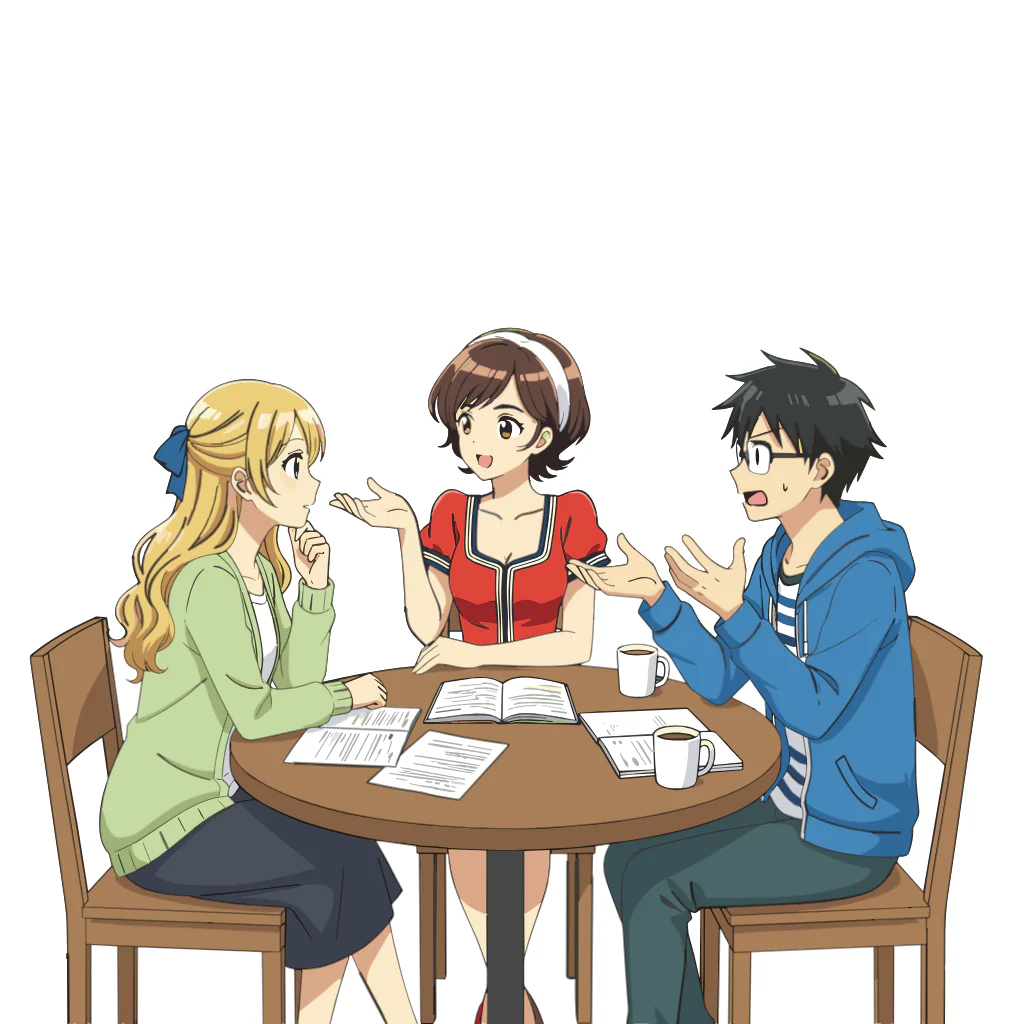
I'm Koshon (.kocon. in Lojban). I speak Lojban pretty well and I'll be guiding you through these conversations.

And I'm Sora (.soran.). A complete beginner — so anything I find confusing, you probably will too. Good luck to us both!
Lesson 1. First Words

Every Lojban conversation starts with coi — the universal greeting. Let's listen to a short exchange and see how much you can pick up just from context.
I like that it doesn't have a "good morning" vs "good evening" distinction yet. Just… hello!
Opening exchange
| Lojban | English |
|---|---|
| coi do .i xu do se bangu le glico | Hello. Can you speak English? |
| na go'i .i xu do se bangu la .lojban. | No. Can you speak Lojban? |
| go'i .i mi milxe se bangu | Yes. I can speak a little. |
| xu do merko | Are you American? |
| go'i .i mi merko | Yes. I'm American. |
New words
| Lojban | Meaning |
|---|---|
| milxe | mildly, a little |
| merko | American (from the USA) |
| se bangu | to speak / know a language |

Oh — go'i is just "yes, what you said is true." And na go'i means "no, it isn't." That's elegant.
Continuing the conversation
| Lojban | English |
|---|---|
| coi do .i do mo | Hello — how are you? |
| le tcima cu zabna vi mi | The weather is nice at my place. |
| do zabna se bangu la .lojban. | You speak Lojban well. |
| mi na'e zabna se bangu la .lojban. | I don't speak Lojban very well. |
| ki'e do | Thank you. |
| co'o do .i mi cliva | Goodbye — I'm leaving. |
| co'o do | Goodbye. |
New words
| Lojban | Meaning |
|---|---|
| tcima | weather |
| zabna | nice, pleasant |
| vi | at / near (here) |
| ki'e | thank you |
| cliva | to leave |
| do mo | how are you? (lit. "you — what predicate?") |
Notice na'e — it softens a negation: not "I speak Lojban badly" but "I speak Lojban not-well." A more nuanced shade of no.
Written prompts
Say in Lojban: I can speak a little. (go'i .i mi milxe se bangu)
Say in Lojban: The weather is nice. (le tcima cu zabna)
Say in Lojban: Goodbye, I'm leaving. (co'o do .i mi cliva)
Lesson 2. Rain and Plans
We'll expand weather talk and add the three most useful Lojban time markers: ca (now), ba (future), pu (past). And our first verb of intention: .ai.
Wait — .ai is a word? It doesn't look like one.
Lojban has a whole class of one-syllable "attitude words." .ai means "I intend to / I'm going to." You'll meet many more.
| Lojban | English |
|---|---|
| le tcima cu zabna vi mi ji'a | The weather is nice at my place too. |
| le tcima ca ku vi mi na'e zabna | The weather here now is not really nice. |
| ca carvi | It's raining now. |
| .i ku'i mi na nelci le nu glare | But I don't like it when it's hot. |
| mi mutce nelci le nu mi tavla do | I really like talking to you. |
| .ai mi citka | I'm going to eat. |
| do ba citka ma | What will you eat? |
| mi na djuno | I don't know. |
| co'o cliva | Goodbye (from the one who is leaving). |
New words
| Lojban | Meaning |
|---|---|
| ji'a | also, too |
| ca | now (current tense marker) |
| carvi | to rain |
| ku'i | but |
| nelci | to like |
| glare | to be hot |
| mutce | very, a lot |
| tavla | to talk to |
| citka | to eat |
| ba | future tense marker (will) |
| ma | what? / which? (question word) |
| djuno | to know (a fact) |

So do ba citka ma is literally "you — will — eat — what?" The question word just slots in where the answer would go?

Exactly right. ma is a slot-holder for the unknown. Put it anywhere you'd put a noun and you've asked about that noun.
Written prompts
Say in Lojban: It's raining now. (ca carvi)
Say in Lojban: But I don't like heat. (ku'i mi na nelci le nu glare)
Say in Lojban: I don't know. (mi na djuno)
Recycle — Lesson 1 vocabulary
| Lojban | English |
|---|---|
| mi milxe se bangu la .lojban. | I speak Lojban a little. |
| le tcima cu zabna vi do | The weather is nice at your place. |
| co'o .i mi cliva | Goodbye — I'm leaving. |
Say in Lojban: Thank you — the weather is nice. (ki'e do .i le tcima cu zabna)
Lesson 3. Going to the Park
Now we'll meet names — la introduces proper names — and learn to say where you are, where you're going, and how far things are.
| Lojban | English |
|---|---|
| la gleki cu zvati ma | Where is Happy (Gleki)? |
| mi'e la rozgu | I'm Rose. |
| xu do ca gleki | Are you happy now? |
| mi gleki le nu mi tavla do vau .e le nu mi tadni la .lojban. | I'm happy that I talk to you and that I study Lojban. |
| mi ba klama le panka | I will go to the park. |
| xu le panka cu darno le zdani be do | Is the park far from your home? |
| le panka cu jibni mi | The park is near me. |
| le panka cu jibni mi .i na darno | The park is near me. Not far. |
New words
| Lojban | Meaning |
|---|---|
| la | name-tag (introduces a proper name) |
| zvati | to be at / present at |
| mi'e | I am (introducing oneself: "I'm…") |
| gleki | to be happy |
| tadni | to study |
| klama | to go / come (to a place) |
| panka | park |
| darno | to be far |
| zdani | home / dwelling |
| jibni | to be near / close |
| le zdani be do | your home |
| le zdani be mi | my home |
So le panka is "the park" and le zdani be do is literally "the home of you" — possessives are just be?
Right. be links a place-slot to a specifier. le zdani be mi = the home of me, i.e. my home.
Written prompts
Say in Lojban: I will go to the park. (mi ba klama le panka)
Say in Lojban: The park is near me. (le panka cu jibni mi)
Say in Lojban: I'm studying Lojban. (mi tadni la .lojban.)
Recycle — Lessons 1–2
| Lojban | English |
|---|---|
| xu do ca gleki | Are you happy now? |
| mi mutce nelci le nu mi klama le panka | I really like going to the park. |
| le tcima cu zabna .i na carvi | The weather is nice. It's not raining. |
Say in Lojban: Are you going to eat now? (xu do ba citka ca)
Lesson 4. Soup and Intentions
This lesson focuses on expressing intention and willingness: .au (I want), .ai (I intend), .ainai (I don't intend). You'll also get your first taste of zi — "soon."
And what's pei doing at the end of .au pei?
pei turns any attitude word into a question. .au pei = "do you want to?" .ai pei = "are you going to?" You'll see it a lot.
| Lojban | English |
|---|---|
| .au pei do retsku | Do you want to ask something? |
| fanva zoi gy.pretty.gy. la .lojban. fu ma | How does one translate "pretty" into Lojban? |
| xu do ba zi citka | Will you eat soon? |
| .ainai mi citka | I'm not going to eat. |
| .ai mi ba citka | I'm going to eat in a while. |
| mi ba zi klama le panka | I'll go to the park soon. |
| do ba citka ma | What will you eat? |
| le stasu | Soup. |
| .ai mi pinxe | I'm going to drink something. |
New words
| Lojban | Meaning |
|---|---|
| .au | I want / I wish (attitudinal) |
| pei | makes an attitudinal into a question |
| retsku | to ask a question |
| fanva | to translate |
| zi | soon / in a short time |
| .ainai | I don't intend to |
| stasu | soup |
| pinxe | to drink |
So .ai and .ainai are like an intention switch — on and off. And zi just tacks "soon" on without any verb tense complexity?
Exactly. ba zi = "will, soon." Time markers stack naturally in Lojban.
Written prompts
Say in Lojban: I'm not going to eat. (.ainai mi citka)
Say in Lojban: Will you eat soon? (xu do ba zi citka)
Say in Lojban: I'm going to drink something. (.ai mi pinxe)
Recycle — Lessons 1–3
| Lojban | English |
|---|---|
| mi na djuno le du'u .au pei do klama le panka | I don't know if you want to go to the park. |
| mi ba zi klama le zdani be mi | I'll go home soon. |
| xu le panka cu darno le zdani be do | Is the park far from your home? |
Say in Lojban: I want to talk to you. (.au mi tavla do)
Lesson 5. Juice or Water?
Now the conversation gets into daily preferences. You'll encounter lo (some / an instance of) vs le (the specific…), and lo'e which refers to a type in general — like "juices in general," not a specific glass.
Three articles already? le, lo, lo'e…
Just note the pattern for now: le = the one(s) I have in mind; lo = some; lo'e = the typical kind. You'll get it from context.
| Lojban | English |
|---|---|
| .ai mi zukte lo ka tavla da vau le nu mi se bangu la .lojban. | I plan to talk to someone so that I can speak Lojban. |
| .ai mi pinxe lo jisra | I'm going to drink some juice. |
| .ai mi pinxe lo djacu | I'm going to drink some water. |
| je'e do | Got it. / Roger that. |
| xu do nelci lo'e jisra | Do you like juices (in general)? |
| mi ji'a nelci lo'e jisra | I like juices too. |
| ui | Yay! |
| mi gleki le nu ge do gi mi nelci lo'e jisra | I'm glad that both you and I like juices. |
| mi gleki le nu ge do gi mi se bangu la .lojban. | I'm glad that both you and I speak Lojban. |
| .au mi ba za tavla do | I want to talk to you later. |
| .au mi cliva | I want to leave. |
| do ba klama le panka ca ma | When will you go to the park? |
| ca le vanci | In the evening. |
New words
| Lojban | Meaning |
|---|---|
| zukte | to act / do (intentionally) |
| lo ka | property of / in order to |
| da | something / someone (existential) |
| jisra | juice |
| djacu | water |
| je'e | understood / roger |
| lo'e | the typical / generic kind |
| ui | yay! (attitudinal: happiness) |
| vanci | evening |
| ca ma | when? |
| za | after a medium time |
ge … gi … — "both … and …"! That's a neat coordinating construction.
And ui on its own is a complete sentence. Lojban attitudinals can stand alone as emotional punctuation.
Written prompts
Say in Lojban: I'm going to drink some water. (.ai mi pinxe lo djacu)
Say in Lojban: I like juices too. (mi ji'a nelci lo'e jisra)
Say in Lojban: When will you go to the park? (do ba klama le panka ca ma)
Recycle — Lessons 2–4
| Lojban | English |
|---|---|
| mi mutce nelci le nu mi pinxe lo jisra | I really like drinking juice. |
| .au mi ba za klama le panka | I want to go to the park later. |
| xu do ba zi citka le stasu | Will you eat the soup soon? |
Say in Lojban: I don't know if she likes juices. (mi na djuno .i xu le prenu cu nelci lo'e jisra)
Lesson 6. At the Restaurant
This lesson introduces location questions with bu'u ma (where?), and the important .aunai — "I don't want to."

I feel like I've been eating and drinking for three lessons straight. When do we get to grammar?

This is the grammar. You already know tense markers, attitudinals, articles, question words, and the verb-first sentence shape — you just learned them through soup and juice.
| Lojban | English |
|---|---|
| .au pei do ca citka | Would you like to eat now? |
| .au mi ca citka | I'd like to eat now. |
| .aunai .i ba za go'i | I don't want to. I'll eat in a while. |
| .ai mi pinxe | I'm going to drink something. |
| bu'u ma | Where? |
| mi na djuno | I don't know. |
| .ai mi klama lo gusta | I'm going to go to some restaurant. |
New words
| Lojban | Meaning |
|---|---|
| .aunai | I don't want to |
| go'i | (repeat of the previous sentence's predicate — here: eat) |
| bu'u | at (location tense marker) |
| bu'u ma | where? |
| gusta | restaurant |
So .aunai .i ba za go'i = "I don't want to. In a while I will [do the same thing again]." go'i is an incredible shortcut.
It echoes the last predicate. Very natural in rapid Lojban conversation.
Written prompts
Say in Lojban: I don't want to eat now. (.aunai mi ca citka)
Say in Lojban: Where? (bu'u ma)
Say in Lojban: I'm going to go to some restaurant. (.ai mi klama lo gusta)
Recycle — Lessons 3–5
| Lojban | English |
|---|---|
| mi na djuno le du'u do ba klama ma | I don't know where you will go. |
| .ai mi pinxe lo jisra ca le vanci | I'm going to drink some juice in the evening. |
| xu do nelci lo gusta | Do you like restaurants? |
Say in Lojban: I want to eat soup at the restaurant. (.au mi citka le stasu lo gusta)
Lesson 7. Shopping for Snacks
Now we're buying things. te vecnu is "to buy" — literally the third place of vecnu (to sell): the buyer's role. And je'i is an or-question: "A or B?"
And su'o da — is that "something" like a quantity?
su'o = at least one; da = some thing. Together: "at least one thing" — natural Lojban for "something."
| Lojban | English |
|---|---|
| .ai mi te vecnu su'o da | I'm going to buy something. |
| do ba te vecnu ma | What will you buy? |
| .ai mi ba te vecnu lo titnanba .e lo jisra | I'm going to buy some cookies and some juice. |
| do djica lo nu do pinxe ma | What do you want to drink? |
| .au pei do pinxe lo jisra je'i lo djacu | Are you going to drink juice or water? |
New words
| Lojban | Meaning |
|---|---|
| te vecnu | to buy (lit. third place of "sell") |
| su'o | at least one |
| lo titnanba | cookies / sweet baked goods |
| djica | to desire / want (an event) |
| je'i | or (choice question) |
The A .e B structure for "A and B" — is that the same .e that means "and"?
Exactly. .e connects noun-phrases: lo titnanba .e lo jisra = "cookies and juice." For connecting sentences you'd use .i je. Lojban keeps those roles distinct.
Written prompts
Say in Lojban: I'm going to buy some cookies. (.ai mi te vecnu lo titnanba)
Say in Lojban: What do you want to drink? (do djica lo nu do pinxe ma)
Say in Lojban: Juice or water? (lo jisra je'i lo djacu)
Recycle — Lessons 4–6
| Lojban | English |
|---|---|
| .au mi ba zi te vecnu lo titnanba | I want to buy cookies soon. |
| mi ba klama lo gusta .i mi ba te vecnu le stasu | I'll go to a restaurant. I'll order the soup. |
| xu do djica lo nu do pinxe lo djacu | Do you want to drink some water? |
Say in Lojban: I'm not going to buy anything. (.ainai mi te vecnu su'o da)
Lesson 8. Telling the Time
Clocks! ti'u li cacra bu N is the formula: ti'u = at the time; li = number; cacra bu = o'clock; N = the digit. So ti'u li cacra bu pa = "at 1 o'clock."
That's a lot of machinery for a single clock time. Can't we just say "pa tcika"?

The full form is precise — you're saying "at the hour marked by the number one." In conversation people do shorten it, but knowing the full form means you always understand others.
| Lojban | English |
|---|---|
| .ai mi citka da .i do mo | I'm going to eat something. What about you? |
| ra'a mi zo'u .ai mi te vecnu lo titnanba | As for me, I'm going to buy some cookies. |
| .i'e | I approve of that! |
| ti'u li cacra bu pa | At 1 o'clock. |
| ti'u li cacra bu re | At 2 o'clock. |
| mi citka ti'u li cacra bu so | I eat at 9 o'clock. |
| mi pu pinxe le jisra ti'u li cacra bu bi | I drank the juice at 8 o'clock. |
| xu do ba citka ti'u li cacra bu mu | Will you eat at 5 o'clock? |
| .ai mi klama le panka ti'u li cacra bu vo | I'm going to go to the park at 4 o'clock. |
| ti'u li cacra bu ze mi tavla le pendo | At 7 o'clock I talk to a friend. |
| mi pu te vecnu le ci botpi | I bought the 3 bottles. |
| lei xa botpi cu kargu | The 6 bottles are expensive. |
| no da zvati ti | Nobody is here. |
| mi ba klama ti'u li cacra bu pa no | I'll come at 10 o'clock. |
| do ba klama ti'u li cacra bu pa no je'i li cacra bu pa re | Will you come at 10 or at 12? |
New words
| Lojban | Meaning |
|---|---|
| ti'u | at (a clock time) |
| li | introduces a number |
| cacra bu | o'clock (lit. "hour mark") |
| pu | past tense marker (did) |
| ra'a … zo'u | as for … (topic marker) |
| .i'e | I approve / that's good |
| botpi | bottle |
| kargu | expensive |
| pendo | friend |
| no da | nobody / nothing |
| zvati | to be present at |
| lei | the mass of (collective) |
Numbers: pa re ci vo mu xa ze bi so pa no — one through ten. And they just slot into li?
Yes. li pa no = the number 10. li pa re = 12. pa, re, ci… are standalone number words.
Written prompts
Say in Lojban: At 3 o'clock. (ti'u li cacra bu ci)
Say in Lojban: I drank water at 7 o'clock. (mi pu pinxe lo djacu ti'u li cacra bu ze)
Say in Lojban: Nobody is here. (no da zvati ti)
Recycle — Lessons 5–7
| Lojban | English |
|---|---|
| .ai mi ba za te vecnu lo titnanba .e lo jisra | I'm going to buy cookies and juice later. |
| mi ba klama le panka ti'u li cacra bu xa | I'll go to the park at 6 o'clock. |
| xu do nelci lo'e jisra je'i lo'e djacu | Do you like juice or water (in general)? |
Say in Lojban: I'll buy 3 bottles of juice at 5 o'clock. (mi ba te vecnu le ci botpi lo jisra ti'u li cacra bu mu)
Lesson 9. Morning and Evening
This lesson introduces greetings by time of day and the question ma ca tcika — "what time is it now?" You'll also meet xukau, the indirect question marker.
| Lojban | English |
|---|---|
| xu do djica le nu do citka | Do you want to eat? |
| .i ku'i do ba citka ca ma | But when will you eat? |
| mi na djuno le du'u xukau ti kukte | I don't know whether this is tasty. |
| ku'i mi ba citka ti'u li pa pa | But I'll eat at 11 o'clock. |
| do xu ji'a | You too? |
| mi citka ca le vanci ce'e ti'u li cacra bu pa no | I eat in the evening, specifically at 10 o'clock. |
| cerni coi | Good morning! |
| vanci coi | Good evening! |
| ma ca tcika | What time is it now? |
| li cacra bu mu | Five o'clock. |
New words
| Lojban | Meaning |
|---|---|
| du'u | that (indirect statement) |
| xukau | whether (indirect yes/no question) |
| kukte | tasty, delicious |
| cerni | morning |
| ce'e | and specifically / that is |
| tcika | time (clock time) |
cerni coi — "morning hello"! So you just put the time word in front of coi?
Right. cerni coi and vanci coi are the standard greetings. You can build others: nicte coi for "good night," donri coi for "good day."
Written prompts
Say in Lojban: Good morning! (cerni coi)
Say in Lojban: I don't know whether this is tasty. (mi na djuno le du'u xukau ti kukte)
Say in Lojban: What time is it now? (ma ca tcika)
Recycle — Lessons 6–8
| Lojban | English |
|---|---|
| mi ba klama lo gusta ti'u li cacra bu ze | I'll go to a restaurant at 7 o'clock. |
| xu do djica le nu do citka lo titnanba ca le cerni | Do you want to eat cookies in the morning? |
| mi na djuno le du'u no da zvati le gusta | I don't know if nobody is at the restaurant. |
Say in Lojban: I'll eat at the restaurant in the evening. (mi ba citka lo gusta ca le vanci)
Lesson 10. Arranging a Call
In this lesson two people negotiate a convenient time for a voice conversation. Key word: kufra — "convenient, comfortable." And ja'o for drawing a conclusion: "so, therefore."
The line "your voice is beautiful" — how flattering is that in Lojban?
About as flattering as in English. Though in Lojban you're technically saying the speaker has a "pretty voice property," which is somehow even more formal and therefore funnier.
| Lojban | English |
|---|---|
| do se voksa le melbi | Your voice is beautiful. |
| pei do tavla mi | How about talking to me? |
| pei do se voksa tavla mi | How about talking to me in a voice chat? |
| .i'a .i ti'u ma | I accept. At what time? |
| ti'u li cacra bu mu veti'u la .nuiork. | At 5 o'clock New York time. |
| lo ka ca tavla do cu kufra mi | Talking to you now is convenient for me. |
| u'u tu'a li cacra bu mu na'e se kufra mi | I'm sorry, 5 o'clock isn't really convenient for me. |
| xu tu'a li cacra bu xa cu se kufra do | Is 6 o'clock convenient for you? |
| ie kufra mi | Yes, that's convenient for me. |
| ja'o .ai tavla ti'u li cacra bu xa | So let's talk at 6 o'clock. |
New words
| Lojban | Meaning |
|---|---|
| voksa | voice |
| melbi | beautiful, pretty |
| .i'a | I accept / okay |
| veti'u | timezone (time zone marker) |
| kufra | convenient, comfortable |
| tu'a | as for… / regarding (sumti raising) |
| u'u | I'm sorry / I apologize |
| ie | yes / agreed |
| ja'o | therefore / so (attitudinal: inference) |
| se voksa | having as voice / speaking via voice |
u'u — apologetic, .i'a — accepting, ja'o — inferring. These little words do so much.
They're Lojban's emotional layer. Drop them in freely — they don't change the truth of a sentence, only the speaker's attitude toward it.
Written prompts
Say in Lojban: Is 8 o'clock convenient for you? (xu tu'a li cacra bu bi cu se kufra do)
Say in Lojban: I'm sorry, I don't know. (u'u mi na djuno)
Say in Lojban: So I'll go to the park. (ja'o .ai mi klama le panka)
Recycle — Lessons 7–9
| Lojban | English |
|---|---|
| xu tu'a ti'u li cacra bu so cu se kufra do | Is 9 o'clock convenient for you? |
| cerni coi .i ma ca tcika | Good morning! What time is it? |
| mi pu tavla le pendo ti'u li cacra bu ze | I talked to my friend at 7 o'clock. |
Say in Lojban: I don't want to eat at 5 o'clock — 7 is more convenient. (.aunai mi citka ti'u li cacra bu mu .i ti'u li cacra bu ze cu kufra mi)
Lesson 11. Today, Tomorrow, Yesterday
The three essential day-words: le cabdei (today), le bavlamdei (tomorrow), le prulamdei (yesterday). And birti — to be certain.
bavlamdei — "the day that arrives after" and prulamdei — "the day that passed." The words describe themselves!
That's what a logical language does — roots combine in ways that describe their own meaning. Once you learn enough roots, new words become guessable.
| Lojban | English |
|---|---|
| xu do djica lo nu do tavla mi ti'u li cacra bu ze | Do you want to talk to me at 7 o'clock? |
| .u'u tu'a li cacra bu ze milxe na'e se kufra mi | Sorry, 7 o'clock is a little inconvenient for me. |
| pei do tavla mi ca le bavlamdei | How about you talk to me tomorrow? |
| pei mi'o casnu ca le bavlamdei | How about you and I have a discussion tomorrow? |
| tu'a le bavlamdei cu zabna | As for tomorrow — that works fine. |
| pei ca le cabdei | How about today? |
| mi pu tavla la gleki ca le prulamdei | I talked to Gleki yesterday. |
| ca le xu cabdei | Today? |
| ca le xu cabdei .i mi na birti | Today? I'm not sure. |
New words
| Lojban | Meaning |
|---|---|
| cabdei | today's day |
| bavlamdei | tomorrow |
| prulamdei | yesterday |
| casnu | to discuss |
| mi'o | you and I (we two, the pair of us) |
| birti | to be certain / sure |
| ca le xu … | as for today/tomorrow/… (questioning the specific day) |
mi na birti — so the negation goes right after mi, before the verb? Not at the end?

na always comes after the subject and before the selbri (main verb). Never at the end — that's an English habit to unlearn.
Written prompts
Say in Lojban: I'm not sure. (mi na birti)
Say in Lojban: I talked to Happy yesterday. (mi pu tavla la gleki ca le prulamdei)
Say in Lojban: How about tomorrow? (pei ca le bavlamdei)
Recycle — Lessons 8–10
| Lojban | English |
|---|---|
| xu tu'a le bavlamdei cu se kufra do | Is tomorrow convenient for you? |
| mi pu klama le panka ca le prulamdei | I went to the park yesterday. |
| vanci coi .i pei mi'o casnu ca le cabdei | Good evening! How about we discuss today? |
Say in Lojban: I'll talk to my friend at 9 o'clock tomorrow. (mi ba tavla le pendo ti'u li cacra bu so ca le bavlamdei)
Lesson 12. Prices and Money
Money! meryru'u is "US dollar" (from merko + rupnu, the Lojban currency word). Prices use li for the number. Very large numbers use gei — scientific notation.
Scientific notation for car prices?
Cars are expensive. li vo gei mu = 4 × 10⁵ = 50,000. Logical, if a little alarming when you're shopping.
| Lojban | English |
|---|---|
| .ai mi te vecnu su'o da | I'm going to buy something. |
| xu kargu | Is it expensive? |
| ti meryru'u li pa ci | This costs 13 US dollars. |
| le karce cu meryru'u li ji'i gei vo | The car costs approximately 10,000 dollars. |
| le karce cu meryru'u li vo gei mu | The car costs 50,000 dollars. |
| mi na ponse lo jdini | I don't have money. |
| mi na ponse lo jdini meryru'u | I don't have US dollar money. |
New words
| Lojban | Meaning |
|---|---|
| meryru'u | US dollar(s) |
| kargu | expensive |
| karce | car |
| ji'i | approximately |
| gei | scientific notation multiplier (×10^N) |
| ponse | to own / possess |
| jdini | money |

mi na ponse lo jdini — "I don't possess money." Story of my life in Lojban and in life.
Written prompts
Say in Lojban: Is it expensive? (xu kargu)
Say in Lojban: I don't have money. (mi na ponse lo jdini)
Say in Lojban: This costs 20 dollars. (ti meryru'u li re no)
Recycle — Lessons 9–11
| Lojban | English |
|---|---|
| xu le karce cu kargu | Is the car expensive? |
| mi pu te vecnu le karce ca le prulamdei | I bought the car yesterday. |
| mi na birti le du'u kargu | I'm not sure whether it's expensive. |
Say in Lojban: I don't know whether the car costs 50,000 dollars. (mi na djuno le du'u le karce cu meryru'u li vo gei mu)
Lesson 13. Speak Slower!
A practical lesson about pace and shopping. sutra = fast, masno = slow. du'enzu = too (excessively). raunzu = enough, sufficiently. These four make a complete speed dial.
Finally — I can tell you to slow down!
| Lojban | English |
|---|---|
| do ba zukte ma ca le cabdei | What will you do today? |
| .ai ca le cabdei mi klama lo zarci | Today I'm going to go to a shop. |
| xu do ponse lo jdini | Do you have money? |
| go'i .i mi ponse loi jdini meryru'u be li pa no no | Yes. I have 100 US dollars. |
| mi ponse loi meryru'u be li so'o | I have some US dollars. |
| mi ponse loi meryru'u be li so'u | I have a few US dollars. |
| .ai mi te vecnu lo cidja | I'm going to buy some food. |
| xu le jisra cu kargu | Is the juice expensive? |
| le jisra cu du'enzu kargu | The juice is too expensive. |
| do sutra tavla | You speak fast. |
| do du'enzu sutra tavla | You speak too fast. |
| do masno tavla | You speak slowly. |
| do raunzu masno tavla | You speak slow enough. |
| do du'enzu masno tavla | You speak too slowly. |
| .ai mi masno tavla | I'll speak slowly. |
| .ai mi masno tavla seva'u do | I'll speak slowly for your benefit. |
New words
| Lojban | Meaning |
|---|---|
| zarci | shop, store |
| cidja | food |
| sutra | fast, quick |
| masno | slow |
| du'enzu | too, excessively |
| raunzu | enough, sufficiently |
| seva'u | for the benefit of |
| so'o | some (medium quantity) |
| so'u | a few (small quantity) |
| loi | the mass of (collective lo) |
seva'u do — "for your benefit." I'm going to use that one constantly.
Good. It's also a polite softener: "I'll do X for you" reads more considerately than just "I'll do X."
Written prompts
Say in Lojban: You speak too fast. (do du'enzu sutra tavla)
Say in Lojban: I'll speak slowly for your benefit. (.ai mi masno tavla seva'u do)
Say in Lojban: I have a few dollars. (mi ponse loi meryru'u be li so'u)
Recycle — Lessons 10–12
| Lojban | English |
|---|---|
| xu le zarci cu darno le zdani be do | Is the shop far from your home? |
| mi ponse loi jdini meryru'u be li pa no | I have 10 US dollars. |
| le jisra cu kargu .i mi na ponse lo jdini | The juice is expensive. I don't have money. |
Say in Lojban: Please speak slowly. (ko masno tavla seva'u mi)
Lesson 14. Tea Time with Family
Comparisons — nesemau (more than) and tolkargu (cheap, lit. opposite-of-expensive) — plus your first family vocabulary: le speni (spouse).
Opposite-of-expensive is literally cheaper?
tol- is a prefix meaning "the opposite of." It's a systematic way to derive antonyms. tolkargu = not-expensive = cheap. tolmasno = not-slow = fast (another way to say sutra).
| Lojban | English |
|---|---|
| .au mi te vecnu so'o da | I want to buy several things. |
| do djica lo nu do te vecnu ma | What do you want to buy? |
| mi djica lo nu mi te vecnu lo tcati | I want to buy some tea. |
| ma jdima | What is the price? |
| le meryru'u be li pa pi mu no | 1.50 US dollars. |
| tu'a le meryru'u be li pa pi mu no cu jdima le tcati | 1.50 dollars is the price of the tea. |
| na kargu | Not expensive. |
| le xindo tcati ne semau le merko tcati cu tolkargu | The Indian tea is cheaper than the American tea. |
| ti nesemau tu kargu | This is more expensive than that. |
| do nesemau mi sutra lo ka tavla | You talk faster than I do. |
| le speni be mi ca djica lo nu ri joi mi klama le panka | My spouse now wants the two of us to go to the park. |
| le speni be mi ca djica lo nu ri pinxe lo tcati | My spouse now wants to drink tea. |
| xu le speni be do cu tadni la .lojban. | Does your spouse study Lojban? |
New words
| Lojban | Meaning |
|---|---|
| tcati | tea |
| jdima | price |
| pi | decimal point (for numbers: pa pi mu no = 1.50) |
| tolkargu | cheap (opposite of expensive) |
| nesemau | more than / -er than (comparative) |
| xindo | Hindu / Indian |
| speni | spouse |
| ri | the previous noun (pronoun: "she/he/it" for last mentioned) |
| joi | together with (mass union) |
ri replaces the last mentioned noun. So ri joi mi = "she and I together." That's elegant — no gender, no case.
And joi forms a joint mass — the two act as one unit. Different from .e which lists independently.
Written prompts
Say in Lojban: Tea is not expensive. (le tcati na kargu)
Say in Lojban: What is the price? (ma jdima)
Say in Lojban: Does your spouse study Lojban? (xu le speni be do cu tadni la .lojban.)
Recycle — Lessons 11–13
| Lojban | English |
|---|---|
| le tcati cu du'enzu kargu ca le cabdei | The tea is too expensive today. |
| .ai mi ba te vecnu lo tcati ca le bavlamdei | I'm going to buy some tea tomorrow. |
| xu do sutra tavla ne semau le speni be do | Do you speak faster than your spouse? |
Say in Lojban: I want to buy cheap tea. (.au mi te vecnu lo tolkargu tcati)
Lesson 15. Travel Stories
Geography! xabju = to live in / inhabit; litru = to travel; gugde = country; tcadu = city. And we introduce the welcome word fi'i and a suggestion: .e'u.
Moscow, Washington, Big Apple — suddenly we're globetrotting!
| Lojban | English |
|---|---|
| coi do mi'e la .alis. | Hello, I'm Alice. |
| fi'i do | Welcome! |
| fi'i do .i mi'o casnu ma .ei | Welcome! What shall we discuss? |
| .e'u mi'o casnu lo'e tcima | I suggest we talk about weather. |
| .e'u mi'o casnu lo'e djalitki | I suggest we talk about drinks. |
| xu do nelci lo'e vanju | Do you like wine? |
| na go'i .i mi nelci lo'e jisra | No. I like juices. |
| le speni be mi ca litru lu'i le drata gugde | My spouse is now travelling in another country. |
| xu do pu'i litru lu'i le ropno | Have you ever travelled in Europe? |
| mi pu'i litru lu'i le merko | I have travelled in the USA. |
| .i ku'i mi ca xabju le xazdo | But now I live in Asia. |
| mi xabju la .moskov. | I live in Moscow. |
| xu do xabju la .uocinton. | Do you live in Washington? |
| la .moskov. cu barda tcadu | Moscow is a big city. |
| mi xabju la barda plise | I live in Big Apple (New York). |
New words
| Lojban | Meaning |
|---|---|
| fi'i | welcome! (attitudinal: hospitality) |
| .e'u | I suggest / let's (attitudinal: suggestion) |
| djalitki | beverages |
| vanju | wine |
| litru | to travel |
| lu'i | in the domain of / as a set member |
| gugde | country |
| drata | other, different |
| pu'i | have ever (experiential past) |
| ropno | European |
| xabju | to live in / inhabit |
| xazdo | Asian |
| barda | big |
| tcadu | city |
pu'i — you've done it at least once before. A "have you ever" past. That's subtle but useful.
It marks that the experience has occurred at some point. You'll find it in "have you ever tried X?" questions constantly.
Written prompts
Say in Lojban: I live in Moscow. (mi xabju la .moskov.)
Say in Lojban: Have you ever travelled in Asia? (xu do pu'i litru lu'i le xazdo)
Say in Lojban: I suggest we discuss the weather. (.e'u mi'o casnu lo'e tcima)
Recycle — Lessons 12–14
| Lojban | English |
|---|---|
| la .moskov. cu barda tcadu .i na kargu | Moscow is a big city. Not expensive. |
| le speni be mi pu litru lu'i le ropno | My spouse has travelled in Europe. |
| mi nelci lo'e tcati ne semau lo'e vanju | I like tea more than wine. |
Say in Lojban: Welcome! Does your spouse live in Moscow? (fi'i do .i xu le speni be do cu xabju la .moskov.)
Lesson 16. Families and Fears
Family vocabulary: panzi (child/offspring), bersa (son), tixnu (daughter), nanla (boy), nixli (girl). Plus an emotional moment: xanka — to be nervous.
Oh, this one starts with someone being afraid to speak!
A very relatable opening. Nervousness is universal in language learning — and Lojban has a word for it.
| Lojban | English |
|---|---|
| ju'i do | Hello? (getting attention) |
| xu su'o da tirna mi | Can anyone hear me? |
| mi tirna do | I can hear you. |
| coi do mi'e .djan. | Hello, I'm John. |
| fi'i la .djan. | Welcome, John! |
| .e'ei do cusku su'o da | Say something! |
| ko na xanka | Don't be nervous! |
| mi xanka lo nu mi na se bangu la .lojban. | I'm nervous because I don't speak Lojban. |
| .i ku'i do ca je'a se bangu la .lojban. | But you do speak Lojban now. |
| xu do se panzi su'o da | Do you have children? |
| mi se panzi re da | I have two children. |
| mi se panzi le pa nanla .e le pa nixli | I have a boy and a girl. |
| le tixnu be mi ca tadni le saske be lo ka skami | My daughter is now studying computer science. |
| le bersa be mi cu se esporte | My son is a sportsperson. |
| mi ji'a se esporte | I'm a sportsperson too. |
| mi se cuntu la .baskedbol. | I play basketball. |
| mi se cuntu la .soker. | I play soccer. |
New words
| Lojban | Meaning |
|---|---|
| ju'i | hey / attention (vocative particle) |
| tirna | to hear |
| .e'ei | I urge / come on! (attitudinal) |
| cusku | to express / say |
| xanka | to be nervous / anxious |
| je'a | indeed / yes (emphatic affirmation) |
| panzi | offspring / child |
| se panzi | to have as offspring |
| nanla | boy |
| nixli | girl |
| tixnu | daughter |
| bersa | son |
| saske | science |
| skami | computer |
| se esporte | to be athletic / a sportsperson |
| se cuntu | to play a sport |
se panzi = "to be offspring-had-by." The se swaps the x1 and x2 slot. So mi se panzi re da = "two children have me as parent." Very logical.
And ko na xanka — ko is the command form ("you, do this"). Here ko na = "you, don't…"
Written prompts
Say in Lojban: Don't be nervous! (ko na xanka)
Say in Lojban: I have two children. (mi se panzi re da)
Say in Lojban: Can anyone hear me? (xu su'o da tirna mi)
Recycle — Lessons 13–15
| Lojban | English |
|---|---|
| le tixnu be mi ca xabju la .moskov. | My daughter now lives in Moscow. |
| xu le bersa be do cu tadni le saske be lo ka skami | Does your son study computer science? |
| mi pu litru .i ku'i mi ca xanka lo nu mi tavla | I have travelled. But I'm nervous when I talk. |
Say in Lojban: My daughter is a sportsperson and studies in the city. (le tixnu be mi cu se esporte .e tadni le tcadu)
Lesson 17. Grown-Up or Baby?
makcu means grown-up / mature; cifnu means baby / infant. Two ends of the life-stage spectrum — and both come up in family conversation constantly.
Short lesson this time?
Short but dense. Four sentences to lock in bersa, tixnu, makcu, cifnu, and zabju — that's five words in eight lines. Efficient.
| Lojban | English |
|---|---|
| xu do se panzi su'o da | Do you have children? |
| go'i .i mi se panzi ci da | Yes, I have three children. |
| xu le bersa be do cu makcu | Is your son grown-up? |
| le bersa be mi ca cifnu | My son is a baby. |
| le tixnu be mi ca makcu | My daughter is grown-up. |
| le tixnu be mi ca zabju la barda plise | My daughter now lives in New York. |
New words
| Lojban | Meaning |
|---|---|
| makcu | grown-up, mature, adult |
| cifnu | baby, infant |
| zabju | to reside / to live (long-term dwelling) |
xabju vs zabju — are those different?
xabju is broader: to inhabit a region. zabju implies more settled residence, often used for an address. In practice they overlap — most speakers use them interchangeably for "lives in."
Written prompts
Say in Lojban: My son is grown-up. (le bersa be mi cu makcu)
Say in Lojban: Is your daughter a baby? (xu le tixnu be do cu cifnu)
Say in Lojban: I have three children. (mi se panzi ci da)
Recycle — Lessons 14–16
| Lojban | English |
|---|---|
| le bersa be mi cu se esporte .i ku'i le tixnu be mi cu tadni la .lojban. | My son is athletic. But my daughter studies Lojban. |
| xu le tixnu be do cu makcu je'i cifnu | Is your daughter grown-up or a baby? |
| le speni be mi pu xabju la .moskov. .i ca ri zabju la barda plise | My spouse used to live in Moscow. Now she lives in New York. |
Say in Lojban: Welcome — is your son grown-up or still a baby? (fi'i do .i xu le bersa be do cu makcu je'i cifnu)
Lesson 18. How Many? How Far?
xo is the quantity question word — "how many?" And we get distance vocabulary: sepli (separated/apart), ki'otre (kilometer), cmalu (small).
Oh! So xo da = "how many somethings"?
Exactly — xo slots in where a number would go. "You-have-how-many-children?" → do se panzi xo da.
| Lojban | English |
|---|---|
| do se panzi xo da | How many children do you have? |
| mi se panzi re da | I have two children. |
| xu le panzi be do cu makcu | Are your children grown-up? |
| le bersa be mi ca makcu .i ku'i le tixnu be mi ca cifnu | My son is grown-up. But my daughter is a baby. |
| le bersa be do ca zvati ma | Where is your son now? |
| le bersa be mi ca zvati la .moskov. | My son is now in Moscow. |
| le tixnu be mi ca xabju le zdani be mi | My daughter now lives in my house. |
| .ue | Oh, what a surprise! |
| mi ponse le pa cmalu karce | I own a small car. |
| .ai mi klama le tcadu ca le bavlamdei | I'm going to the city tomorrow. |
| xu le tcadu cu darno | Is the city far? |
| go'i .i le tcadu cu darno | Yes, the city is far. |
| le tcadu cu sepli mi le ki'otre be li mu no | The city is 50 kilometres from me. |
| tu sepli mi lo barda | That is a large distance from me. |
| lo'e dikca ca kargu | Electricity is expensive now. |
New words
| Lojban | Meaning |
|---|---|
| xo | how many? (quantity question) |
| panzi | child / offspring (here used for the group) |
| .ue | surprise! (attitudinal: unexpected) |
| cmalu | small |
| sepli | to be separated / apart |
| ki'otre | kilometre |
| dikca | electricity |
tu sepli mi lo barda — "that is separated from me by a large amount." A relative-clause-free way to say "that's far from me."
Written prompts
Say in Lojban: How many children do you have? (do se panzi xo da)
Say in Lojban: The city is 50 kilometres away. (le tcadu cu sepli mi le ki'otre be li mu no)
Say in Lojban: Oh, what a surprise! (.ue)
Recycle — Lessons 15–17
| Lojban | English |
|---|---|
| la .moskov. cu barda .i ku'i mi xabju lo cmalu tcadu | Moscow is big. But I live in a small city. |
| xu le bersa be do cu zabju la .moskov. | Does your son live in Moscow? |
| go'i .i ri ca makcu | Yes. He is grown-up now. |
Say in Lojban: My daughter lives in my home — not far from the city. (le tixnu be mi ca zabju le zdani be mi .i na darno le tcadu)
Lesson 19. Where's Home?
A short but warm exchange about where people live and who lives with them. lanzu = family.
Nice and compact after the last couple of heavy ones!
| Lojban | English |
|---|---|
| do xabju ma | Where do you live? |
| mi xabju la bersi trutca | I live in Northern Capital City. |
| xu do se panzi | Do you have children? |
| mi se panzi xa da | I have 6 children. |
| le lanzu be do cu barda | Your family is big. |
| xu le panzi be do ca xabju le zdani be do | Do your children live in your home? |
| go'i .i le panzi be mi ca xabju le zdani be mi | Yes. My children live in my home. |
New words
| Lojban | Meaning |
|---|---|
| lanzu | family |
| bersi trutca | Northern Capital City (a place name) |
le lanzu be do — "your family" just like le zdani be do is "your home." The be do possessive chain works the same everywhere.
Every relational noun in Lojban takes be for the related person. Very consistent once you see the pattern.
Written prompts
Say in Lojban: Where do you live? (do xabju ma)
Say in Lojban: Your family is big. (le lanzu be do cu barda)
Say in Lojban: My children live in my home. (le panzi be mi ca xabju le zdani be mi)
Recycle — Lessons 16–18
| Lojban | English |
|---|---|
| mi se panzi xa da .i le lanzu be mi cu barda | I have 6 children. My family is big. |
| le tcadu cu sepli le zdani be mi le ki'otre be li re no | The city is 20 kilometres from my home. |
| xu do pu litru lu'i le drata gugde | Have you ever travelled in another country? |
Say in Lojban: Does your big family live in a small home? (xu le barda lanzu be do cu xabju lo cmalu zdani)
Lesson 20. Bills and Utilities
pleji = to pay; detma'i = calendar month; kagni = company / organization. And a lovely compound: jo'u = together with (both participate equally).
Monthly electricity bills in Lojban. I feel very adult.
Congratulations. You also now know how to form "every X" using ca ro.
| Lojban | English |
|---|---|
| xu lo'e dikca ca kargu | Is electricity expensive now? |
| mi na djuno .i mi na pleji | I don't know. I don't pay. |
| xu do pleji su'o da le kagni tu'a lo'e dikca | Do you pay anything to the company for electricity? |
| ca ro detma'i mi pleji | Every calendar month I pay. |
| mi pleji tu'a le meryru'u be li pa no | I pay 20 US dollars. |
| ca ro detma'i mi pleji tu'a le meryru'u be li pa no le kagni tu'a lo'e dikca | Every month I pay 10 dollars to the electricity company. |
| mi zukte fi lo nu mi jo'u le speni be mi cu klama le tcadu | I'm working toward the goal of going to the city with my spouse. |
New words
| Lojban | Meaning |
|---|---|
| pleji | to pay |
| detma'i | calendar month |
| kagni | company, organization, firm |
| jo'u | together with (mutual participation) |
| ro | every / all |
| ca ro | every (recurring time) |
| zukte fi | to do something toward (a goal) |
mi jo'u le speni be mi = "me together with my spouse." Different from mi joi le speni be mi which is "me-and-spouse as a single mass entity."
Good distinction. jo'u = side by side, parallel. joi = merged into one unit. For travel companions, jo'u is usually right.
Written prompts
Say in Lojban: Every month I pay. (ca ro detma'i mi pleji)
Say in Lojban: I don't know — I don't pay. (mi na djuno .i mi na pleji)
Say in Lojban: Do you pay the company? (xu do pleji le kagni)
Recycle — Lessons 17–19
| Lojban | English |
|---|---|
| le lanzu be mi cu xabju lo barda zdani .i ku'i lo'e dikca ca kargu | My family lives in a big home. But electricity is expensive now. |
| mi jo'u le speni be mi ba klama le tcadu ca ro bavlamdei | My spouse and I are going to the city every tomorrow (i.e. every day). |
| xu do pleji tu'a lo'e dikca ca ro detma'i | Do you pay for electricity every month? |
Say in Lojban: My spouse and I are going to the city because the children are there. (mi jo'u le speni be mi ba klama le tcadu ki'u le nu le panzi be mi cu zvati ti)
Lesson 21. Evening Routines
Winding down for the night. sipna = to sleep; lerci = late; nitcu = to need; jibri = job/occupation; finti = to author/program.
Finally, the lesson where people admit they need to sleep. Relatable.
| Lojban | English |
|---|---|
| ca vanci fi mi | It's evening in my timezone. |
| .ai mi sipna | I'm going to sleep. |
| ca vanci fi mi .i .ai mi sipna | It's evening at my place. I'm going to sleep. |
| ca lerci | It's late now. |
| mi ca te vanci | I'm in the evening zone now. |
| co'o te vanci | Goodbye, evening-person! |
| xu ca na lerci | Is it not late now? |
| mi nitcu lo nu mi gunka ca le bavlamdei | I need to work tomorrow. |
| ma jibri do | What is your job? |
| lo ka finti lo proga cu jibri mi | Writing programs is my job. |
New words
| Lojban | Meaning |
|---|---|
| sipna | to sleep |
| lerci | late |
| te vanci | person in the evening / evening zone |
| fi mi | at my place (location: for me) |
| nitcu | to need |
| gunka | to work |
| jibri | job, occupation |
| finti | to author, create, write (a work) |
| proga | program, software |
lo ka finti lo proga — "the property of creating programs" — used as a noun-phrase for "programming." That's a flexible construction.
lo ka [verb] turns any verb into a property-noun. "The-being-of programming" = programming. You can use it wherever a noun fits.
Written prompts
Say in Lojban: It's late now. (ca lerci)
Say in Lojban: I'm going to sleep. (.ai mi sipna)
Say in Lojban: What is your job? (ma jibri do)
Recycle — Lessons 18–20
| Lojban | English |
|---|---|
| ca lerci .i no da zvati le zarci | It's late. Nobody is in the shop. |
| mi nitcu lo nu mi pleji le kagni ca ro detma'i | I need to pay the company every month. |
| vanci coi .i .ai mi sipna .i ca lerci | Good evening! I'm going to sleep — it's late. |
Say in Lojban: I need to work tomorrow because my family needs money. (mi nitcu lo nu mi gunka ca le bavlamdei ki'u le nu le lanzu be mi nitcu lo jdini)
Lesson 22. Morning Errands and Taxis
Duration vocabulary: ze'a (for a while), ze'u (for a long time), ze'i (for a short time). And kanpe — to expect. Plus taksi for taxi, and stali for staying somewhere.
When do you use ze'a vs ze'u?
ze'u = for a long time (longer than expected); ze'a = for a moderate while; ze'i = for a short time. Like spatial markers vi / va / vu but for duration.
| Lojban | English |
|---|---|
| .ai mi te vecnu su'o da ca le cerni be le bavlamdei | I'm going to buy something tomorrow morning. |
| .ai mi te vecnu su'o da ca le cabvanci bu'u le tcadu | I'm going to buy something this evening in the city. |
| ca lerci .i no da zvati le zarci | It's late. Nobody is in the shop. |
| no da zvati le zarci .i ki'u bo ca lerci | Nobody is in the shop, because it's late. |
| .ai mi klama le tcadu fu tu'a le taksi | I'm going to go to the city by taxi. |
| .ai mi klama le tcadu fu tu'a le karce pe mi | I'm going to go to the city in my car. |
| xu do djica lo nu do vitke le pendo le tcadu | Do you want to visit a friend in the city? |
| .ai mi ze'a gunka | I'm going to work for a while. |
| xu do pu ze'u gunka | Did you work for a long time? |
| na go'i .i mi pu ze'i gunka | No. I worked for a short while. |
| do kanpe lo nu do stali le tcadu ze'a ma | How long do you expect to stay in the city? |
| mi kanpe lo nu mi stali le tcadu ze'a le masti be li re | I expect to stay in the city for two months. |
| la'a mi stali le tcadu ze'a le jeftu be li pa | I'll probably stay in the city for one week. |
| mi ba surla ze'a le djedi be li ci | I'll rest for three days. |
New words
| Lojban | Meaning |
|---|---|
| cerni | morning (here in le cerni be le bavlamdei = tomorrow's morning) |
| cabvanci | this evening |
| taksi | taxi |
| fu tu'a | by means of / using |
| vitke | to visit |
| ze'a | for a while (moderate duration) |
| ze'u | for a long time |
| ze'i | for a short time |
| kanpe | to expect |
| stali | to stay / remain |
| masti | month |
| jeftu | week |
| djedi | day |
| surla | to rest / take a break |
| ki'u bo | because (causal compound) |
le masti be li re = "the month of number 2" = two months. The be li construction attaches a number to any time unit.
le djedi be li ci = three days. le jeftu be li pa = one week. Same pattern for masti, nanca (year) — all the time units.
Written prompts
Say in Lojban: I worked for a short while. (mi pu ze'i gunka)
Say in Lojban: I'll go by taxi. (.ai mi klama fu tu'a le taksi)
Say in Lojban: I expect to stay for one week. (mi kanpe lo nu mi stali ze'a le jeftu be li pa)
Recycle — Lessons 19–21
| Lojban | English |
|---|---|
| ca lerci .i no da zvati le zarci .i ku'i mi nitcu lo nu mi te vecnu lo cidja | It's late. Nobody's in the shop. But I need to buy food. |
| mi ba stali le tcadu ze'a le djedi be li re | I'll stay in the city for two days. |
| mi kanpe lo nu mi sipna ca le cerni be le bavlamdei | I expect to sleep tomorrow morning. |
Say in Lojban: I'll rest for three days, then go to work. (mi ba surla ze'a le djedi be li ci .i ba bo mi gunka)
Lesson 23. A Day in the City
di'a means "resuming / going back" — here it's used for returning. Combined with klama it gives you "to come back / return."
So di'a klama ti = "go back here" = "return here." ti is just "here"?
Yes — ti / ta / tu are spatial demonstratives: here / there / way over there. Same distance scale as vi / va / vu but pointing at objects rather than marking locations.
| Lojban | English |
|---|---|
| mi ba klama le tcadu | I'll go to the city. |
| xu do ba klama fu tu'a le karce pe do | Will you go in your own car? |
| na go'i .i mi ba klama fu tu'a le taksi | No. I'll go by taxi. |
| do djica lo nu do zukte ma bu'u le tcadu | What do you want to do in the city? |
| .ai mi te vecnu su'o da bu'u le tcadu | I'm going to buy something in the city. |
| .ai mi vitke le re pendo be mi le tcadu | I'm going to visit my two friends in the city. |
| .i .ai ba le nu vitke kei mi di'a klama ti | After the visit, I'm going to come back here. |
| xu do ca le cerni be le cabdei di'a klama ti | Will you return here today in the morning? |
New words
| Lojban | Meaning |
|---|---|
| di'a | resuming / going back to |
| ba le nu … kei | after (something happens) |
| re pendo be mi | my two friends |
ba le nu vitke kei — "after visiting." So ba le nu [clause] kei is the formula for "after doing something"?
Exactly. le nu turns a verb into an event-noun; ba puts it after that event; kei closes the clause cleanly. You'll see this pattern constantly in storytelling.
Written prompts
Say in Lojban: I'll visit my two friends in the city. (.ai mi vitke le re pendo be mi le tcadu)
Say in Lojban: After eating, I'll return here. (ba le nu citka kei mi di'a klama ti)
Say in Lojban: Will you go by taxi or in your car? (xu do ba klama fu tu'a le taksi je'i le karce pe do)
Recycle — Lessons 20–22
| Lojban | English |
|---|---|
| mi ba vitke le pendo ca le bavlamdei .i mi ba di'a klama le zdani ba le nu vitke kei | I'll visit a friend tomorrow. I'll return home after the visit. |
| xu do ba stali le tcadu ze'a le jeftu be li pa | Will you stay in the city for one week? |
| mi kanpe lo nu mi di'a klama ti ca le cerni be le bavlamdei | I expect to return here tomorrow morning. |
Say in Lojban: I need to return home after buying food in the city. (mi nitcu lo nu mi di'a klama le zdani ba le nu te vecnu lo cidja bu'u le tcadu kei)
Lesson 24. Before You Go
Winding down: pu'o = about to (imminent future); pluka = pleasant; kansa = to accompany. And a beautiful parting phrase: pu'o nicte co'o do — night is coming, goodbye.
I love that one. It's almost poetic.
Lojban is full of these. pu'o nicte — "night is about to happen" — is compressed and evocative. Worth memorising for its own sake.
| Lojban | English |
|---|---|
| mi ba zi co'a sipna | I'll go to sleep soon. |
| ca vanci fi mi .i .ai mi ba zi co'a sipna | It's evening here. I'll fall asleep soon. |
| lo ka tavla do kei pu pluka mi | Talking to you was a pleasure. |
| pu'o nicte co'o do | Night is coming — goodbye! |
| ca le bavlamdei mi klama le tcadu | Tomorrow I'll go to the city. |
| xu do kanpe lo nu do ze'u stali le tcadu | Do you expect to stay in the city for a long time? |
| la'a mi ba stali ze'a le djedi be li vo | I'll probably stay for 4 days. |
| ca ma do di'a klama le zdani | When are you returning home? |
| mi na djuno le du'u ca makau mi di'a klama le zdani | I don't know when I'm returning home. |
| mi na djuno le du'u ca makau mi co'e | I don't know when I'll do it. |
| xu le speni be do cu kansa do lo ka litru | Does your spouse accompany you when you travel? |
| na go'i .i mi kansa no da lo ka litru | No. I travel without company. |
| .ei mi ki'u klama le zdani | I must go home — for a reason. |
| mi klama le zdani ki'u le nu le speni be mi cu nitcu su'o da | I'm going home because my spouse needs something. |
New words
| Lojban | Meaning |
|---|---|
| co'a | to begin / start (event inchoative) |
| pu'o | about to / imminently |
| nicte | night |
| pluka | pleasant |
| la'a | probably / I expect (attitudinal) |
| makau | when-specifically (indirect question for time) |
| co'e | does the contextually obvious thing (dummy predicate) |
| kansa | to accompany |
| .ei | I should / obligation (attitudinal) |
| ki'u | because (causal marker) |
co'e — a wild card predicate meaning "does whatever the context implies." I can see that saving a lot of circumlocution.
It's Lojban's "thing" or "do." When you can't remember a word or the context makes it obvious, co'e fills in. Speakers use it all the time.
Written prompts
Say in Lojban: Talking to you was a pleasure. (lo ka tavla do kei pu pluka mi)
Say in Lojban: Night is coming — goodbye! (pu'o nicte co'o do)
Say in Lojban: I must go home. (.ei mi klama le zdani)
Recycle — Lessons 21–23
| Lojban | English |
|---|---|
| mi ba zi co'a sipna .i lo ka tavla do kei pu pluka mi | I'll sleep soon. Talking to you was a pleasure. |
| la'a mi ba stali le tcadu ze'a le jeftu be li re | I'll probably stay in the city for two weeks. |
| xu le speni be do cu kansa do lo ka vitke le pendo | Does your spouse accompany you when visiting friends? |
Say in Lojban: I'm going home because I need to sleep. (mi klama le zdani ki'u le nu mi nitcu lo nu mi sipna)
Lesson 25. Tasty Yesterday, Plans Today
The final lesson of the core course — and a deliberate spiral. Almost every word here has appeared before. Read it through and notice how much you understand without looking at the English column.
Oh — I actually do recognise most of this. That's satisfying.
That's what the Recycle blocks have been building toward. Let's confirm it.
| Lojban | English |
|---|---|
| mi pu citka su'o kukte ca le prulamdei | I ate something tasty yesterday. |
| .ai mi citka su'o titnanba ca le cabdei | I'm going to eat some cookies today. |
| xu do nelci le titnanba | Do you like cookies? |
| mi nelci .i ie mi nelci | I like them. Yes, I like them. |
| do pu klama ma ca le cerni be le cabdei | Where did you go this morning? |
| do ba klama ma ca le vanci be le cabdei | Where will you go this evening? |
New words
No truly new vocabulary — this lesson recycles the whole course. Here is a compact cumulative reference of the core lemmas you now know:
| Lojban | Meaning |
|---|---|
| coi / co'o | hello / goodbye |
| .ai / .ainai | I intend / I don't intend |
| .au / .aunai | I want / I don't want |
| go'i / na go'i | yes (it's true) / no (it isn't) |
| ma / xo | what? / how many? |
| ca / ba / pu | now / future / past |
| le / lo / lo'e | the specific / some / the typical |
| ku'i / je'a / .ue | but / indeed / surprise |
| tavla / citka / pinxe | talk / eat / drink |
| klama / cliva / stali | go / leave / stay |
| djuno / birti / kanpe | know / be certain / expect |
| kargu / tolkargu / jdima | expensive / cheap / price |
| cerni / vanci / nicte | morning / evening / night |
| cabdei / bavlamdei / prulamdei | today / tomorrow / yesterday |
| ze'a / ze'u / ze'i | for a while / long / short time |
| jibni / darno / sepli | near / far / separated by |
From "can you speak English?" to "I ate something tasty yesterday" — I feel like I've actually been somewhere.
You have. And this is only the beginning of the path — every lesson here opened a door that goes much deeper. Keep going!
Final written prompts
Say in Lojban: I ate something tasty yesterday. (mi pu citka su'o kukte ca le prulamdei)
Say in Lojban: Where will you go this evening? (do ba klama ma ca le vanci be le cabdei)
Say in Lojban: I like cookies. I'm going to buy some today. (mi nelci le titnanba .i .ai mi te vecnu lo titnanba ca le cabdei)
Full spiral review
| Lojban | English |
|---|---|
| coi do .i xu do se bangu la .lojban. | Hello. Can you speak Lojban? |
| go'i .i mi milxe se bangu | Yes. I can speak a little. |
| mi pu citka le stasu ca le vanci .i ku'i mi na nelci le nu glare | I ate soup in the evening. But I don't like heat. |
| mi ba klama le panka ti'u li cacra bu vo ca le bavlamdei | I'll go to the park at 4 o'clock tomorrow. |
| lo ka tavla do kei pu pluka mi .i pu'o nicte co'o do | Talking to you was a pleasure. Night is coming — goodbye! |