How to use this course
This course teaches Lojban through situation-first immersion.
Every lesson follows the same rhythm:
- Read the Opening Dialogue passively. Let the English column carry the meaning. Don't stop to memorise anything yet.
- Say each Lojban line aloud (or sub-vocalise). Even in a written course, hearing the sounds in your head builds patterns faster.
- Study the New Words table — each lesson introduces only 3–5 new words, explained right after the dialogue.
- Read the Grammar Note (if present). It only appears when a new structure is used.
- Work through the Practice Dialogue. A second mini-scene reuses the new words alongside recently learned ones.
- Do the Anticipation Prompts. Each prompt is a small table: English in the first column, the model Lojban answer in the second — cover that column, say your Lojban aloud, then check.
- Don't skip the Spaced Recall section. It brings back vocabulary from earlier lessons at scientifically timed intervals — the engine that makes words stick.
- Try the Challenge under spaced recall — same table shape (prompt then Lojban in the second column): one harder sentence that weaves in older material with what you just learned.
If something feels unclear, keep reading — context usually resolves it within a few more lines. Ask questions in 💬 the live chat.
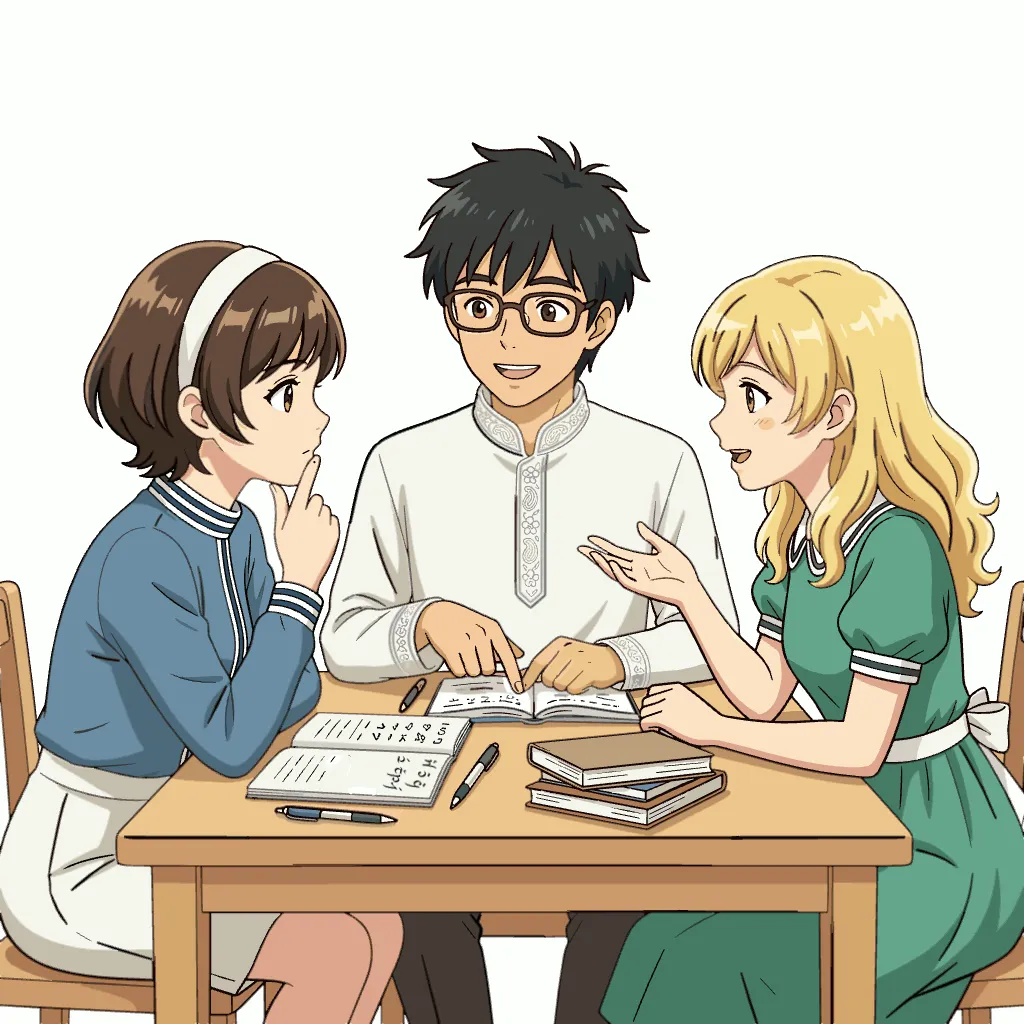
Characters

I'm Lifri (la lifri in Lojban). I speak Lojban fluently and I'll be guiding you through these conversations.

I'm Mentu (la mentu in Lojban). I'm learning Lojban from scratch — you and I are in the same boat.

I'm Linto (la linto in Lojban). I ask the questions everyone else is thinking. Good luck to us all!
Lesson 1. Hello, Goodbye, and Leaving
Lifri has just spotted Mentu at a Lojban meetup — his first time here. A real conversation rarely stops at the first hello: people introduce themselves, then someone has to run.
| Lojban | English |
|---|---|
coi .i mi'e la mentu | Hello — I'm Mentu. |
coi la mentu .i mi'e la lifri .i coi do | Hello, Mentu — I'm Lifri. Hello to you. |
 mi cliva co'o | I'm off — bye! / I'm leaving — bye. |
co'o | Goodbye. |
co'o la lifri | Goodbye, Lifri. |
New words
| Lojban | Meaning |
|---|---|
| coi | hello (greeting) |
| co'o | goodbye (parting) |
| mi'e | I am … / my name is … |
| la | name-tag — turns the next word into a name |
| do | you |
| cliva | x₁ leaves x₂ — with mi and co'o: mi cliva co'o = "I'm leaving — bye" |
Grammar note:
A single Lojban word can be a complete sentence. coi on its own means "I greet you." co'o means "I bid you farewell." mi cliva co'o chains two common moves: you say who is leaving (mi cliva), then the parting (co'o) — very natural in online and offline conversations when someone has to go.
Practice dialogue
A little later, Linto walks up to Mentu.
| Lojban | English |
|---|---|
coi do | Hello (to you). |
coi do .i mi'e la linto | Hello. I'm Linto. |
coi .i mi'e la mentu | Hello. I'm Mentu. |
mi cliva co'o .i co'o la mentu | I'm heading out — bye, Mentu! |
co'o la linto | Goodbye, Linto. |
New word
| Lojban | Meaning |
|---|---|
| .i | sentence boundary — separates two sentences (like a spoken full stop) |
Grammar note:
.i is written with a dot before it. You can chain as many sentences as you like: coi .i mi'e la mentu .i mi cliva co'o.
Anticipation prompts
| Prompt | Lojban |
|---|---|
| Hello. | coi |
| I'm Mentu. | mi'e la mentu |
| Goodbye, Lifri. | co'o la lifri |
| I'm leaving — bye. | mi cliva co'o |
| Hello. I'm Linto. | coi .i mi'e la linto |
| Hello, Mentu. I'm heading out — bye! | coi la mentu .i mi cliva co'o |
Challenge
| Prompt | Lojban |
|---|---|
| Hello. I'm Mentu. I'm leaving — bye. | coi .i mi'e la mentu .i mi cliva co'o |
Lesson 2. Do You Speak Lojban?
Lifri wants to know if Mentu has any Lojban at all. Watch how she asks yes/no questions and how Mentu answers — full lines, the way people actually reply, not bare go'i floating on its own.
| Lojban | English |
|---|---|
coi do .i xu do se bangu la .lojban. | Hi — do you speak Lojban? |
 go'i .i mi milxe se bangu | Yes. I speak it a little. |
 xu do milxe se bangu la .lojban. | Only a little Lojban? |
 go'i | Yes — still just a little. |
 xu do na se bangu la .lojban. | (teasing) So you don't speak Lojban? |
 na go'i | I do not. |
New words
| Lojban | Meaning |
|---|---|
| mi | I / me |
| xu | yes/no question marker — put it before any sentence to ask whether it is true |
| se bangu | to speak / know a language (lit. "to be a language-user of") |
| go'i | yes / that's right (echoes the previous sentence as true) |
| na | not — negates what follows |
| milxe | mildly, a little, somewhat |
Grammar note:
xu at the start of a sentence turns it into a yes/no question.
go'i by itself means "yes, the last thing said is true."
na go'i answers "no" to a plain yes/no question like xu do se bangu la .lojban. — it takes the same shape as the last sentence and adds not.
milxe softens what follows: milxe se bangu = "speaks a language a little."
mi is "I" — you already know do from Lesson 1; mi is its mirror.
xu do na se bangu la .lojban. asks whether "you don't speak Lojban" is true. go'i agrees with that whole line. na go'i here does not swap the meaning to "I speak Lojban" — it still lines up with I do not in the dialogue above. To say you do speak, answer with a full line you already have in this lesson, e.g. mi milxe se bangu or go'i .i mi milxe se bangu.
In the practice table, mi na cliva uses cliva from Lesson 1: na sits right before cliva ("I'm not leaving").
Practice dialogue
Mentu keeps Lifri talking.
| Lojban | English |
|---|---|
coi do .i xu do se bangu la .lojban. | Hi — do you speak Lojban? |
 go'i .i mi milxe se bangu | Yes. I speak it a little. |
 xu do cliva | Are you leaving? |
na go'i .i mi na cliva | No. I'm not leaving. |
Anticipation prompts
| Prompt | Lojban |
|---|---|
| Can you speak Lojban? | xu do se bangu la .lojban. |
| Yes. I can speak a little. | go'i .i mi milxe se bangu |
| No. | na go'i |
| Can you speak Lojban a little? | xu do milxe se bangu la .lojban. |
Spaced recall — Lessons 1–2
| Lojban | English |
|---|---|
| coi .i mi'e la lifri | Hello. I'm Lifri. |
| coi .i mi'e la mentu .i mi cliva co'o | Hello. I'm Mentu — I'm off, bye! |
Challenge
| Prompt | Lojban |
|---|---|
| Hello. I'm Mentu. Can you speak Lojban? | coi .i mi'e la mentu .i xu do se bangu la .lojban. |
Lesson 3. What's Your Name?
Linto arrives at the meetup — the introductions go deeper. Lifri shows two question words that come up in almost every Lojban conversation.
| Lojban | English |
|---|---|
coi .i mi'e la linto .i ma cmene do | Hello! I'm Linto. What is your name? |
zo lifri cmene mi | My name is Lifri. |
do mo | What are you up to? |
 mi milxe se bangu la .lojban. | I'm speaking a little Lojban. |
 .i mi nelci la .lojban. i xu do nelci la .lojban. | I like Lojban. Do you like Lojban? |
go'i | Yes! |
New words
| Lojban | Meaning |
|---|---|
| ma | question word for nouns — "what?" or "who?" — fills the slot where the answer would go |
| mo | question word for predicates — "what are you doing?" / "what's going on?" |
| zo | quotes exactly one following Lojban word (the word itself, not what it refers to) |
| cmene | x₁ is the name of x₂ — to ask someone's name, put ma in x₁: ma cmene do; to say your name: zo word cmene mi ("the word word names me") |
| nelci | x₁ likes x₂ |
Grammar note:
ma is a placeholder: put it exactly where the answer would go.
do nelci ma asks "you like what?"
— replace ma with the answer: mi nelci la .lojban.
mo asks about the predicate itself:
do mo = "you — what?" — a natural casual greeting meaning "what's up?"
Names with
cmene:The predicate cmene has place structure "x₁ is the name of x₂."
So ma cmene do asks what sumti is your name. To say what you're called, put the word of your name after zo:
zo lifri cmene mi — zo quotes one word only. That is different from mi'e la lifri in Lesson 1, which is a vocative self-introduction. Use both patterns.
Practice dialogue
Linto tries asking questions too.
| Lojban | English |
|---|---|
coi .i ma cmene do | Hello! What is your name? |
zo mentu cmene mi | My name is Mentu. |
 do mo | What are you up to? |
mi milxe se bangu la .lojban. | I'm speaking a little Lojban. |
do nelci ma | What do you like? |
mi nelci la .lojban. | I like Lojban. |
Anticipation prompts
| Prompt | Lojban |
|---|---|
| What's up? | do mo |
| What is your name? | ma cmene do |
| My name is Linto. | zo linto cmene mi |
| What do you like? | do nelci ma |
| I like you. | mi nelci do |
Spaced recall — Lessons 1–2
| Lojban | English |
|---|---|
| coi .i mi'e la mentu | Hello. I'm Mentu. |
| xu do se bangu la .lojban. | Can you speak Lojban? |
| go'i .i mi milxe se bangu | Yes. I can speak a little. |
| na go'i | No. |
Challenge
| Prompt | Lojban |
|---|---|
| Hello! I'm Mentu. What do you like? | coi .i mi'e la mentu .i do nelci ma |
Lesson 4. Thank You
The meetup is ending. Lifri checks how Mentu is doing with the language; they talk about what they like; then thanks and reactions land naturally — not out of nowhere.
| Lojban | English |
|---|---|
xu do se bangu la .lojban. | Can you speak Lojban? |
na go'i .i mi milxe se bangu | No. I speak a little. |
do zabna se bangu la .lojban. | You speak Lojban well. |
 ki'e do .i mi nelci la .lojban. | Thank you. I like Lojban. |
 je'e do .i .ui | Got you. Yay! |
xu do nelci la .lojban. | Do you like Lojban? |
 mi nelci la .lojban. .i .u'u mi cliva | I like Lojban. Sorry! I'm leaving. |
je'e .i co'o | No problem. Goodbye! |
New words
| Lojban | Meaning |
|---|---|
| ki'e | thank you (attitudinal: gratitude) |
| je'e | understood / you're welcome / roger |
| zabna | nice, favorable — stacks with se bangu like milxe in Lesson 2 (do zabna se bangu la .lojban. = you speak Lojban well) |
| .ui | yay! / hooray! (attitudinal: happiness) |
| .u'u | I'm sorry / oops (attitudinal: repentance) |
| pei | how about …? — asks the listener the same question; alone = "how do you feel?" |
Grammar note:
Words like ki'e, .ui, and .u'u are called attitudinals — they express the speaker's feeling and are complete sentences on their own. You can add do to direct one at someone: ki'e do = "thank you (to you)." pei after an attitudinal turns it into a question for the listener: .ui pei = "are you happy too?" On its own, pei asks: "how do you feel?" or echoes the previous question: je'e .i pei = "you're welcome — and you (what do you like)?"
je'e is the usual short reply for "understood," "OK," or "you're welcome." je'e do adds do — same pattern as ki'e do: the acknowledgment is aimed at the listener. In fast talk it can gloss as "got you", "I hear you", or "message received" (not "I got you" as in a trick). Later lessons use plain je'e for "got it" after a command.
You already saw mi milxe se bangu (Lesson 2): a word can sit right before se bangu to say how you speak — milxe = "a little." do zabna se bangu la .lojban. is the same kind of thing: zabna = "well" / nicely here (praise). Later you will also use zabna with days and situations (Lesson 20).
Preview: The next lesson introduces .e'u ("let's…"), mi'o ("we — you and I together"), and tavla ("to talk"). Already you can guess what .e'u mi'o tavla means.
Practice dialogue
Linto and Mentu run the same kind of scene: substance first, then thanks.
| Lojban | English |
|---|---|
xu do se bangu la .lojban. | Can you speak Lojban? |
go'i .i mi milxe se bangu | Yes — I speak a little. |
do nelci ma | What do you like? |
mi nelci la .lojban. | I like Lojban. |
ki'e do | Thank you. |
 je'e .i pei | You're welcome. And you? |
mi nelci la .lojban. .i .ui | I like Lojban — yay! |
.u'u | Sorry! |
je'e .i co'o | No problem — goodbye! |
co'o | Goodbye! |
Anticipation prompts
| Prompt | Lojban |
|---|---|
| Thank you. | ki'e |
| I'm sorry. | .u'u |
| Yay! | .ui |
| You're welcome. And you? | je'e .i pei |
| Thank you (to you). | ki'e do |
| Got you (to you). / I hear you. | je'e do |
| You speak Lojban well. | do zabna se bangu la .lojban. |
Spaced recall — Lessons 1–3
| Lojban | English |
|---|---|
| coi .i mi'e la lifri | Hello. I'm Lifri. |
| xu do se bangu la .lojban. | Can you speak Lojban? |
| go'i .i mi milxe se bangu | Yes. I can speak a little. |
| ma cmene do | What is your name? |
| zo lifri cmene mi | My name is Lifri. |
| mi nelci la .lojban. | I like Lojban. |
Challenge
| Prompt | Lojban |
|---|---|
| Hello, Linto! What is your name? I like Lojban. Thank you! | coi la linto .i ma cmene do .i mi nelci la .lojban. .i ki'e |
Lesson 5. Let's Meet at the Park
After the meetup, Mentu and Lifri exchange texts about where to meet next.
| Lojban | English |
|---|---|
ma nuzba | What's new? |
mi zvati le zdani .i do zvati ma | I'm at home. Where are you? |
mi zvati le panka | I'm at the park. |
.e'u mi'o klama le panka | Let's go to the park. |
je'e .i mi klama le panka | Sure — I'll go to the park. |
.ui | Great! |
New words
| Lojban | Meaning |
|---|---|
| zvati | x₁ is present at / located at x₂ |
| le | the — marks a specific thing the speaker has in mind |
| zdani | home, dwelling |
| klama | x₁ goes to x₂ (from x₃ via x₄ by means x₅) |
| panka | park |
| nuzba | news; ma nuzba = "what's the news?" — a practical greeting-style question |
| .e'u | let's … / I suggest … (attitudinal: suggestion) |
| mi'o | we — you and I together |
Grammar note:
le is like the English "the" — it marks something specific that the speaker has in mind: le panka = "the park (I'm thinking of)." ma nuzba is a high-frequency fixed question — treat it as one unit for now. .e'u proposes a joint action: .e'u mi'o klama le panka = "let's go to the park." mi'o = "we — you and I" (not including others). Compare: mi = I, do = you, mi'o = you-and-I.
Practice dialogue
Linto wants to know where everyone is.
| Lojban | English |
|---|---|
ma nuzba | What's new? |
mi zvati le zdani | I'm at home. |
do zvati ma | Where are you? |
mi zvati le zdani | I'm at home too. |
do klama ma | Where are you going? |
mi klama le panka | I'm going to the park. |
.e'u mi'o klama le panka | Let's go to the park! |
.ui | Great! |
Anticipation prompts
| Prompt | Lojban |
|---|---|
| What's the news? | ma nuzba |
| I'm at the park. | mi zvati le panka |
| Where are you? | do zvati ma |
| I go home. | mi klama le zdani |
| Let's go to the park. | .e'u mi'o klama le panka |
Spaced recall — Lessons 3–4
| Lojban | English |
|---|---|
| ki'e do .i je'e | Thank you. You're welcome. |
| ma cmene do | What is your name? |
| zo mentu cmene mi | My name is Mentu. |
| mi nelci la .lojban. | I like Lojban. |
| pei | How about you? |
Challenge
| Prompt | Lojban |
|---|---|
| Hello! I like the park. Let's go to the park. | coi .i mi nelci le panka .i .e'u mi'o klama le panka |
Lesson 6. What Time? Let's Say Seven
They need to agree on a time. Mentu asks; Lifri answers; they settle on 7 o'clock.
| Lojban | English |
|---|---|
ma ca tcika | What time is it now? |
ti'u li cacra bu mu | Five o'clock. |
.e'u mi'o klama le panka ti'u li cacra bu ze | Let's go to the park at 7! |
xu do zvati le panka ti'u li cacra bu ze | Will you be at the park at 7? |
go'i .i mi klama le panka ti'u li cacra bu ze | Yes — I'll go to the park at 7. |
je'e .i mi zvati le panka ti'u li cacra bu ze | Sure. I'll be at the park at 7. |
New words
| Lojban | Meaning |
|---|---|
| pa | one (1) |
| re | two (2) |
| ci | three (3) |
| vo | four (4) |
| mu | five (5) |
| xa | six (6) |
| ze | seven (7) |
| bi | eight (8) |
| so | nine (9) |
| no | zero (0) |
| tcika | x₁ is the time of day of event x₂ — ma ca tcika = "what time is it now?" |
| ti'u | at (a clock time) — time-point marker; ti'u li cacra bu N = "at N o'clock" |
| li | introduces a number or numeric expression |
| cacra bu | o'clock (lit. "hour-mark") — always paired with li and a digit chain |
Grammar note:
Digits chain left to right: pano = 10, pare = 12, reno = 20, reci = 23. All ten digits are single syllables: pa re ci vo mu xa ze bi so no. The clock formula is ti'u li cacra bu [digits] — read it as "at the hour marked [N] o'clock." li tells Lojban that what follows is a number. ma ca tcika = "what is the now-time?" = "what time is it?" (Tense markers pu and ba come in Lesson 9.)
Practice dialogue
Mentu and Linto negotiate a meeting time.
| Lojban | English |
|---|---|
.e'u mi'o klama le panka | Let's go to the park! |
go'i .i ma ca tcika | Yes! What time is it? |
li cacra bu mu | Five o'clock. |
.e'u mi'o klama ti'u li cacra bu ze | Let's go at seven o'clock. |
 je'e .i mi ba zvati le panka ti'u li cacra bu ze | Sure — I'll be at the park at seven. |
.ui .i mi ba klama le panka ti'u li cacra bu ze | Great! I'll go to the park at seven. |
Anticipation prompts
| Prompt | Lojban |
|---|---|
| What time is it? | ma ca tcika |
| At 7 o'clock. | ti'u li cacra bu ze |
| I go to the park at 4. | mi klama le panka ti'u li cacra bu vo |
| At 10 o'clock. | ti'u li cacra bu pano |
| Three parks. | ci panka |
| Two homes. | re zdani |
Spaced recall — Lessons 4–5
| Lojban | English |
|---|---|
| ki'e do .i je'e | Thank you. You're welcome. |
| mi zvati le panka | I'm at the park. |
| do klama le zdani | You go home. |
| .e'u mi'o klama le panka | Let's go to the park. |
| ma nuzba | What's the news? |
Challenge
| Prompt | Lojban |
|---|---|
| Hello! Let's go to the park at 7. | coi .i .e'u mi'o klama le panka ti'u li cacra bu ze |
Lesson 7. Good Morning
Morning of the meetup. Mentu and Lifri text each other, compare their plans for the day.
| Lojban | English |
|---|---|
cerni coi .i do mo | Good morning! How are you? |
mi gleki .i donri coi | I'm happy. Good day! |
ca le cerni mi zvati le zdani .i do mo | In the morning I'm at home. How about you? |
go'i .i ca le cerni mi zvati le zdani | Same — in the morning I'm at home. |
ca le vanci mi tatpi | In the evening I'm tired. |
.oi .i ca le nicte mi tatpi | Ugh. At night I'm tired too. |
New words
| Lojban | Meaning |
|---|---|
| cerni | morning |
| vanci | evening |
| nicte | night |
| donri | daytime / daylight period — donri coi = "good day!" |
| ca | at (time) — "now" or "at the time of" |
| gleki | x₁ is happy about x₂ |
| tatpi | x₁ is tired/fatigued by x₂ |
| .oi | ugh / ouch (attitudinal: complaint, pain, annoyance) |
Grammar note:
ca le cerni means "at the morning / in the morning." ca places the sentence at a particular time. It stacks naturally: ca le vanci mi tatpi = "in the evening I am tired." donri coi pairs donri (daytime) with coi exactly like cerni coi — a natural daytime greeting.
Practice dialogue
Linto and Mentu compare how they feel at different times of day.
| Lojban | English |
|---|---|
cerni coi .i do mo | Good morning! What's up? |
mi gleki .i ca le cerni mi zvati le zdani | I'm happy. In the morning I'm at home. |
xu do gleki ca le vanci | Are you happy in the evening? |
na go'i .i ca le vanci mi tatpi | Not really — in the evening I get tired. |
Anticipation prompts
| Prompt | Lojban |
|---|---|
| Good morning! | cerni coi |
| Good day! | donri coi |
| I'm happy. | mi gleki |
| In the evening I'm tired. | ca le vanci mi tatpi |
| At night I'm at home. | ca le nicte mi zvati le zdani |
Spaced recall — Lessons 5–6
| Lojban | English |
|---|---|
| mi zvati le panka | I'm at the park. |
| do klama le zdani | You go home. |
| .e'u mi'o klama le panka | Let's go to the park. |
| ti'u li cacra bu ze | At 7 o'clock. |
| ti'u li cacra bu pa | At 1 o'clock. |
| ti'u li cacra bu re | At 2 o'clock. |
| ti'u li cacra bu vo | At 4 o'clock. |
| ti'u li cacra bu mu | At 5 o'clock. |
| ma nuzba | What's the news? |
Challenge
| Prompt | Lojban |
|---|---|
| Good morning! Let's go to the park. | cerni coi .i .e'u mi'o klama le panka |
Lesson 8. Speak Slowly! I Don't Understand
They meet at the park. Lifri starts speaking fast. Mentu panics — and eventually gets what he needs.
| Lojban | English |
|---|---|
xu do jimpe | Do you understand? |
mi na jimpe .i do sutra tavla | I don't understand. You speak fast. |
.u'u | Sorry! |
ko masno tavla .i mi na djuno | Speak slowly! I don't know [what you said]. |
 je'e .i xu do jimpe | Got it. Do you understand now? |
milxe .i .e'o do masno tavla | A little. Please speak slowly. |
New words
| Lojban | Meaning |
|---|---|
| tavla | x₁ talks to x₂ about x₃ in language x₄ |
| sutra | fast, quick |
| masno | slow |
| ko | command form of do — replace do with ko to turn any statement into a command |
| djuno | x₁ knows that x₂ is true |
| jimpe | x₁ understands x₂ |
Grammar note:
ko is simply do with a command force. do masno tavla = "you speak slowly (statement)." ko masno tavla = "speak slowly! (command)." ko na + predicate = "don't…!" .e'o softens a request: .e'o do masno tavla asks the same thing as ko masno tavla but sounds less blunt.
je'e here means "got it" / "OK" with no sumti after it. je'e do (Lesson 4) aims the acknowledgment at do — "message received [by you]," often glossed "got you" / "I hear you" (not a prank "gotcha").
Practice dialogue
Linto gives commands too.
| Lojban | English |
|---|---|
 ko masno tavla | Speak slowly! |
je'e .i mi masno tavla | Got it. I speak slowly. |
xu do jimpe | Do you understand? |
mi na djuno | I don't know. |
.e'o do masno tavla | Please speak slowly. |
ko na sutra tavla | Don't speak fast! |
Anticipation prompts
| Prompt | Lojban |
|---|---|
| You speak fast. | do sutra tavla |
| Speak slowly! | ko masno tavla |
| Please speak slowly. | .e'o do masno tavla |
| I don't know. | mi na djuno |
| Don't speak fast! | ko na sutra tavla |
Spaced recall — Lessons 6–7
| Lojban | English |
|---|---|
| cerni coi .i mi gleki | Good morning! I'm happy. |
| ca le vanci mi klama le panka | In the evening I go to the park. |
| .oi .i mi tatpi | Ugh — I'm tired. |
| donri coi | Good day! |
| ca le nicte mi tatpi | At night I'm tired. |
| ma ca tcika | What time is it? |
| ti'u li cacra bu ze | At 7 o'clock. |
| ti'u li cacra bu xa | At 6 o'clock. |
| ti'u li cacra bu bi | At 8 o'clock. |
| ti'u li cacra bu so | At 9 o'clock. |
| ti'u li cacra bu no | At 0 hours. |
| ti'u li cacra bu ci | At 3 o'clock. |
Challenge
| Prompt | Lojban |
|---|---|
| You speak fast. Speak slowly! I don't understand. | do sutra tavla .i ko masno tavla .i mi na jimpe |
Lesson 9. Yesterday and Tomorrow
Lifri slows down and they catch up. What did Mentu do yesterday? What will happen tomorrow? Tense markers and day-reference words all in one place — they belong together.
bavlamdei — "the day that arrives next" and prulamdei — "the day that passed." The words explain themselves!
| Lojban | English |
|---|---|
ca le cabdei mi zvati le zdani | Today I'm at home. |
ca le prulamdei mi pu klama le panka | Yesterday I went to the park. |
ca le bavlamdei mi ba klama le panka | Tomorrow I'll go to the park. |
do pu tavla ma | Who did you talk to? |
mi pu tavla la lifri | I talked to Lifri. |
mi pu klama le panka .i ku'i mi ba klama le zdani | I went to the park, but I'll go home. |
le panka cu zabna | The park is nice. |
New words
| Lojban | Meaning |
|---|---|
| pu | past tense — the action happened before now |
| ba | future tense — the action will happen after now |
| ku'i | discursive: but / however — often .i ku'i between sentences |
| cu | separator — marks the end of a noun phrase and the start of the predicate (no translation) |
| cabdei | today (lit. "current day") |
| bavlamdei | tomorrow (lit. "next-adjacent day") |
| prulamdei | yesterday (lit. "previous-adjacent day") |
Grammar note:
pu and ba come just before the predicate and shift the time. mi pu klama = "I went." mi ba klama = "I will go." cu is a small structural word — in le panka cu zabna, it signals "the noun phrase is done, here comes the predicate." It carries no meaning of its own. .i ku'i links two sentences with a contrast: past action, but future plan.
The compound day-words combine naturally with tense: ca le prulamdei mi pu klama = "at yesterday I went." mi na djuno (from Lesson 8) works perfectly when you're not sure about tomorrow: say mi na djuno instead of committing.
Practice dialogue
Linto tells Mentu about her own yesterday and tomorrow — different from his.
| Lojban | English |
|---|---|
do pu klama ma ca le prulamdei | Where did you go yesterday? |
mi pu klama le panka | I went to the park. |
 mi pu klama le zdani .i ku'i mi ba klama le panka | I went home. But I'll go to the park. |
ca le bavlamdei xu do ba klama | Tomorrow, will you go? |
go'i .i mi ba klama ca le vanci | Yes — I'll go in the evening. |
.ui | Great! |
Anticipation prompts
| Prompt | Lojban |
|---|---|
| I went to the park. | mi pu klama le panka |
| I will go home. | mi ba klama le zdani |
| Yesterday I went to the park. | ca le prulamdei mi pu klama le panka |
| Tomorrow I'll go to the park. | ca le bavlamdei mi ba klama le panka |
| The park is nice. | le panka cu zabna |
| I went to the park, but I'll go home. | mi pu klama le panka .i ku'i mi ba klama le zdani |
Spaced recall — Lessons 7–8
| Lojban | English |
|---|---|
| cerni coi .i mi gleki | Good morning! I'm happy. |
| ca le vanci mi klama le panka | In the evening I go to the park. |
| do sutra tavla | You speak fast. |
| ko masno tavla | Speak slowly! |
| mi na djuno | I don't know. |
| xu do jimpe | Do you understand? |
| ca le donri mi gleki | During the day I'm happy. |
| ca le nicte mi tatpi | At night I'm tired. |
| ti'u li cacra bu vo mi tatpi | At 4 o'clock I'm tired. |
| .oi .i ma ca tcika | Ugh — what time is it? |
Challenge
| Prompt | Lojban |
|---|---|
| I spoke slowly yesterday. Tomorrow I'll go to the park. | mi pu masno tavla ca le prulamdei .i ca le bavlamdei mi ba klama le panka |
Lesson 10. I Want to Eat
Mentu is hungry after the walk in the park. Two key attitudinals: .au (desire — "I want") and .ai (intent — "I'm going to"). Learning both together now saves you a lesson later.
| Lojban | English |
|---|---|
.au mi citka | I want to eat. |
.ai mi pinxe lo djacu | I'm going to drink water. |
.au mi citka lo nanba | I want to eat some bread. |
xu do .au citka | Do you want to eat? |
go'i .i .ai mi citka lo nanba | Yes — I'm going to eat bread. |
New words
| Lojban | Meaning |
|---|---|
| .au | I want … / I wish … (attitudinal: desire) |
| .ai | I intend to … / I'm going to … (attitudinal: intent) |
| citka | x₁ eats x₂ |
| pinxe | x₁ drinks x₂ |
| lo | some / a(n) — refers to something in general, not a specific one |
| djacu | water |
| nanba | bread |
Grammar note:
.au expresses desire — something you want or wish for. .ai expresses intent — something you've decided to do. They feel similar in English but carry different certainty: "I want to eat" vs "I'm going to eat." lo is a general article: lo djacu = "some water / water in general." Compare with le which points at something specific: le djacu = "the water (that particular one)."
Practice dialogue
Mentu and Lifri discuss what they want.
| Lojban | English |
|---|---|
.au mi citka | I want to eat. |
xu do .ai pinxe lo djacu | Are you going to drink water? |
go'i .i .ai mi pinxe lo djacu | Yes. I'm going to drink water. |
.au mi citka lo nanba | I want to eat bread. |
.ui | Great! |
Anticipation prompts
| Prompt | Lojban |
|---|---|
| I want to eat. | .au mi citka |
| I'm going to drink water. | .ai mi pinxe lo djacu |
| Do you want to eat? | xu do .au citka |
| I want to eat bread. | .au mi citka lo nanba |
| I'm going to eat bread. | .ai mi citka lo nanba |
Spaced recall — Lessons 7–9
| Lojban | English |
|---|---|
| cerni coi .i mi gleki | Good morning! I'm happy. |
| mi pu klama le panka | I went to the park. |
| ca le bavlamdei mi ba klama le panka | Tomorrow I'll go to the park. |
| ko masno tavla | Speak slowly! |
| mi na djuno | I don't know. |
| ca le cabdei mi gleki | Today I'm happy. |
| xu do jimpe | Do you understand? |
| do sutra tavla | You speak fast. |
| ti'u li cacra bu xa mi gleki | At 6 o'clock I'm happy. |
| ti'u li cacra bu bi mi tatpi | At 8 o'clock I'm tired. |
| ma ca tcika | What time is it? |
Challenge
| Prompt | Lojban |
|---|---|
| I want to eat. Let's go to the park! | .au mi citka .i .e'u mi'o klama le panka |
Lesson 11. Ordering at the Café
Lifri takes Mentu and Linto to a café. Time to order — food words fit right into the structures you already know.
| Lojban | English |
|---|---|
.ai mi klama lo gusta | I'm going to go to a restaurant. |
.au mi citka lo cidja | I want to eat some food. |
.ai mi citka lo stasu | I'm going to eat soup. |
.au mi pinxe lo jisra | I want to drink some juice. |
pei | How about you? |
.ai mi citka lo titnanba | I'm going to eat cookies. |
xu do .au citka lo stasu | Do you want soup? |
go'i | Yes. |
New words
| Lojban | Meaning |
|---|---|
| gusta | restaurant, café |
| cidja | food |
| stasu | soup |
| jisra | juice |
| titnanba | cookies / sweet baked goods |
Grammar note:
No new grammar this lesson — practise the structures you know (.au for desire, .ai for intent, lo for general things, pei to ask back) with fresh vocabulary. lo gusta = "a restaurant," lo cidja = "some food," lo jisra = "some juice." pei after your order asks: "and you?"
Practice dialogue
Linto and Mentu haggle over what to order.
| Lojban | English |
|---|---|
.ai mi klama lo gusta | I'm going to the restaurant! |
.au mi citka lo titnanba | I want cookies. |
xu do .au citka lo stasu | Do you want soup? |
na go'i .i .au mi citka lo titnanba | No — I want cookies. |
pei .i .au mi pinxe lo jisra | How about you? I want juice. |
.ui .i .ai mi pinxe lo jisra | Yay! I'm going to drink juice too. |
.ai mi'o klama lo gusta | Let's go to the restaurant! |
Anticipation prompts
| Prompt | Lojban |
|---|---|
| I'm going to a restaurant. | .ai mi klama lo gusta |
| I want to eat food. | .au mi citka lo cidja |
| I want juice. | .au mi pinxe lo jisra |
| I want cookies. | .au mi citka lo titnanba |
| How about you? | pei |
Spaced recall — Lessons 8–10
| Lojban | English |
|---|---|
| ko masno tavla | Speak slowly! |
| mi na djuno | I don't know. |
| mi pu klama le panka | I went to the park. |
| .au mi citka | I want to eat. |
| .ai mi pinxe lo djacu | I'm going to drink water. |
| .au mi citka lo nanba | I want to eat bread. |
| ca le cabdei mi citka lo nanba | Today I'm eating bread. |
| xu do jimpe | Do you understand? |
| ti'u li cacra bu so mi tatpi | At 9 o'clock I'm tired. |
Challenge
| Prompt | Lojban |
|---|---|
| Yesterday I went to a restaurant. I ate soup and drank juice. | ca le prulamdei mi pu klama lo gusta .i mi pu citka lo stasu .i mi pu pinxe lo jisra |
Lesson 12. How Much? Is It Expensive?
Checking the menu prices at the café. meryru'u gives you exact prices; kargu and tolkargu cover expensive vs cheap. And pleji — to pay.
| Lojban | English |
|---|---|
xu kargu | Is it expensive? |
lo nanba cu meryru'u li pa ci | The bread costs 13 dollars. |
na kargu .i tolkargu | Not expensive — cheap! |
lo stasu cu meryru'u li re no | The soup costs 20 dollars. |
xu do se jdini | Do you have money? |
go'i .i .ai mi pleji | Yes — I'll pay. |
New words
| Lojban | Meaning |
|---|---|
| kargu | expensive |
| tolkargu | cheap (lit. opposite-of-expensive — tol- reverses any predicate) |
| meryru'u | x₁ costs x₂ US dollars — lo X cu meryru'u li N = "X costs N dollars" |
| jdini | money — se jdini = "to have money": xu do se jdini = "do you have money?" |
| pleji | x₁ pays x₂ to x₃ for x₄ — mi pleji = "I pay" |
Grammar note:
tol- is a systematic reversal prefix: kargu → tolkargu (expensive → cheap), sutra → tolsutra (fast → slow, though masno is the natural word). li before a number works the same as in clock times: meryru'u li re no = "costs 20 dollars." se jdini uses the familiar se swap: jdini = "x₁ is money for x₂," so se jdini = "x₁ has money x₂."
Practice dialogue
Linto discovers the price of soup.
| Lojban | English |
|---|---|
xu lo stasu cu kargu | Is the soup expensive? |
go'i .i lo stasu cu meryru'u li re no | Yes — the soup costs 20 dollars. |
.u'u .i lo stasu cu kargu | Ugh! The soup is expensive. |
xu do se jdini | Do you have money? |
milxe .i .ai mi pleji | A little. I'll pay. |
ki'e | Thank you! |
Anticipation prompts
| Prompt | Lojban |
|---|---|
| Is it expensive? | xu kargu |
| I don't have money. | mi na se jdini |
| The soup costs 20 dollars. | lo stasu cu meryru'u li re no |
| I'll pay. | .ai mi pleji |
Spaced recall — Lessons 9–11
| Lojban | English |
|---|---|
| mi pu klama le panka .i ku'i mi ba klama le zdani | I went to the park, but I'll go home. |
| .ai mi pinxe lo djacu | I'm going to drink water. |
| .au mi citka lo stasu | I want to eat soup. |
| .ai mi klama lo gusta | I'm going to a restaurant. |
| ca le prulamdei mi pu klama le panka | Yesterday I went to the park. |
Challenge
| Prompt | Lojban |
|---|---|
| I went to the restaurant yesterday. The soup was expensive. | ca le prulamdei mi pu klama lo gusta .i lo stasu cu kargu |
Lesson 13. Buying Things
On the way home, they stop at a shop. te vecnu = to buy. .e links things you're buying into a list. mutce pushes any predicate to an extreme.
| Lojban | English |
|---|---|
.ai mi klama lo zarci | I'm going to go to a shop. |
.ai mi te vecnu su'o cidja | I'm going to buy some food. |
.ai mi te vecnu lo titnanba .e lo jisra | I'm going to buy cookies and juice. |
xu le jisra cu kargu | Is the juice expensive? |
na kargu .i tolkargu | Not expensive — cheap. |
le cidja cu mutce kargu | The food is very expensive. |
New words
| Lojban | Meaning |
|---|---|
| zarci | shop, store |
| te vecnu | to buy — lit. "the buyer's role in a sale"; mi te vecnu X = "I buy X" |
| su'o | at least one / some (quantifier) — su'o cidja = "some food / at least some food" |
| .e | and — connects two noun phrases: A .e B = "A and B" |
| mutce | very, a lot — mutce kargu = "very expensive" |
Grammar note:
.e links noun phrases: lo titnanba .e lo jisra = "cookies and juice." The prefix tol- (Lesson 12) works with any predicate to give its opposite. mutce intensifies: mutce tolkargu = "very cheap." su'o before a noun means "some / at least one": su'o cidja = "some food" — slightly more emphatic than plain lo cidja.
Practice dialogue
Linto compares prices.
| Lojban | English |
|---|---|
xu le titnanba cu kargu | Are the cookies expensive? |
na kargu .i tolkargu | Not expensive. Cheap. |
le jisra cu mutce tolkargu | The juice is very cheap. |
.ai mi te vecnu lo titnanba .e lo jisra | I'm going to buy cookies and juice. |
.ui | Yay! |
Anticipation prompts
| Prompt | Lojban |
|---|---|
| I'm going to buy cookies and juice. | .ai mi te vecnu lo titnanba .e lo jisra |
| I'm going to a shop. | .ai mi klama lo zarci |
| The food is very expensive. | le cidja cu mutce kargu |
| I'm going to buy some food. | .ai mi te vecnu su'o cidja |
Spaced recall — Lessons 10–12
| Lojban | English |
|---|---|
| .au mi citka lo nanba | I want to eat bread. |
| .au mi pinxe lo djacu | I want to drink water. |
| .ai mi klama lo gusta | I'm going to a restaurant. |
| xu kargu | Is it expensive? |
| lo stasu cu meryru'u li re no | The soup costs 20 dollars. |
| go'i .i .ai mi pleji | Yes. I'll pay. |
| mi nelci lo jdini | I like money. |
| .ai mi pleji lo jdini | I'm going to pay money. |
Challenge
| Prompt | Lojban |
|---|---|
| Tomorrow I'll go to the shop. I'll buy cookies and water. They're cheap! | ca le bavlamdei .ai mi klama lo zarci .i .ai mi te vecnu lo titnanba .e lo djacu .i tolkargu |
Lesson 14. Planning the Week
The trio is wrapping up at the café. Lifri wants to lock in a regular meetup — but not everyone can make tomorrow.
| Lojban | English |
|---|---|
ca le bavlamdei xu do ba klama le panka | Tomorrow — will you go to the park? |
go'i .i mi ba klama ti'u li cacra bu ze | Yes — at seven o'clock. |
.i ku'i mi na ba klama ca le bavlamdei | But I won't go tomorrow. |
xu do ba klama ca ro jeftu | Will you come every week? |
go'i .i mi birti | Yes! I'm certain. |
.ui .i ca ro jeftu mi'o ba klama le panka | Yay! Let's go to the park every week. |
ca ro jeftu mi ba zvati le panka | Every week I'll be at the park. |
New words
| Lojban | Meaning |
|---|---|
| birti | x₁ is certain / sure about x₂ — mi birti = "I'm sure" |
| jeftu | week |
| djedi | day — le djedi be li re = "a two-day span" (same pattern as le jeftu be li pa = "a one-week span") |
| ro | every / all — ca ro jeftu = "every week" |
| detma'i | calendar month — ca ro detma'i = "every calendar month" |
Grammar note:
ro means "every" and can quantify any noun: ca ro jeftu = "every week," ca ro detma'i = "every month," ca ro djedi = "every day." birti = "certain": mi birti leaves x₂ implicit (the thing just discussed). To be explicit: mi birti lo nu mi ba klama = "I'm certain I'll go."
For day and week spans, attach the number with be li: le djedi be li re = "a two-day period," le jeftu be li pa = "a one-week period." You'll see this pattern in many later lessons.
Practice dialogue
Mentu and Linto confirm the plan between themselves.
| Lojban | English |
|---|---|
ca ro jeftu xu mi'o ba klama le panka | Do we go to the park every week? |
go'i .i mi birti | Yes. I'm certain. |
xu do ba klama ca ro djedi | Will you go every day? |
na go'i .i ca ro jeftu mi ba klama | No — every week I'll go. |
.ui .i ca ro detma'i mi ba klama | Yay! Every month I'll come. |
ca ro jeftu mi ba klama .i mi birti | I'll go every week — I'm certain! |
Anticipation prompts
| Prompt | Lojban |
|---|---|
| I'm certain. | mi birti |
| Every week I'll go to the park. | ca ro jeftu mi ba klama le panka |
| Will you come every week? | xu do ba klama ca ro jeftu |
| Every day I'll go to the park. | ca ro djedi mi ba klama le panka |
| Every month I'll come. | ca ro detma'i mi ba klama |
Spaced recall — Lessons 11–13
| Lojban | English |
|---|---|
| .ai mi klama lo gusta | I'm going to a restaurant. |
| .au mi citka lo cidja | I want to eat food. |
| xu kargu | Is it expensive? |
| lo stasu cu meryru'u li re no | The soup costs 20 dollars. |
| .ai mi te vecnu lo titnanba .e lo jisra | I'm going to buy cookies and juice. |
| le cidja cu mutce kargu | The food is very expensive. |
| .au mi te vecnu su'o cidja | I want to buy some food. |
| mi nelci lo jdini | I like money. |
Challenge
| Prompt | Lojban |
|---|---|
| Every week I'll go to the shop. I'm certain. | ca ro jeftu mi ba klama lo zarci .i mi birti |
Lesson 15. My Family
The conversation turns to family. se swaps predicate slots to change perspective; be links a possessor inside a noun phrase; da is a variable for "things"; xo da asks "how many?"
| Lojban | English |
|---|---|
xu do speni | Are you married? |
go'i .i le speni be mi cu gleki | Yes. My spouse is happy. |
xu do se panzi | Do you have children? |
go'i .i mi se panzi re da | Yes. I have two. |
do se panzi xo da | How many children do you have? |
re .i le lanzu be mi cu gleki | Two. My family is happy. |
New words
| Lojban | Meaning |
|---|---|
| speni | x₁ is the spouse of x₂ |
| panzi | x₁ is the offspring of x₂ |
| lanzu | x₁ is a family including members x₂ |
| se | swaps x₁ and x₂ of a predicate |
| be | links a sumti (noun phrase) inside a description: "of" — le speni be mi = "my spouse" |
| da | variable: "thing(s)" — numbers quantify it: re da = "two things" |
| xo | how many? — always used with da: xo da = "how many things?" |
Grammar note:
se swaps the first and second slots. panzi = "x₁ is offspring of x₂." se panzi = "x₁ has offspring x₂." da is a variable meaning "things"; a number in front quantifies it: re da = "two things." So mi se panzi re da = "I have two children." be links a possessor inside a description: le speni be mi = "the spouse of me" = "my spouse." xo asks "how many?" and always precedes da: do se panzi xo da = "how many children do you have?" Answer: mi se panzi re da.
Names revisited: Now that se is a tool, you can say mi se cmene zo lifri — "I am named by the word lifri" — as an alternative to zo lifri cmene mi from Lesson 3. Both are correct.
Practice dialogue
Linto asks about Mentu's family — and connects it to what she knows about him.
| Lojban | English |
|---|---|
xu do se panzi | Do you have children? |
go'i .i mi se panzi re da | Yes. I have two. |
do se panzi xo da | How many children? |
re | Two. |
le lanzu be do cu gleki | Your family is happy. |
ki'e | Thanks. |
xu le speni be do cu se bangu la .lojban. | Does your spouse speak Lojban? |
milxe .i le speni be mi cu nelci la .lojban. | A little. My spouse likes Lojban. |
Anticipation prompts
| Prompt | Lojban |
|---|---|
| Are you married? | xu do speni |
| I have two children. | mi se panzi re da |
| My family is happy. | le lanzu be mi cu gleki |
| My spouse is happy. | le speni be mi cu gleki |
| How many children do you have? | do se panzi xo da |
Spaced recall — Lessons 12–14
| Lojban | English |
|---|---|
| lo nanba cu meryru'u li pa ci | The bread costs 13 dollars. |
| .ai mi te vecnu lo titnanba .e lo jisra | I'm going to buy cookies and juice. |
| le cidja cu mutce kargu | The food is very expensive. |
| ca ro jeftu mi ba klama le panka | Every week I'll go to the park. |
| mi birti | I'm certain. |
| .au mi te vecnu su'o titnanba | I want to buy at least one cookie. |
| ca ro djedi mi nelci la .lojban. | Every day I love Lojban. |
| ca ro detma'i mi ba klama le panka | Every month I'll go to the park. |
| mi nelci su'o jdini | I like some money. |
Challenge
| Prompt | Lojban |
|---|---|
| I have two children. My spouse wants to go to the park every week. | mi se panzi re da .i le speni be mi cu .au klama le panka ca ro jeftu |
Lesson 16. Son, Daughter, Siblings
More about family — sons, daughters, brothers, sisters. The be pattern from Lesson 15 keeps working the same way.
| Lojban | English |
|---|---|
le bersa be mi cu gleki | My son is happy. |
le tixnu be mi cu zvati le zdani | My daughter is at home. |
mi se panzi le pa nanla .e le pa nixli | I have a boy and a girl. |
xu do se bruna | Do you have a brother? |
go'i .i le bruna be mi cu gleki | Yes. My brother is happy. |
xu do se mensi | Do you have a sister? |
na go'i | No. |
New words
| Lojban | Meaning |
|---|---|
| bersa | x₁ is the son of x₂ |
| tixnu | x₁ is the daughter of x₂ |
| bruna | x₁ is the brother of x₂ — se bruna = "to have a brother" |
| mensi | x₁ is the sister of x₂ — se mensi = "to have a sister" |
| nanla | boy |
| nixli | girl |
Grammar note:
be continues to link possessed items: le bersa be mi = "the son of me" = "my son." le pa nanla = "the one boy" — a number can go between le and the predicate to specify quantity. For siblings: since bruna = "x₁ is brother of x₂," you ask xu do se bruna = "do you have a brother?" (literally "is there a brother of you?").
Practice dialogue
Linto chimes in with questions — and Mentu shares a detail about his daughter.
| Lojban | English |
|---|---|
xu le bersa be do cu gleki | Is your son happy? |
go'i .i le bersa be mi cu gleki | Yes. My son is happy. |
xu le tixnu be do cu zvati le zdani | Is your daughter at home? |
na go'i .i le tixnu be mi cu zvati le panka | No. My daughter is at the park. |
.ui .i xu le tixnu be do cu klama le panka ca ro jeftu | Oh — does your daughter go to the park every week? |
go'i .i le lanzu be mi cu nelci le panka | Yes. My family likes the park. |
Anticipation prompts
| Prompt | Lojban |
|---|---|
| My son is happy. | le bersa be mi cu gleki |
| My daughter is at home. | le tixnu be mi cu zvati le zdani |
| I have a boy and a girl. | mi se panzi le pa nanla .e le pa nixli |
| Do you have a brother? | xu do se bruna |
| Is your son happy? | xu le bersa be do cu gleki |
Spaced recall — Lessons 13–15
| Lojban | English |
|---|---|
| .ai mi te vecnu lo titnanba .e lo jisra | I'm going to buy cookies and juice. |
| ca ro jeftu mi klama le panka | Every week I go to the park. |
| xu do se panzi | Do you have children? |
| le speni be mi cu gleki | My spouse is happy. |
| do se panzi xo da | How many children do you have? |
| xu do nelci su'o jdini | Do you like some money? |
| ca ro djedi mi gleki | Every day I'm happy. |
| ca ro detma'i mi klama | Every month I come. |
Challenge
| Prompt | Lojban |
|---|---|
| My daughter likes the park. My son wants to go to the shop. | le tixnu be mi cu nelci le panka .i le bersa be mi cu .au klama lo zarci |
Lesson 17. Where Do You Live?
Lifri invites Mentu to visit her city. He's keen — but first he wants to know how close everything is.
| Lojban | English |
|---|---|
.e'u do klama le zdani be mi | Come to my home! |
.ui .i do xabju ma | Great — where do you live? |
mi xabju lo barda tcadu | I live in a big city. |
xu le tcadu cu darno | Is the city far? |
go'i .i ku'i le panka cu jibni le zdani be mi | Yes. But the park is near my home. |
le zdani be mi cu cmalu .i mi xabju lo cmalu tcadu | My home is small. I live in a small city. |
le zdani be mi cu barda .i .e'u do klama | My home is big. Come! |
mi ba klama .i mi birti | I'll come — I'm certain! |
New words
| Lojban | Meaning |
|---|---|
| xabju | x₁ inhabits / lives in x₂ |
| tcadu | city |
| barda | big, large |
| cmalu | small |
| jibni | x₁ is near x₂ — le panka cu jibni le zdani be mi = "the park is near my home" |
| darno | x₁ is far from x₂ |
| detydei | calendar day — ma detydei = "what day?" |
Grammar note:
When two predicate words appear side by side — barda tcadu — the left one modifies the right. This is called a tanru (compound predicate). barda tcadu = "big city." lo barda tcadu = "a big city." The right-hand word is always the head.
jibni and darno can each take a second sumti specifying what they're near or far from: le panka cu jibni le zdani be mi = "the park is near my home." Without x₂, the reference point stays implicit: le panka cu jibni = "the park is near."
Practice dialogue
Linto and Mentu compare notes on their cities.
| Lojban | English |
|---|---|
do xabju ma | Where do you live? |
mi xabju lo barda tcadu | I live in a big city. |
xu le tcadu cu darno | Is the city far? |
go'i .i ku'i le panka cu jibni | Yes. But the park is near. |
xu le zdani be do cu barda | Is your home big? |
na go'i .i le zdani be mi cu cmalu | No. My home is small. |
le zdani be mi cu barda .i mi nelci lo barda zdani | My home is big. I like big homes. |
.ui | Nice! |
Anticipation prompts
| Prompt | Lojban |
|---|---|
| Where do you live? | do xabju ma |
| I live in a big city. | mi xabju lo barda tcadu |
| My home is small. | le zdani be mi cu cmalu |
| The park is near. | le panka cu jibni |
| The city is far. | le tcadu cu darno |
| Come to my home! | .e'u do klama le zdani be mi |
Spaced recall — Lessons 14–16
| Lojban | English |
|---|---|
| ca ro jeftu mi ba klama le panka | Every week I'll go to the park. |
| xu do se panzi | Do you have children? |
| le speni be mi cu gleki | My spouse is happy. |
| le tixnu be mi cu zvati le zdani | My daughter is at home. |
| mi se panzi le pa nanla .e le pa nixli | I have a boy and a girl. |
| le bersa be mi cu nanla | My son is a boy. |
| le mensi be mi cu nixli | My sister is a girl. |
| le bruna be mi cu gleki | My brother is happy. |
| do se panzi xo da | How many children do you have? |
| ma detma'i | What month? |
Challenge
| Prompt | Lojban |
|---|---|
| My big family lives in a small home. The park is near. The city is far. | le barda lanzu be mi cu xabju lo cmalu zdani .i le panka cu jibni .i le tcadu cu darno |
Lesson 18. I Need to Work
Evening. Mentu is tired and has to work tomorrow. Two essential patterns: nitcu (to need) and lo nu (turning a predicate into an event-noun).
| Lojban | English |
|---|---|
 .ai mi sipna | I'm going to sleep. |
ca lerci | It's late now. |
mi nitcu lo nu mi gunka | I need to work. |
ma jibri do | What is your job? |
mi gunka ca le cerni | I work in the morning. |
mi nitcu lo nu mi sipna | I need to sleep. |
New words
| Lojban | Meaning |
|---|---|
| sipna | x₁ sleeps |
| gunka | x₁ works at x₂ |
| nitcu | x₁ needs x₂ |
| jibri | x₁ is a job / occupation of x₂ |
| lerci | x₁ is late by standard x₂ |
Grammar note:
lo nu X turns a predicate into an event-noun: "the event of X happening." mi nitcu lo nu mi gunka = "I need [the event of] my working" = "I need to work." You can nest any predicate: lo nu mi sipna = "my sleeping," lo nu do tavla = "your talking." This pattern will appear regularly from here on.
Practice dialogue
Linto yawns. Mentu asks about her work, and they wrap up the evening.
| Lojban | English |
|---|---|
 ca lerci | It's late. |
.ai mi sipna | I'm going to sleep. |
mi nitcu lo nu mi gunka ca le bavlamdei | I need to work tomorrow. |
ma jibri do | What is your job? |
mi gunka ca le cerni .i ca lerci | I work in the mornings. It's late. |
je'e .i mi ba sipna | Got it. I'll sleep. |
Anticipation prompts
| Prompt | Lojban |
|---|---|
| I'm going to sleep. | .ai mi sipna |
| It's late. | ca lerci |
| I need to work. | mi nitcu lo nu mi gunka |
| What is your job? | ma jibri do |
Spaced recall — Lessons 15–17
| Lojban | English |
|---|---|
| le speni be mi cu gleki | My spouse is happy. |
| le tixnu be mi cu zvati le zdani | My daughter is at home. |
| do xabju ma | Where do you live? |
| mi xabju lo barda tcadu | I live in a big city. |
| le panka cu jibni | The park is near. |
| le bersa be mi cu cmalu | My son is small. |
| le mensi be mi cu zvati le panka | My sister is at the park. |
| le bruna be mi cu nanla | My brother is a boy. |
| ma cmalu | What is small? |
| do se panzi xo da | How many children do you have? |
Challenge
| Prompt | Lojban |
|---|---|
| I need to sleep. Tomorrow I work in the morning. | mi nitcu lo nu mi sipna .i ca le bavlamdei mi gunka ca le cerni |
Lesson 19. Travel and Countries
Linto mentions she travelled abroad. They discuss countries and languages — including a new standalone use of bangu beyond the se bangu you already know.
| Lojban | English |
|---|---|
fi'i do | Welcome! |
xu do pu litru lo drata gugde | Have you travelled in another country? |
go'i .i mi pu litru | Yes. I have travelled. |
xu do pu se bangu le glibau ca le nu do litru | Did you use English while you were travelling? |
go'i .i le glibau cu bangu mi | Yes. English is my language. |
.i ku'i mi nelci la .lojban. | But I like Lojban! |
New words
| Lojban | Meaning |
|---|---|
| litru | x₁ travels in/through x₂ |
| gugde | country |
| fi'i | welcome! (attitudinal: hospitality) |
| drata | other, different — lo drata gugde = "another country" |
| bangu | x₁ is a language used by x₂ — le glibau cu bangu mi = "English is my language"; se bangu (Lesson 2) swaps to "x₁ speaks language x₂" |
Grammar note:
fi'i is a vocative attitudinal for welcoming someone — like coi but warmer: "you are my guest." drata means "other / different" and modifies nouns the same way as barda: lo drata gugde = "another country." Place and language names use la (la .paris., la .lojban.); English as a language is le glibau (the English language). bangu place structure: x₁ is a language used by x₂ — so the language goes in x₁: le glibau cu bangu mi = "English is my language." Compare: mi se bangu le glibau (Lesson 2 pattern — swap puts the speaker in x₁) means the same thing.
Practice dialogue
Mentu tells Lifri about his travels.
| Lojban | English |
|---|---|
xu do pu litru | Did you travel? |
go'i .i mi pu litru lo drata gugde | Yes. I travelled in another country. |
fi'i do | Welcome! |
ki'e | Thank you. |
le gugde cu darno | The country is far. |
Anticipation prompts
| Prompt | Lojban |
|---|---|
| Welcome! | fi'i do |
| Have you travelled in another country? | xu do pu litru lo drata gugde |
| English is my language. | le glibau cu bangu mi |
| The city is far. | le tcadu cu darno |
| I live in a big city. | mi xabju le barda tcadu |
Spaced recall — Lessons 16–18
| Lojban | English |
|---|---|
| le tixnu be mi cu zvati le zdani | My daughter is at home. |
| do xabju ma | Where do you live? |
| mi xabju lo barda tcadu | I live in a big city. |
| le panka cu jibni | The park is near. |
| mi nitcu lo nu mi gunka | I need to work. |
| .ai mi sipna | I'm going to sleep. |
| ma jibri do | What is your job? |
| mi lerci | I'm late. |
| le bersa be mi cu cmalu | My son is small. |
| le mensi be mi cu nixli | My sister is a girl. |
| le bruna be mi cu nanla | My brother is a boy. |
Challenge
| Prompt | Lojban |
|---|---|
| Welcome! My family lives in a big city. I have travelled in another country. | fi'i do .i le lanzu be mi cu xabju lo barda tcadu .i mi pu litru lo drata gugde |
Lesson 20. I'm Thirsty — How Do You Feel?
End of a long day together. Feelings, comfort, and the pleasant observation that talking to someone is enjoyable.
| Lojban | English |
|---|---|
do mo | What's up? |
mi taske | I'm thirsty. |
xu do kufra | Are you comfortable? |
milxe .i mi taske | A little. I'm thirsty. |
le bavlamdei cu zabna | Tomorrow will be nice. |
lo nu tavla do kei cu pluka | Talking to you is pleasant. |
mi gleki | I'm happy. |
New words
| Lojban | Meaning |
|---|---|
| taske | x₁ is thirsty for x₂ |
| kufra | x₁ feels comfortable / at ease |
| pluka | x₁ is pleasant to x₂ |
Grammar note:
zabna (Lesson 4 — praise do zabna se bangu) also describes situations and conditions: le bavlamdei cu zabna = "tomorrow is nice." pluka describes what is pleasant to someone: lo nu tavla do kei cu pluka mi = "the event of talking to you is pleasant to me." lo nu … kei (from Lesson 18) turns any predicate into an event-noun; kei closes the clause.
Practice dialogue
Mentu and Linto wrap up the day.
| Lojban | English |
|---|---|
mi taske | I'm thirsty. |
xu do kufra | Are you comfortable? |
milxe kufra .i mi taske | A little comfortable. I'm thirsty. |
le bavlamdei cu zabna | Tomorrow is nice. |
lo nu tavla do kei cu pluka | Talking to you is pleasant. |
.ui | Yay! |
Anticipation prompts
| Prompt | Lojban |
|---|---|
| I'm thirsty. | mi taske |
| Are you comfortable? | xu do kufra |
| Tomorrow is nice. | le bavlamdei cu zabna |
| Talking to you is pleasant. | lo nu tavla do kei cu pluka |
| I feel happy. | mi gleki |
Spaced recall — Lessons 17–19
| Lojban | English |
|---|---|
| do xabju ma | Where do you live? |
| mi xabju lo barda tcadu | I live in a big city. |
| le panka cu jibni | The park is near. |
| mi nitcu lo nu mi gunka | I need to work. |
| xu do pu litru lo drata gugde | Have you travelled in another country? |
| fi'i do | Welcome! |
| ma jibri do | What is your job? |
| mi lerci .i .ai mi sipna | I'm late. I'll sleep. |
| le bersa be mi cu cmalu | My son is small. |
| ma detydei | What day? |
Challenge
| Prompt | Lojban |
|---|---|
| I'm thirsty. Tomorrow is nice. Talking to you is pleasant. | mi taske .i le bavlamdei cu zabna .i lo nu tavla do kei cu pluka |
Lesson 21. Let's Go Together
Planning a group trip to Lifri's city. jo'u links people acting side-by-side; casnu gets the discussion going; prami is for what you love.
| Lojban | English |
|---|---|
ma nuzba .i .e'u mi'o casnu | What's new? Let's discuss! |
xu do .au klama le tcadu | Do you want to go to the city? |
go'i .i mi jo'u do ba klama | Yes. We'll go together. |
mi prami lo nu tadni la .lojban. | I love studying Lojban. |
mi prami la .lojban. .i do pendo mi | I love Lojban too. You're my friend! |
go'i .i do pendo mi .i mi gleki | Yes — you're my friend. I'm happy! |
.e'u mi'o casnu ca le vanci | Let's discuss in the evening. |
New words
| Lojban | Meaning |
|---|---|
| casnu | x₁ discusses x₂ |
| jo'u | together with — links two people acting in parallel: mi jo'u do = "you and I together" |
| prami | x₁ loves x₂ |
| tadni | x₁ studies x₂ |
| pendo | x₁ is a friend of x₂ |
Grammar note:
jo'u links two people acting side-by-side as equals: mi jo'u le speni be mi = "my spouse and I (together)." Compare with .e which lists noun phrases separately. For travel companions and joint actions, jo'u is the natural choice. coi ro do = "hello, everyone!" uses ro (Lesson 14): greet every person present.
Practice dialogue
Linto and Mentu nail down the plan while Lifri is away.
| Lojban | English |
|---|---|
.e'u mi'o casnu | Let's discuss! |
mi prami lo nu tadni la .lojban. | I love studying Lojban. |
le bavlamdei cu zabna | Tomorrow is nice. |
mi jo'u do ba klama le tcadu | You and I will go to the city. |
ca le bavlamdei xu mi'o ba klama le tcadu | Tomorrow — will we go to the city? |
go'i .i mi birti | Yes! I'm certain. |
Anticipation prompts
| Prompt | Lojban |
|---|---|
| Let's discuss. | .e'u mi'o casnu |
| I love studying Lojban. | mi prami lo nu tadni la .lojban. |
| You and I will go to the city. | mi jo'u do ba klama le tcadu |
| You're my friend. | do pendo mi |
| Hello, everyone! | coi ro do |
| Goodbye, everyone! | co'o ro do |
Spaced recall — Lessons 18–20
| Lojban | English |
|---|---|
| mi nitcu lo nu mi gunka | I need to work. |
| .ai mi sipna | I'm going to sleep. |
| xu do pu litru lo drata gugde | Have you travelled in another country? |
| mi taske | I'm thirsty. |
| le bavlamdei cu zabna | Tomorrow is nice. |
| lo nu tavla do kei cu pluka | Talking to you is pleasant. |
| mi gleki | I'm happy. |
| xu do kufra | Are you comfortable? |
| ma jibri do | What is your job? |
| mi lerci | I'm late. |
Challenge
| Prompt | Lojban |
|---|---|
| My friend loves studying Lojban. Let's go to the city together! | le pendo be mi cu prami lo nu tadni la .lojban. .i .e'u mi jo'u do klama le tcadu |
Lesson 22. How Long Will You Stay?
The trip is confirmed — now they figure out how long. Duration markers work just like tense markers but measure span, not direction.
When do you use ze'a vs ze'u?
ze'u = for a long time; ze'a = for a moderate while; ze'i = for a short time. They follow tense markers just like ca does.
| Lojban | English |
|---|---|
.ai mi ze'a gunka | I'm going to work for a while. |
xu do pu ze'u gunka | Did you work for a long time? |
na go'i .i mi pu ze'i gunka | No. I worked for a short while. |
mi kanpe lo nu mi stali ze'a le jeftu be li pa | I expect to stay for one week. |
mi ba stali ze'a le djedi be li ci | I'll stay for three days. |
New words
| Lojban | Meaning |
|---|---|
| ze'a | for a while (moderate duration) |
| ze'u | for a long time |
| ze'i | for a short time |
| stali | x₁ stays / remains at x₂ |
| kanpe | x₁ expects x₂ |
Grammar note:
Duration words follow tense markers: pu ze'i = "for a short time in the past." be li N attaches a number to a time unit: le jeftu be li pa = "a one-week period," le djedi be li ci = "a three-day period." (jeftu = week, djedi = day — from Lesson 14.)
Practice dialogue
Linto is heading somewhere for work — a different duration scenario than Mentu's vacation.
| Lojban | English |
|---|---|
mi ba klama le tcadu | I'm going to the city. |
xu do ba ze'u stali | Will you stay for a long time? |
na go'i .i mi ba ze'i gunka | No. I'll work for a short while. |
mi kanpe lo nu mi stali ze'a le djedi be li ci | I expect to stay for three days. |
.ui .i mi ba stali ze'a le jeftu be li pa | Yay! I'll stay for one whole week. |
.ui .i ca ro jeftu mi ba klama le tcadu | Great! Every week I'll go to the city. |
Anticipation prompts
| Prompt | Lojban |
|---|---|
| I worked for a short while. | mi pu ze'i gunka |
| I'll stay for three days. | mi ba stali ze'a le djedi be li ci |
| I expect to stay for one week. | mi kanpe lo nu mi stali ze'a le jeftu be li pa |
| Did you work for a long time? | xu do pu ze'u gunka |
Spaced recall — Lessons 19–21
| Lojban | English |
|---|---|
| xu do pu litru lo drata gugde | Have you travelled in another country? |
| fi'i do | Welcome! |
| mi taske | I'm thirsty. |
| le bavlamdei cu zabna | Tomorrow is nice. |
| mi jo'u do ba klama le tcadu | You and I will go to the city. |
| mi prami lo nu tadni la .lojban. | I love studying Lojban. |
| do pendo mi | You are my friend. |
| mi gleki | I'm happy. |
| mi kufra | I'm comfortable. |
Challenge
| Prompt | Lojban |
|---|---|
| I'll stay in the city for one week. Then I'll go home. | mi ba stali le tcadu ze'a le jeftu be li pa .i mi ba klama le zdani |
Lesson 23. Visiting — Welcome!
Mentu and Linto arrive at Lifri's home. klama fu marks the vehicle or method; ti points at something right here; .ue expresses genuine surprise.
| Lojban | English |
|---|---|
fi'i do .i .ui | Welcome — yay! |
ki'e do | Thank you! |
xu do pu klama fu le karce | Did you come by car? |
na go'i .i mi pu klama fu le taksi | No. I came by taxi. |
.ue .i le tcadu cu darno | Wow — the city is far! |
.e'u mi'o stali ti | Let's stay here. |
.ai mi vitke do re djedi | I'm going to visit you for two days. |
New words
| Lojban | Meaning |
|---|---|
| vitke | x₁ visits x₂ at x₃ |
| fu | by means of / using — marks the transport or method slot |
| karce | car |
| taksi | taxi |
| ti | this / here — points to something near the speaker |
| .ue | surprise! (attitudinal: amazement) — "wow!" |
Grammar note:
fu marks the method/vehicle: klama fu le taksi = "go by taxi." ti = "this / here" — points to something near the speaker; ta = "that" (near listener); tu = "that yonder" (far from both). .ue expresses surprise — like "Wow!" or "Oh!"
Practice dialogue
Mentu confirms the plan.
| Lojban | English |
|---|---|
mi pu klama fu le taksi | I came by taxi. |
le tcadu cu darno .i ze'u mi pu klama | The city is far. I travelled for a long time. |
.ue | Wow! |
.e'u mi'o stali ti | Let's stay here. |
.ai mi vitke do re djedi | I'm going to visit you for two days. |
Anticipation prompts
| Prompt | Lojban |
|---|---|
| I came by taxi. | mi pu klama fu le taksi |
| Did you come by car? | xu do pu klama fu le karce |
| Wow — the city is far! | .ue .i le tcadu cu darno |
| Let's stay here. | .e'u mi'o stali ti |
Spaced recall — Lessons 20–22
| Lojban | English |
|---|---|
| lo nu tavla do kei cu pluka | Talking to you is pleasant. |
| le bavlamdei cu zabna | Tomorrow is nice. |
| mi jo'u do ba klama le tcadu | You and I will go to the city. |
| mi ba stali ze'a le djedi be li ci | I'll stay for three days. |
| mi kanpe lo nu mi stali | I expect to stay. |
| mi ze'i stali | I'll stay briefly. |
| mi ze'u tatpi | I've been tired for a long time. |
| do pendo mi | You are my friend. |
| mi gleki | I'm happy. |
| mi kufra | I'm comfortable. |
| ma detydei | What day? |
Challenge
| Prompt | Lojban |
|---|---|
| I came by taxi. I'll visit you for two days. | mi pu klama fu le taksi .i .ai mi vitke do re djedi |
Lesson 24. The City Is Beautiful
Walking around Lifri's city. Two words for how good things are — melbi for beauty, xamgu for goodness — and sepli for how far apart things are.
| Lojban | English |
|---|---|
le tcadu cu melbi | The city is beautiful. |
.ui .i le zarci cu xamgu | Yay! And the shop is good. |
xu le panka cu jibni | Is the park near? |
le panka cu sepli mi lo ki'otre be li re | The park is 2 km from me. |
xu le zarci cu jibni le zdani be do | Is the shop near your home? |
go'i .i le zdani be mi cu xamgu | Yes. My home is good. |
mi birti .i le tcadu cu melbi | I'm sure — the city is beautiful. |
.ui .i mi prami lo barda tcadu | Yay! I love big cities. |
New words
| Lojban | Meaning |
|---|---|
| melbi | x₁ is beautiful / pretty to x₂ |
| xamgu | x₁ is good / beneficial |
| sepli | x₁ is separated from x₂ by distance x₃ — le panka cu sepli mi lo ki'otre be li re = "the park is 2 km from me" |
| ki'otre | kilometre — lo ki'otre be li N = "N kilometres" |
Grammar note:
sepli takes three sumti: the two things separated, and the measure of the gap. lo ki'otre be li re = "2 kilometres" — ki'otre (kilometre) with be li N to attach the number. Compare: lo ki'otre be li mu no = "50 km," lo ki'otre be li pa no = "10 km."
melbi and xamgu are property predicates: le tcadu cu melbi = "the city is beautiful," le zdani cu xamgu = "the home is good." Both can take a second sumti for "beautiful/good to whom": le panka cu melbi mi = "the park is beautiful to me."
Practice dialogue
Linto and Mentu wander ahead while Lifri leads the way.
| Lojban | English |
|---|---|
le tcadu cu melbi | The city is beautiful! |
go'i .i le zdani be la lifri cu xamgu | Yes. Lifri's home is good. |
xu le panka cu jibni | Is the park near? |
le panka cu sepli mi lo ki'otre be li ci | The park is 3 km from me. |
xu le zarci cu jibni le zdani be la lifri | Is the shop near Lifri's home? |
go'i .i le zarci cu jibni | Yes. The shop is near. |
.ui .i mi nelci le tcadu | Yay! I like the city. |
Anticipation prompts
| Prompt | Lojban |
|---|---|
| The city is beautiful. | le tcadu cu melbi |
| The shop is good. | le zarci cu xamgu |
| The park is 2 km from me. | le panka cu sepli mi lo ki'otre be li re |
| Is the park near? | xu le panka cu jibni |
| I love big cities. | mi prami lo barda tcadu |
Spaced recall — Lessons 21–23
| Lojban | English |
|---|---|
| .e'u mi'o casnu | Let's discuss. |
| mi prami lo nu tadni la .lojban. | I love studying Lojban. |
| mi ba stali ze'a le djedi be li ci | I'll stay for three days. |
| mi kanpe lo nu mi stali | I expect to stay. |
| mi pu klama fu le taksi | I came by taxi. |
| .ue .i le tcadu cu darno | Wow — the city is far! |
| mi ze'u stali le tcadu | I'll stay in the city for a long time. |
| mi ze'i vitke do | I'll visit you briefly. |
Challenge
| Prompt | Lojban |
|---|---|
| The city is 50 km away. Beautiful! I'll stay here for one week. | le tcadu cu sepli mi lo ki'otre be li mu no .i melbi .i mi ba stali ti ze'a le jeftu be li pa |
Lesson 25. Opinions and Preferences
Over dinner at Lifri's. Discussing what you think, what seems true, and what's more or less. The du'u clause lets you embed a whole sentence as a noun.
| Lojban | English |
|---|---|
mi jinvi lo du'u le tcadu cu melbi | I think the city is beautiful. |
le tcadu cu simlu zabna | The city seems nice. |
le panka cu zmadu le zarci | The park is better than the shop. |
le titnanba cu zmadu lo nanba | Cookies are better than bread. |
New words
| Lojban | Meaning |
|---|---|
| jinvi | x₁ opines that x₂ is true — mi jinvi lo du'u X = "I think that X" |
| simlu | x₁ seems / appears to be x₂ — le tcadu cu simlu zabna = "the city seems nice" |
| zmadu | x₁ exceeds x₂ in property x₃ — A cu zmadu B = "A is more/better than B" |
| mleca | x₁ is less than x₂ in property x₃ — opposite of zmadu |
| du'u | turns a predicate into a statement-noun — "that…" in English: lo du'u le tcadu cu melbi = "that the city is beautiful" |
Grammar note:
jinvi takes a lo du'u clause as x₂: mi jinvi lo du'u le tcadu cu melbi = "I think [that the city is beautiful]." du'u nominalises a statement (a fact or belief), while nu (Lesson 18) nominalises an event. zmadu and mleca compare two things: A cu zmadu B = "A exceeds B." A third sumti can specify the property — zmadu lo ka melbi = "exceeds in beauty" — but in casual speech the property can be left implicit.
lo ka turns a predicate into a property/infinitive: lo ka melbi = "beautiness; the property of being beautiful; to be beautiful." It appears with comparatives (zmadu lo ka melbi = "exceeds in beauty") and can also express purpose or manner.
Practice dialogue
Over dinner, Linto shares her opinions.
| Lojban | English |
|---|---|
mi jinvi lo du'u le tcadu cu melbi | I think the city is beautiful. |
le tcadu cu simlu zabna | The city seems nice. |
le panka cu zmadu le zarci | The park is better than the shop. |
go'i .i mi jinvi lo du'u go'i | Yes — I think so too. |
le titnanba cu zmadu lo nanba | Cookies are better than bread. |
.ui | Yay! |
Anticipation prompts
| Prompt | Lojban |
|---|---|
| I think the city is beautiful. | mi jinvi lo du'u le tcadu cu melbi |
| The city seems nice. | le tcadu cu simlu zabna |
| The park is better than the shop. | le panka cu zmadu le zarci |
| Cookies are better than bread. | le titnanba cu zmadu lo nanba |
Spaced recall — Lessons 22–24
| Lojban | English |
|---|---|
| mi ba stali ze'a le djedi be li ci | I'll stay for three days. |
| mi kanpe lo nu mi stali | I expect to stay. |
| mi pu klama fu le taksi | I came by taxi. |
| .ue .i le tcadu cu sepli mi lo ki'otre be li mu no | Wow — the city is 50 km from me. |
| le zdani be do cu melbi | Your home is beautiful. |
Challenge
| Prompt | Lojban |
|---|---|
| The park is better than the city. I think the city is good too. | le panka cu zmadu le tcadu .i mi jinvi lo du'u le tcadu cu xamgu |
Lesson 26. Coming Back
The morning of departure. Sorting out who has which car — and what comes after the visit.
| Lojban | English |
|---|---|
xu do ba klama fu le karce pe do | Will you go by your own car? |
na go'i .i mi pu klama fu le taksi | No — I came by taxi. |
ta cu taksi xu | Is that a taxi? |
.ue .i go'i | Wow — yes! |
tu cu karce pe mi | That over there is my car. |
le karce pe do cu melbi | Your car is beautiful. |
ba le nu vitke kei xu do ba di'a klama ti | After the visit, will you come back here? |
go'i .i co'o ro do | Yes! Goodbye, everyone! |
New words
| Lojban | Meaning |
|---|---|
| di'a | resuming / going back to (aspect marker) — di'a klama = "come back / return" |
| pe | of / belonging to (loose possessive — lighter than be) — le karce pe do = "your car" |
| ta | that — near the listener (demonstrative; ti = here / ta = there / tu = yonder) |
| tu | that yonder — far from both speaker and listener |
Grammar note:
ba le nu [bridi] kei = "after [event]." kei closes the event-noun started by nu: le nu vitke kei = "the visiting." ba le nu vitke kei = "after the visit." Compare lo nu tavla do kei (Lesson 18) — same structure.
pe is a loose possessive: le karce pe do = "the car of yours." It connects a noun phrase to a following sumti more lightly than be (which binds tighter inside descriptions). In casual speech, pe is often preferred after a complete noun phrase.
The three demonstratives: ti = here / near me (Lesson 23); ta = there / near you; tu = yonder / far from both of us.
co'o ro do = "goodbye, everyone!" — co'o (Lesson 1) + ro do = "all of you." Likewise coi ro do = "hello, everyone!"
Practice dialogue
Mentu calls Lifri after arriving home.
| Lojban | English |
|---|---|
.ui .i mi di'a zvati le zdani be mi | Yay! I'm back at my home. |
.ui .i xu do pu klama fu le taksi | Yay! Did you come by taxi? |
go'i .i le taksi cu xamgu | Yes. The taxi was good. |
ba le nu vitke kei xu do ba di'a klama ti | After the visit, will you come back here? |
go'i .i coi ro do | Yes! Hello to everyone! |
.ui .i co'o | Yay! Goodbye! |
Anticipation prompts
| Prompt | Lojban |
|---|---|
| Will you go by your car? | xu do ba klama fu le karce pe do |
| I came by taxi. | mi pu klama fu le taksi |
| Is that a taxi? | ta cu taksi xu |
| After the visit I'll return home. | ba le nu vitke kei mi di'a klama le zdani |
| Your car is beautiful. | le karce pe do cu melbi |
| Goodbye, everyone! | co'o ro do |
Spaced recall — Lessons 23–25
| Lojban | English |
|---|---|
| mi pu klama fu le taksi | I came by taxi. |
| .ue | Wow! |
| le tcadu cu sepli mi lo ki'otre be li mu no | The city is 50 km from me. |
| le zdani be do cu melbi | Your home is beautiful. |
| le panka cu zmadu le zarci | The park is better than the shop. |
| le tcadu cu simlu zabna | The city seems nice. |
Challenge
| Prompt | Lojban |
|---|---|
| After eating, I'll return home by taxi. | ba le nu citka kei mi di'a klama le zdani fu le taksi |
Lesson 27. Paying Bills
Back home. Monthly expenses — electricity, companies, and asking the price of things.
| Lojban | English |
|---|---|
xu lo dikca ca kargu | Is electricity expensive now? |
na kargu .i tolkargu | Not expensive — cheap. |
xu do pleji le kagni be lo dikca | Do you pay the electricity company? |
ca ro detma'i mi pleji | Every calendar month I pay. |
ma jdima le dikca | What is the price of electricity? |
lo dikca cu meryru'u li re no | Electricity costs 20 dollars. |
le dikca cu tolkargu | Electricity is cheap. |
New words
| Lojban | Meaning |
|---|---|
| dikca | electricity |
| kagni | company, organization, firm |
| jdima | x₁ is the price of x₂ for x₃ — ma jdima le X = "what is the price of X?" |
Grammar note:
jdima asks about the price as a property: ma jdima le dikca = "what price is electricity?" Compare with meryru'u (Lesson 12) which states a dollar amount: lo dikca cu meryru'u li re no = "electricity costs 20 dollars." Use jdima to ask; use meryru'u to answer with a number. ro (every, Lesson 14) and detma'i (calendar month, Lesson 14) are recalled here.
Practice dialogue
Linto asks about expenses.
| Lojban | English |
|---|---|
xu do pleji le kagni be lo dikca | Do you pay the electricity company? |
go'i .i ca ro detma'i mi pleji | Yes. Every month I pay. |
xu lo dikca cu kargu | Is electricity expensive? |
na kargu .i tolkargu | Not expensive. Cheap. |
ma jdima le dikca | What is the price of electricity? |
lo dikca cu meryru'u li re no | It costs 20 dollars. |
Anticipation prompts
| Prompt | Lojban |
|---|---|
| Every month I pay. | ca ro detma'i mi pleji |
| Electricity is not expensive — cheap. | lo dikca na kargu .i tolkargu |
| Do you pay the electricity company? | xu do pleji le kagni be lo dikca |
| Electricity is cheap. | le dikca cu tolkargu |
| What is the price of electricity? | ma jdima le dikca |
Spaced recall — Lessons 24–26
| Lojban | English |
|---|---|
| le zdani be do cu melbi | Your home is beautiful. |
| le tcadu cu sepli mi lo ki'otre be li mu no | The city is 50 km from me. |
| ta simlu zabna | That seems nice. |
| mi jinvi lo du'u le tcadu cu melbi | I think the city is beautiful. |
| ba le nu vitke kei mi di'a klama le zdani | After the visit I'll return home. |
| le karce pe do cu melbi | Your car is beautiful. |
Challenge
| Prompt | Lojban |
|---|---|
| I need to pay the company every month. Electricity is expensive. | mi nitcu lo nu mi pleji le kagni ca ro detma'i .i lo dikca cu kargu |
Lesson 28. Because and Should
The evening before Mentu leaves. ki'u gives reasons; .ei expresses obligation; co'a marks beginnings; pu'o signals imminence. And a beautiful parting phrase.
| Lojban | English |
|---|---|
mi klama le zdani ki'u le nu mi nitcu lo nu mi sipna | I'm going home because I need to sleep. |
.ei mi sipna | I should sleep. |
mi ba co'a sipna | I'll start sleeping. |
pu'o nicte | Night is about to come. |
lo nu tavla do kei pu pluka mi | Talking to you was a pleasure. |
pu'o nicte co'o do | Night is coming — goodbye! |
New words
| Lojban | Meaning |
|---|---|
| ki'u | because (causal marker) — ki'u le nu X = "because X" |
| .ei | I should / obligation (attitudinal) |
| co'a | to begin / start — marks the onset of an action |
| pu'o | about to / imminently — marks that something hasn't started yet but will soon |
Grammar note:
ki'u le nu X = "because [the event of] X." Example: mi klama le zdani ki'u le nu mi nitcu lo nu mi sipna = "I'm going home because I need to sleep." .ei is an attitudinal of obligation: .ei mi sipna = "I should sleep." co'a marks the start of an action: co'a sipna = "start sleeping." pluka (pleasant — Lesson 20) appears here in the parting phrase lo nu tavla do kei pu pluka mi = "talking to you was a pleasure."
Practice dialogue
The trio says goodnight.
| Lojban | English |
|---|---|
ca lerci .i .ei mi sipna | It's late. I should sleep. |
mi ba co'a sipna | I'll start sleeping. |
lo nu tavla do kei pu pluka mi | Talking to you was a pleasure. |
mi cliva .i pu'o nicte co'o do | I'm leaving — night is coming — goodbye! |
lo nu tavla do kei cu pluka mi .i co'o ro do | Talking to you is always a pleasure. Goodbye, everyone! |
Anticipation prompts
| Prompt | Lojban |
|---|---|
| Talking to you was a pleasure. | lo nu tavla do kei pu pluka mi |
| I'm leaving — night is coming — goodbye! | mi cliva .i pu'o nicte co'o do |
| I should sleep. | .ei mi sipna |
| I'm going home because I need to sleep. | mi klama le zdani ki'u le nu mi nitcu lo nu mi sipna |
Spaced recall — Lessons 25–27
| Lojban | English |
|---|---|
| le tcadu cu simlu zabna | The city seems nice. |
| le panka cu zmadu le zarci | The park is better than the shop. |
| ba le nu vitke kei mi di'a klama le zdani | After the visit I'll return home. |
| le karce pe do cu melbi | Your car is beautiful. |
| xu lo dikca cu kargu | Is electricity expensive? |
| ma jdima le dikca | What is the price of electricity? |
Challenge
| Prompt | Lojban |
|---|---|
| I should go home because it's late. Talking to you was a pleasure. Goodbye! | .ei mi klama le zdani ki'u le nu ca lerci .i lo nu tavla do kei pu pluka mi .i co'o |
Lesson 29. Future Hopes
One last evening conversation. What do the three hope for? What's possible? What do they truly want?
| Lojban | English |
|---|---|
mi pacna lo nu mi ba se bangu la .lojban. | I hope to speak Lojban. |
cumki fa lo nu do ba litru lo drata gugde | It's possible you'll travel to another country. |
mi djica lo nu mi ba klama le tcadu be do | I want to go to your city. |
le tcini cu zabna | The situation is nice. |
mi prami la .lojban. | I love Lojban. |
.e'u mi'o casnu ca le bavlamdei | Let's discuss tomorrow. |
New words
| Lojban | Meaning |
|---|---|
| pacna | x₁ hopes for x₂ — mi pacna lo nu X = "I hope X will happen" |
| cumki | x₁ is possible — cumki fa lo nu X = "it is possible that X" |
| djica | x₁ desires x₂ — like .au but as a full predicate; mi djica lo nu X = "I want X" |
| tcini | x₁ is the situation / context / circumstances of x₂ |
Grammar note:
pacna lo nu X = "hope for [the event of] X." cumki fa lo nu X = "it is possible that X" — fa marks the subject slot explicitly, useful when the clause comes first. djica is the predicate form of .au: both express desire, but djica fits into lo nu clauses and complex sentences more naturally.
Practice dialogue
The trio imagines the future — and makes one concrete plan before saying goodnight.
| Lojban | English |
|---|---|
mi pacna lo nu mi ba klama | I hope to go. |
cumki | It's possible. |
mi djica lo nu mi ba tavla do | I want to talk to you. |
le tcini cu zabna | The situation is nice. |
mi prami la .lojban. | I love Lojban. |
.e'u mi'o casnu ca le bavlamdei .i ca ro jeftu mi'o klama le panka | Let's discuss tomorrow — and go to the park every week! |
Anticipation prompts
| Prompt | Lojban |
|---|---|
| I hope to speak Lojban. | mi pacna lo nu mi ba se bangu la .lojban. |
| It's possible you'll travel. | cumki fa lo nu do ba litru |
| I want to go to your city. | mi djica lo nu mi ba klama le tcadu be do |
| The situation is nice. | le tcini cu zabna |
Spaced recall — Lessons 26–28
| Lojban | English |
|---|---|
| ba le nu vitke kei mi di'a klama le zdani fu le taksi | After the visit I'll return home by taxi. |
| le karce pe do cu melbi | Your car is beautiful. |
| lo dikca cu tolkargu | Electricity is cheap. |
| ma jdima le dikca | What is the price of electricity? |
| .ei mi sipna | I should sleep. |
| pu'o nicte co'o do | Night is coming — goodbye! |
| lo nu tavla do kei pu pluka mi | Talking to you was a pleasure. |
Challenge
| Prompt | Lojban |
|---|---|
| I hope to return. It's possible. I want to visit you every week. | mi pacna lo nu mi di'a klama .i cumki .i mi djica lo nu mi vitke do ca ro jeftu |
Lesson 30. Extra Review A — Friends and Opinions
After the meetup, the three walk back through the city. They share opinions about what they see, point at landmarks, and notice that the evening is settling in. No new vocabulary — just letting recent words rest into long-term memory.
| Lojban | English |
|---|---|
mi jinvi lo du'u le tcadu cu zmadu le drata gugde | I think this city is better than the other country. |
go'i .i ku'i mi jinvi lo du'u le drata cu mleca zabna | Same. But I think the other is less nice. |
tu mo | What's that yonder? |
tu kagni .i lo pendo be mi cu gunka tu | That yonder is a company. A friend of mine works there. |
.i ta mo | And what is that? |
ta zarci be lo dikca | That is an electricity shop. |
co'a vanci .i .ei mi'o klama le zdani | Evening is starting. We should head home. |
ki'u ma | Why? |
ki'u le nu pu'o nicte .i mi tatpi | Because night is imminent — and I'm tired. |
Practice dialogue
A short exchange at the corner. Linto tries the same patterns.
| Lojban | English |
|---|---|
ta mo | What is that? |
ta kagni be lo dikca | That is an electricity company. |
tu mo | And that yonder? |
tu zarci .i mi jinvi lo du'u le jdima cu mleca | That yonder is a shop. I think the prices are lower. |
.ei mi'o co'a klama .i pu'o nicte | We should start going. Night is about to come. |
Anticipation prompts
| Prompt | Lojban |
|---|---|
| I think this city is better than the other. | mi jinvi lo du'u le tcadu cu zmadu le drata |
| What is that yonder? | tu mo |
| That yonder is a company. | tu kagni |
| What is that? | ta mo |
| That is a shop. | ta zarci |
| Why? | ki'u ma |
| Because night is about to come. | ki'u le nu pu'o nicte |
| Evening is starting. | co'a vanci |
| We should go home. | .ei mi'o klama le zdani |
Spaced recall — Lessons 25–28
| Lojban | English |
|---|---|
| mi jinvi lo du'u le tcadu cu zmadu | I think the city is better. |
| le drata cu mleca | The other is less. |
| ta kagni | That is a company. |
| tu mo | What is that yonder? |
| .ei mi sipna | I should sleep. |
| co'a vanci | Evening is starting. |
| pu'o nicte | Night is about to come. |
| ki'u ma | Why? |
Challenge
| Prompt | Lojban |
|---|---|
| I think that yonder is a company. We should go because night is starting. | mi jinvi lo du'u tu kagni .i .ei mi'o cliva ki'u le nu co'a nicte |
Lesson 31. Extra Review B — Plans and Possibilities
The next morning. Lifri and Linto sit on a bench in the park. They imagine what could happen, what they hope for, and what they truly want — pure recycling of recent vocabulary, no new words.
| Lojban | English |
|---|---|
mi pacna lo nu la mentu cu ba klama | I hope Mentu will come. |
cumki .i ku'i mi jinvi lo du'u la mentu cu tatpi | It's possible. But I think Mentu is tired. |
mi djica lo nu mi'o casnu lo tcini | I want us to discuss the situation. |
.i le tcini cu mleca zabna .i ze'u tatpi mi | The situation is less than nice — I've been tired for a long time. |
.ei mi'o co'a casnu | We should start discussing. |
ki'u ma do djica lo nu casnu | Why do you want to discuss? |
ki'u le nu mi gleki .i mi pacna lo nu mi'o pendo | Because I'm happy. I hope we'll be friends. |
do pendo mi | You are my friend. |
Practice dialogue
Linto stretches the same patterns further.
| Lojban | English |
|---|---|
cumki fa lo nu mi'o ba klama tu | It's possible we'll go to that yonder place. |
mi pacna .i mi djica lo nu mi'o pu'o klama | I hope so. I want us to be about to go. |
.ei mi co'a tavla la mentu | I should start talking to Mentu. |
le tcini ze'i cu mleca zabna .i ku'i ba zabna | The situation is briefly less nice. But it'll be nice. |
mi djica lo nu mi'o ba kagni | I want us to be a company someday. |
Anticipation prompts
| Prompt | Lojban |
|---|---|
| I hope Mentu will come. | mi pacna lo nu la mentu cu ba klama |
| It's possible. | cumki |
| I want us to discuss. | mi djica lo nu mi'o casnu |
| The situation is nice. | le tcini cu zabna |
| We should start discussing. | .ei mi'o co'a casnu |
| Why? | ki'u ma |
| Because I'm happy. | ki'u le nu mi gleki |
Spaced recall — Lessons 25–29
| Lojban | English |
|---|---|
| mi jinvi lo du'u le tcini cu zabna | I think the situation is nice. |
| mi pacna lo nu klama | I hope to go. |
| cumki fa lo nu mi tatpi | It's possible I'll be tired. |
| mi djica lo nu sipna | I want to sleep. |
| .ei mi cliva ki'u le nu ca lerci | I should leave because it's late. |
| pu'o nicte | Night is about to come. |
| tu kagni | That yonder is a company. |
| ta mo | What is that? |
| le tcini cu mleca zabna | The situation is less than nice. |
Challenge
| Prompt | Lojban |
|---|---|
| I hope it's possible. I want us to start. The situation is nice. | mi pacna lo nu cumki .i mi djica lo nu mi'o co'a .i le tcini cu zabna |
Lesson 32. Extra Review C — One Last Pass
A short final check before the capstone. The trio meet briefly: hopes, possibilities, and one last word about the local kagni. Pure review, no new vocabulary.
| Lojban | English |
|---|---|
mi pacna lo nu mi'o ba se kagni la .lojban. | I hope we'll work for a Lojban company. |
cumki .i mi djica lo nu mi'o ba klama lo drata tcadu | It's possible. I want us to go to another city. |
le tcini ba cumki .i mi djica | The situation will be possible. I want it. |
mi pacna lo nu zabna tcini .i mi djica lo nu mi'o pendo | I hope for a good situation. I want us to be friends. |
ki'u le nu pu'o nicte .i .ei mi cliva | Because night is imminent — I should leave. |
co'o ro do .i co'a nicte | Goodbye, everyone! Night is starting. |
Practice dialogue
Final exchange — Linto sums it up.
| Lojban | English |
|---|---|
mi pacna lo nu cumki fa lo nu mi'o casnu | I hope it's possible for us to discuss. |
mi djica .i ku'i mi tatpi | I want to. But I'm tired. |
.ei mi'o co'a sipna .i pu'o nicte | We should start sleeping. Night is about to come. |
le tcini cu zabna .i mi pacna lo nu le bavlamdei cu zmadu | The situation is good. I hope tomorrow will be even better. |
Anticipation prompts
| Prompt | Lojban |
|---|---|
| I hope we'll work for a Lojban company. | mi pacna lo nu mi'o ba se kagni la .lojban. |
| It's possible. | cumki |
| I want to go. | mi djica lo nu klama |
| The situation is nice. | le tcini cu zabna |
| I should leave. | .ei mi cliva |
| Night is starting. | co'a nicte |
| Why? Because night is about to come. | ki'u ma .i ki'u le nu pu'o nicte |
Spaced recall — Lessons 27–29
| Lojban | English |
|---|---|
| ma jdima le dikca | What is the price of electricity? |
| ta kagni | That is a company. |
| pu'o nicte co'o do | Night is about to come — goodbye. |
| mi pacna lo nu mi ba se bangu la .lojban. | I hope to speak Lojban. |
| cumki fa lo nu mi sipna | It's possible I'll sleep. |
| mi djica lo nu mi'o casnu | I want us to discuss. |
| le tcini cu zabna | The situation is nice. |
| .ei mi co'a tavla | I should start talking. |
Challenge
| Prompt | Lojban |
|---|---|
| I hope it's possible to work for a company. The situation is nice. | mi pacna lo nu cumki fa lo nu mi se kagni .i le tcini cu zabna |
Lesson 33. Full Spiral Review — One Year Later
The final lesson of Level 1 — and a deliberate spiral. Almost every word here has appeared before. Read it through and notice how much you understand without looking at the English column.
Oh — I actually do recognise most of this. That's satisfying.
That's what the spaced recall blocks have been building toward. Let's confirm it.
| Lojban | English |
|---|---|
coi .i xu do se bangu la .lojban. | Hello. Can you speak Lojban? |
go'i .i mi milxe se bangu | Yes. I speak a little. |
ki'e .i mi gleki | Thank you. I'm happy. |
coi ro do .i donri coi | Hello, everyone — good day! |
mi pu citka su'o kukte ca le prulamdei | I ate something tasty yesterday. |
.ai mi citka lo titnanba ca le cabdei | I'm going to eat cookies today. |
xu do nelci lo titnanba | Do you like cookies? |
mi nelci .i ie | I like them. Yes. |
le speni be mi jo'u mi ba litru lo drata gugde | My spouse and I will travel in another country. |
mi kanpe lo nu mi stali ze'a le jeftu be li re | I expect to stay for two weeks. |
ba le nu vitke kei mi di'a klama le zdani | After the visit I'll return home. |
mi pacna lo nu mi ba se bangu la .lojban. | I hope to speak Lojban. |
lo nu tavla do kei pu pluka mi | Talking to you was a pleasure. |
co'o ro do | Goodbye, everyone! |
New words
| Lojban | Meaning |
|---|---|
| kukte | tasty, delicious |
| ie | yes / agreed (attitudinal: agreement) |
Cumulative vocabulary reference
| Lojban | Meaning |
|---|---|
| coi / co'o / coi ro do / co'o ro do | hello / goodbye / hello everyone / goodbye everyone |
| cliva | leave — mi cliva co'o = "I'm leaving — bye" |
| mi'e / la | I am (self-introduction) / name-tag |
| mi / do / mi'o | I / you / we (you and I) |
| .i | sentence boundary |
| xu / go'i / na go'i | yes/no question / yes / no |
| na | negation |
| se bangu / milxe / zabna | speak a language / a little / nice (in do zabna se bangu "you speak well") |
| ki'e / je'e / je'e do / .ui / .u'u / pei | thank you / you're welcome / roger to you ("got you") / yay / sorry / how about? |
| .e'u | let's / I suggest |
| .au / .ai / .ei | I want / I intend / I should |
| ma / mo / xo | what? / what predicate? / how many? |
| tavla / nelci / prami / casnu / tadni | talk / like / love / discuss / study |
| zo / cmene | quote one word; x₁ is the name of x₂ |
| nuzba | news — ma nuzba ("what's the news?") |
| zvati / klama / stali / vitke | be at / go / stay / visit |
| le / lo / cu | the / some / (predicate separator) |
| zdani / panka / zarci / gusta | home / park / shop / restaurant |
| pa re ci vo mu / xa ze bi so no | 1 2 3 4 5 / 6 7 8 9 0 |
| tcika / ti'u / li / cacra bu | time of day / at (clock) / (number marker) / o'clock |
| cerni / vanci / nicte / donri | morning / evening / night / daytime |
| ca / pu / ba | now (time) / past / future |
| gleki / birti / taske / kufra | happy / certain / thirsty / comfortable |
| cabdei / bavlamdei / prulamdei | today / tomorrow / yesterday |
| ku'i | but / however — .i ku'i between sentences |
| citka / pinxe / djacu / nanba | eat / drink / water / bread |
| stasu / cidja / jisra / titnanba | soup / food / juice / cookies |
| kargu / tolkargu / mutce / meryru'u | expensive / cheap / very / costs N dollars |
| jdini / pleji / te vecnu / su'o | money / pay / buy / some (at least one) |
| jdima / kagni / dikca | price of / company / electricity |
| .e | and (nouns) |
| ko / sutra / masno / djuno / jimpe | command-you / fast / slow / know / understand |
| speni / panzi / lanzu | spouse / offspring / family |
| se / be / pe | (slot swap) / (inner link "of") / (loose "of") |
| bersa / tixnu / bruna / mensi / nanla / nixli | son / daughter / brother / sister / boy / girl |
| xabju / tcadu / barda / cmalu / jibni / darno | live in / city / big / small / near / far |
| litru / gugde / drata / fi'i / bangu | travel / country / other / welcome / language |
| sipna / gunka / nitcu / jibri / lerci | sleep / work / need / job / late |
| lo nu … (kei) | event of … (closes event) |
| pluka | pleasant |
| prami / pendo / jo'u | love / friend / together with |
| ze'a / ze'u / ze'i / jeftu / djedi | medium-duration / long / short / week / day |
| ro / detma'i | every / calendar month |
| melbi / xamgu / sepli / ki'otre | beautiful / good / separated from / kilometre |
| jinvi / simlu / zmadu / mleca | think that / seem / more than / less than |
| di'a / fu / ti / ta / tu | resume/return / by means of / here / there / yonder |
| karce / taksi | car / taxi |
| ba le nu … kei | after (event) |
| ki'u / co'a / pu'o | because / begin / about-to |
| pacna / cumki / djica / tcini | hope / possible / desire / situation |
| kukte / ie | tasty / agreed |
Final anticipation prompts
| Prompt | Lojban |
|---|---|
| I ate something tasty yesterday. | mi pu citka su'o kukte ca le prulamdei |
| My spouse and I will travel in another country. | le speni be mi jo'u mi ba litru lo drata gugde |
| I think the cookies are tasty. Agreed! | mi jinvi lo du'u le titnanba cu kukte .i ie |
| Talking to you was a pleasure. Night is coming — goodbye! | lo nu tavla do kei pu pluka mi .i pu'o nicte co'o do |
Full spiral review
| Lojban | English |
|---|---|
| coi do .i xu do se bangu la .lojban. | Hello. Can you speak Lojban? |
| go'i .i mi milxe se bangu | Yes. I can speak a little. |
| mi pu citka lo stasu ca le vanci | I ate soup in the evening. |
| mi ba klama le panka ti'u li cacra bu vo ca le bavlamdei | I'll go to the park at 4 o'clock tomorrow. |
| le lanzu be mi cu xabju lo barda tcadu | My family lives in a big city. |
| le speni be mi jo'u mi ba litru lo drata gugde | My spouse and I will travel in another country. |
| mi kanpe lo nu mi stali ze'a le jeftu be li re | I expect to stay for two weeks. |
| ba le nu vitke kei mi di'a klama le zdani fu le taksi | After the visit I'll return home by taxi. |
| .ei mi sipna ki'u le nu ca lerci | I should sleep because it's late. |
| mi pacna lo nu mi ba se bangu la .lojban. | I hope to speak Lojban. |
| lo nu tavla do kei pu pluka mi .i pu'o nicte co'o do | Talking to you was a pleasure. Night is coming — goodbye! |
From "can you speak Lojban?" to "my spouse and I are travelling to another country, and I hope to speak Lojban" — I feel like I've actually been somewhere.
You have. And this is only the beginning of the path — every lesson here opened a door that goes much deeper. Keep going!