First Steps in Lojban
Lesson 28. (Extra) Existence and quantifiers

When we make existential claims (saying that something exists), the truth of what we say depends entirely on our domain of discourse. For example, saying "there are two yellow things" might be true if we're only talking about a specific picture or a scene in a movie, but it would be false if we were talking about everything in the entire universe. Whenever you see a quantifier, always ask yourself: What is the frame we're counting within?

Ah, I see. So "a bird exists" usually just means “there's a bird in our line of sight,” not necessarily that a bird exists in every possible corner of the cosmos.
Picture: one domain of discourse
Here is a concrete diagram: colored circles and squares drawn inside a frame. Existential sentences are judged within that frame unless you widen the domain (for example to “the whole world”).
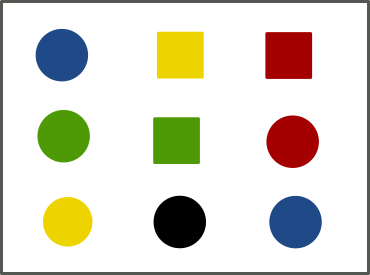
Practice reading existentials against a single boxed universe of objects.
Quantifier prefix + zo'u
Here's the logic-flavored template for building these sentences:
[Quantifiers + Variables] zo'u [The Sentence using those variables]
- da, de, di
- The variables (the things we're talking about). If you don't give an explicit number, they default to "at least one."
- zo'u
- The marker that separates the "inventory list" (the prenex) from the actual sentence.
su'o pa da zo'u da cukla There is at least one thing such that it is round. (Something is round.)
re da zo'u da pelxu There are exactly two things such that they are yellow. (Two things are yellow.)
One very important rule: the order of variables in the list matters! Saying "there is some X and then some Y" isn't always the same as saying it the other way around.
In many simple cases, you can actually fold that list of variables directly into the sentence itself—though we'll stick to the explicit version for now.
Think of it like this: the variables you introduce at the start "bind" to the words in the sentence that follows. Reordering them can change their "scope," which changes the entire meaning. For example, "for every person, there's a favorite hat" is a very different claim than "there's a single favorite hat that belongs to everyone." Formal logic is a deep topic, but for now, just remember: order matters, and the domain of discourse determines what "exists."
Figures: exhausting a small domain
When only finitely many objects are in play, you can test existential claims by case analysis—plug each candidate in and count how many satisfy the inner property. The original lesson walked through grids like these (including a toy “who likes whom” relation) to show why the order of quantifiers in the prenex matters.
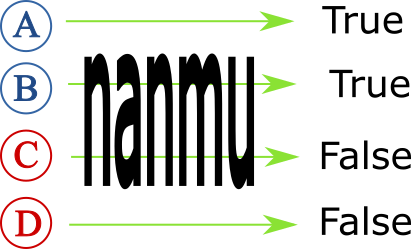
Grid-style check: how many referents satisfy “is a man” inside the domain.
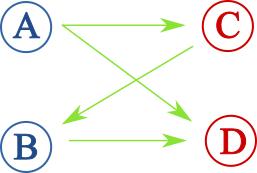
Four people with arrows for likes—used to evaluate nested quantifiers.
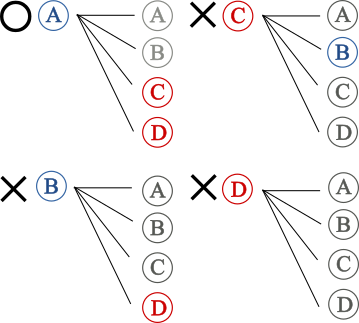
Nested search: for each outer assignment, test the inner existential.

Since we're just scratching the surface here, I highly recommend checking out the quantifier chapters in the CLL for full tables and more formal exercises. This little "Back Alley" is only here to point you toward the machinery!
True or false
Pick whether each statement is true or false according to the lesson.
The boundary between prenex and sentence is marked with zo'e.
Whether an existential sentence is true can depend on the domain of discourse.
When you quantify a free variable, it becomes a bound variable.
The prenex may be omitted.
pa da re de zo'u da prami de and re de pa da zo'u da prami de differ in meaning.
pa de re da zo'u da prami de can be shortened by dropping the prenex to re da prami pa de.