First Steps in Lojban
Lesson 5. Getting comfortable with predicates
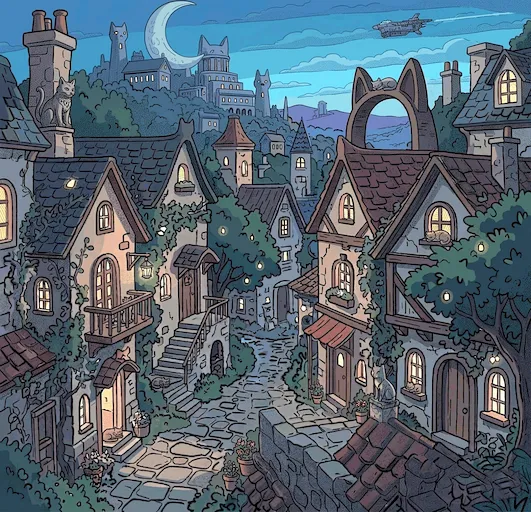
la .lacmatcad.

Welcome to Latcmatcad—the "Cat Town"! In Lojban, we write it as la .latcmatcad. (where la marks it's a name, and the dots are there to separate it from surrounding words).

Ooh! Cats! ...Wait, I don't see any...

That's strange. Maybe they're in a meeting? While we wait for them to show up, let's talk about .i and zo'e.
- .i
- Sentence boundary / start marker
- zo'e
- Unspecified sumti — “something,” “someone,” “who cares for now”

When you're connecting multiple sentences, you use .i to mark the start of each new sentence. It's kind of like a reversed period (Lojban punctuation often feels a bit "backwards" to English speakers!).
.i ti blabi .i tu xekri This is white. That is black.
- blabi
- x1 is white
- xekri
- x1 is black
We didn't use .i much in the previous lessons, did we?
If you're only saying one sentence, you don't strictly need it. But when you're speaking in a flow, it's the standard way to separate your thoughts.

Got it: use .i between sentences. ...And we've seen zo'e before too, right?
Exactly. Here's a very handy rule for keeping things concise:
You can almost always drop zo'e if it's at the very end of a sentence, or if it's in the x1 slot (right before the selbri).
In other words: if a slot for "someone/something" is empty, Lojbanists assume you mean zo'e.
Oh — cats! Look!

Illustration for mlatu in context.

Whoa, you’re right — cats!
Say it in Lojban:
- mlatu
- x1 is a cat of species/breed x2
mlatu zo'e mlatu zo'e “It’s a cat.” / “There’s a cat.”
Basically, leading zo'e and any zo'e hanging off the end of a sentence are optional. So zo'e mlatu zo'e can be shortened to just mlatu.
Here's the pattern:
- zo'e [selbri] [sumti] … zo'e zo'e … = [selbri] [sumti] …
But be careful! Internal zo'e slots that aren't at the end cannot be dropped, or the other sumti will shift into the wrong places:
- [selbri] [sumti] zo'e [sumti] ≠ [selbri] [sumti] [sumti]

Illustration for so'i mlatu.
mlatu .i mlatu .i mlatu .i mlatu...
Quite the crowd! Let’s take a walk and practice putting sentences together. I’ll give you the words you need, and you just arrange them. Grab a pen and paper—if you're not sure which sumti to use for a given terbricmi, just use zo'e (and feel free to drop it if it's at the end!).
Composition practice
- I am in Latcmatcad.
- zvati
- x1 is at location x2
- mi = I
- la .latcmatcad. = Latcmatcad (the so-called place).
- Sora goes to Latcmatcad by this car.
- klama
- x1 goes to x2 from x3 via route x4 by means x5
- la .soran. = Sora
- lo vi karce ku = this car
- Koshon knows that Sora is in Latcmatcad.
- djuno
- x1 knows that proposition x2 is true, about topic x3, in epistemology x4
- la .kocon. = Koshon
- lo du'u la .soran. zvati la .latcmatcad. kei ku = the proposition that Sora is in Latcmatcad
- I like walking.
- nelci
- x1 likes x2
- cadzu
- x1 walks on surface x2 with limbs x3
- lo nu cadzu kei ku = the event of walking
- Many cats are sleeping.
- sipna
- x1 sleeps
- lo so'i mlatu ku = many cats
- I’m happy I met you in Latcmatcad.
- penmi
- x1 meets x2 at x3
- gleki
- x1 is happy about x2
- do = you
- lo nu [bridi] kei ku = the event that [bridi]
- We’re tired, so we drink coffee or tea.
- tatpi
- x1 is tired from x2
- pinxe
- x1 drinks x2 from vessel/source x3
- mi'o = we (you and I)
- .i se ki'u bo = therefore (replaces the .i boundary)
- lo ckafi ku .a lo tcati ku = coffee or tea

Phew, I'm beat... a hot Earl Grey is exactly what I need right now.
Nice work! You're really getting the hang of this. Check your answers below (remember, the bracketed parts are optional):
I am in Latcmatcad. [.i] mi zvati la .latcmatcad.
Sora goes to Latcmatcad by this car. [.i] la .soran. klama la .latcmatcad. zo'e zo'e lo vi karce ku
Koshon knows Sora is there. [.i] la .kocon. djuno lo du'u la .soran. zvati la .latcmatcad. kei ku [zo'e] [zo'e]
I like walking. [.i] mi nelci lo nu cadzu kei ku
Many cats are sleeping. [.i] lo so'i mlatu ku sipna
I'm happy to meet you in Latcmatcad. [.i] mi gleki lo nu mi (or [zo'e]) penmi do la .latcmatcad. kei ku
We’re tired, so we drink coffee or tea. [.i] mi'o tatpi .i se ki'u bo (mi'o) pinxe lo ckafi ku .a lo tcati ku
So: pick the selbri, look up its terbri, and put a sumti in each terbricmi. That "fill-in-the-blanks" template is what you called the Place Structure, right?
Exactly! Place Structure (PS) is the usual English name for a selbri's terbri—the ordered terbricmi that define the relationship.

PS—got it. ...All this talk about tea and coffee is making me crave a crêpe!

Mmm, PS and crêpes... a perfect combination!
Wait, how are those related...?
True or false
Pick whether each statement is true or false according to the lesson.
Every zo'e may always be omitted.
The word .i marks the end of a sentence.
This diagram is correct: zo'e [selbri] [sumti] [sumti] zo'e zo'e = [selbri] [sumti] [sumti].
This diagram is correct: [selbri] [sumti] zo'e [sumti] = [selbri] [sumti] [sumti].
You can fill low‑priority sumti slots you do not care about with zo'e.
Even when context makes “I” obvious, you must still say mi and may not use zo'e there.